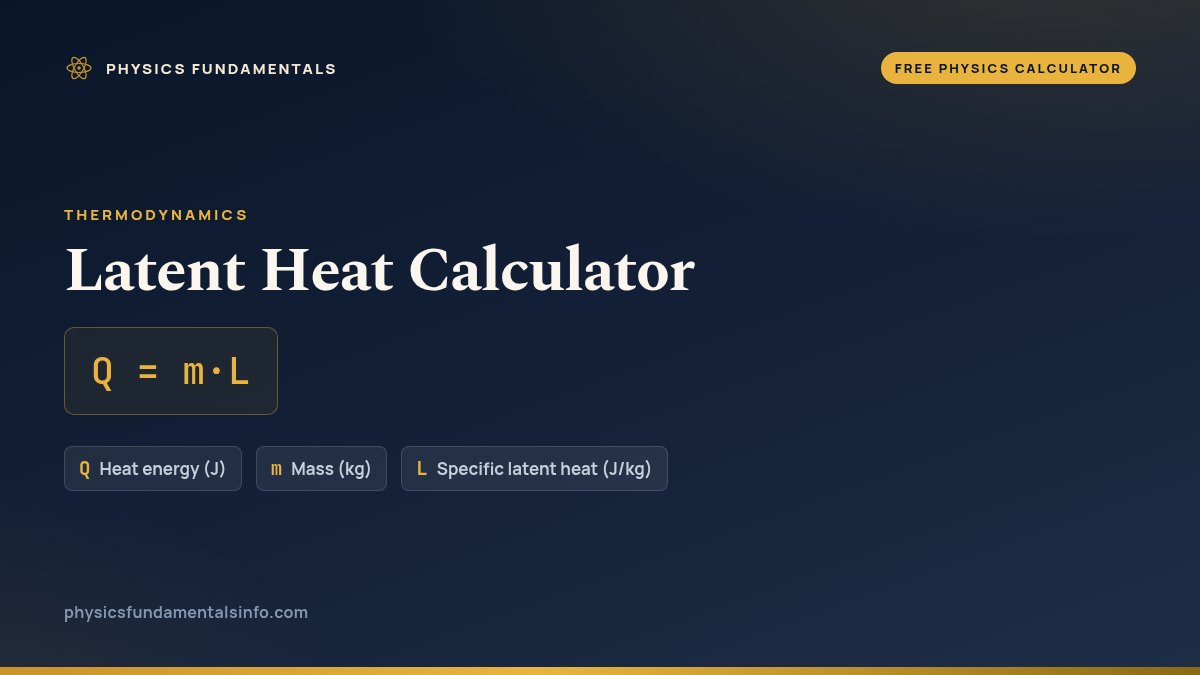
Latent heat: the heat energy (Q) absorbed or released when a mass changes phase — melting, freezing, boiling or condensing — is Q = m·L, where L is the substance’s specific latent heat and the temperature stays constant. This free calorimetry calculator solves for heat energy, mass or specific latent heat — in any unit — and shows every step of the working.
Reference values (water): latent heat of fusion Lf = 334,000 J/kg (melting) · latent heat of vaporisation Lv = 2,260,000 J/kg (boiling). Type the value for any other substance.
What Is the Latent Heat Calculator?
The latent heat calculator is a free online tool built on the formula Q = m·L. Enter the values you already know, in whichever units suit you, and it solves for heat, mass or specific latent heat and shows every step of the substitution. Latent Heat Calculator is energy for a phase change, Q = mL.
| Symbol | Quantity | Default unit | Also accepts | Example value |
|---|---|---|---|---|
| Q | Heat energy | J | kJ, MJ | 668000 |
| m | Mass | kg | g | 2 |
| L | Specific latent heat | J/kg | kJ/kg | 334000 |
How to calculate latent heat
The heat energy absorbed or released during a phase change is found with Q = m·L. Here Q is the heat energy in joules, m is the mass in kilograms, and L is the specific latent heat in joules per kilogram. The defining feature of latent heat is that the temperature does not change while the phase change happens — all the energy goes into breaking (or forming) the bonds between particles rather than speeding them up.
There are three steps. First, choose which quantity you want — heat energy, mass or specific latent heat — in the Solve for menu; the other two become your inputs. Second, enter the values you know and pick their units. For specific latent heat, use water’s reference values (334,000 J/kg to melt, 2,260,000 J/kg to boil) or type the value for any other substance — the calculator stays general. It converts joules, kilojoules and megajoules, and grams and kilograms, into SI base units automatically. Third, read the answer with the worked steps, which show the formula, your numbers substituted in, and the final value in joules and kilojoules.
The equation rearranges two ways. To find the mass that a known amount of heat will melt or boil, use m = Q / L. To find the specific latent heat of an unknown substance from a measured energy and mass, use L = Q / m. Latent heat applies only while the substance is changing phase; if the temperature is also rising or falling you need the specific heat calculator (Q = m·c·ΔT) for those parts, and for a definition of the underlying terms see the physics glossary.
Worked example
How much energy does it take to melt 2 kg of ice at 0 °C? Ice’s specific latent heat of fusion is L = 334,000 J/kg, so Q = m·L = 2 × 334,000 = 668,000 J, which is 668 kJ. Reading it the other way, 668,000 J of heat will melt m = Q / L = 668,000 / 334,000 = 2 kg of ice. Note that none of this energy raises the temperature — the ice and meltwater both sit at 0 °C until the last of the ice has melted.
Why latent heat matters
Latent heat explains why steam burns are so severe, why sweating cools you down, why a frozen pond melts slowly in spring, and how refrigerators, heat pumps and steam turbines move large amounts of energy by cycling a working fluid through phase changes. Storing energy in a phase change — as in latent-heat thermal stores — packs far more energy per kilogram than a simple temperature rise.
Frequently asked questions
What unit is latent heat measured in?
Specific latent heat (L) is measured in joules per kilogram, J/kg. It is the energy needed to change the phase of one kilogram of a substance — for example melting or boiling it — without any change in temperature. The total heat is then Q = m·L, measured in joules.
How do I solve for the mass that a given amount of energy will melt or boil?
Rearrange Q = m·L to m = Q ÷ L. Divide the available heat energy (in joules) by the substance’s specific latent heat (in J/kg). For example, 668,000 J applied to ice (L = 334,000 J/kg) will melt m = 668,000 ÷ 334,000 = 2 kg. Choose “mass” in the Solve for menu and the calculator does the rearrangement for you.
What is the difference between latent heat of fusion and vaporisation?
The latent heat of fusion (L_f) is the energy per kilogram to change between solid and liquid — for water, 334,000 J/kg to melt ice at 0 °C. The latent heat of vaporisation (L_v) is the energy per kilogram to change between liquid and gas — for water, 2,260,000 J/kg to boil it at 100 °C. Vaporisation takes far more energy because every intermolecular bond must be broken to free the molecules into a gas.
What is the most common mistake?
Using Q = m·L when the temperature is actually changing. Latent heat applies only during a phase change, while the temperature stays constant. If the temperature is rising or falling, you need the specific heat equation Q = m·c·ΔT instead. A full melt-then-boil problem uses both: m·c·ΔT for each sloped part of the heating curve and m·L for each flat plateau.
Why does my answer for boiling come out so much larger than melting?
Because water’s latent heat of vaporisation (2,260,000 J/kg) is about 6.8 times its latent heat of fusion (334,000 J/kg). Boiling has to completely separate the molecules into a gas, which costs much more energy than just loosening them from a solid into a liquid — so boiling the same mass needs roughly seven times the energy of melting it.
References & formula source
- Young & Freedman — University Physics, chapter on Temperature and Heat (phase changes and latent heat).
- Halliday, Resnick & Walker — Fundamentals of Physics, Temperature, Heat, and the First Law of Thermodynamics.
- Tipler & Mosca — Physics for Scientists and Engineers, Heat and the First Law of Thermodynamics.
- Further reading: Latent heat — Wikipedia