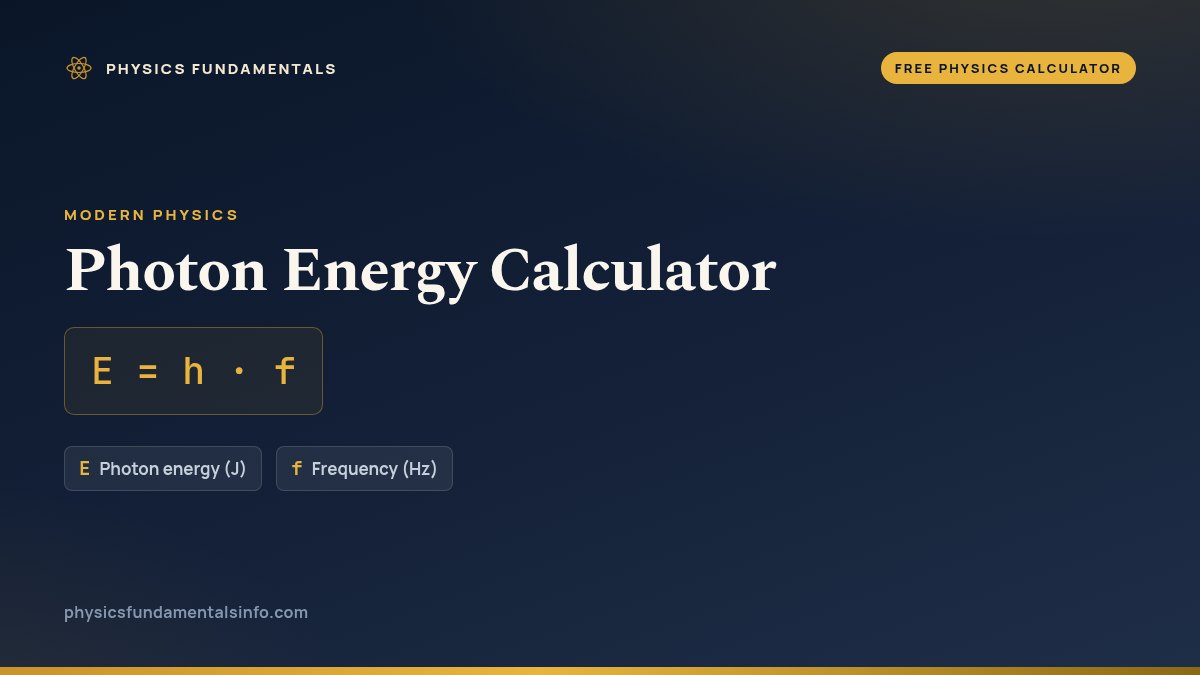
Photon energy: a photon is one quantum of light, and the energy it carries is set entirely by its frequency through E = h·f. This free calculator solves for photon energy or frequency — in J, eV, keV or MeV — shows the matching wavelength, and gives every step of the working.
What Is the Photon Energy Calculator?
The photon energy calculator is a free online tool built on the formula E = h · f. Enter the values you already know, in whichever units suit you, and it solves for photon energy or frequency and shows every step of the substitution. Photon Energy is energy of one quantum of light from its frequency.
| Symbol | Quantity | Default unit | Also accepts | Example value |
|---|---|---|---|---|
| E | Photon energy | J | eV, keV, MeV | — |
| f | Frequency | Hz | THz, PHz | 500000000000000 |
How to calculate photon energy
Light is not perfectly continuous: it arrives in tiny packets called photons, and each photon carries a fixed amount of energy that depends only on its frequency. To calculate it, multiply the frequency by the Planck constant: E = h · f, where h = 6.62607015 × 10-³4 J·s. A higher frequency means a more energetic photon, which is why ultraviolet light damages skin while radio waves of the same intensity do not.
There are three steps. First, decide which quantity you want — energy or frequency — and select it in the calculator’s Solve for menu. Second, enter the value you already know and choose its unit; the calculator converts frequency (Hz, THz, PHz) and energy (J, eV, keV, MeV) to SI base units for you, so you never juggle powers of ten by hand. Third, read the answer with the worked steps, which show the formula, your numbers substituted in, and the final value — plus the matching wavelength in nanometres.
The equation rearranges in one move. If you know the energy and want the frequency, divide by the Planck constant: f = E ÷ h. Frequency and wavelength are themselves linked by the wave-speed relation c = f·λ, so the photon energy can equally be written E = h·c / λ. That form makes the inverse relationship clear — halving the wavelength doubles the photon energy. For an everyday refresher on how frequency and wavelength connect, see our guide to the frequency formula.
Because photon energies are minute in joules, physicists usually quote them in electronvolts (1 eV = 1.602176634 × 10-¹9 J). Visible light sits at a few eV per photon, X-rays at thousands (keV), and gamma rays at millions (MeV). This calculator lets you switch units instantly so the number is always in a convenient range.
Worked example
Yellow-green light has a frequency of about f = 5 × 10¹4 Hz. Its photon energy is E = h·f = 6.62607015 × 10-³4 × 5 × 10¹4 ≈ 3.31 × 10-¹9 J. Converting to electronvolts gives 3.31 × 10-¹9 ÷ 1.602 × 10-¹9 ≈ 2.07 eV, and the matching wavelength is λ = c / f = 2.998 × 10⁸ ÷ 5 × 10¹4 ≈ 600 nm — squarely in the visible band. A blue photon (≈ 7 × 10¹4 Hz) carries about 2.9 eV, noticeably more for the shorter wavelength.
Why photon energy matters
Photon energy underpins solar cells, LEDs and lasers, medical and astronomical imaging, the photoelectric effect, and the whole idea that energy at the atomic scale comes in discrete quanta — the foundation of quantum physics.
Frequently asked questions
What is the formula for photon energy?
The energy of a single photon is E = h·f, where h is the Planck constant (6.62607015 × 10^-34 J·s) and f is the frequency. Because frequency and wavelength are linked by f = c/λ, the energy can also be written as E = hc/λ. The equation rearranges to f = E/h, so you can find frequency from a known energy.
How do I convert photon energy to electronvolts?
Divide the energy in joules by the elementary charge, 1.602176634 × 10^-19 C, since 1 eV = 1.602176634 × 10^-19 J. For example, a 3.31 × 10^-19 J photon equals about 2.07 eV. This calculator lets you read the answer directly in J, eV, keV or MeV.
What is the energy of a visible-light photon?
Visible light spans roughly 400–700 nm, which corresponds to photon energies of about 1.8 eV (red) to 3.1 eV (violet), or around 3 × 10^-19 to 5 × 10^-19 J. Higher-frequency light — ultraviolet, X-rays and gamma rays — carries proportionally more energy per photon.
How is photon energy related to wavelength?
Energy is inversely proportional to wavelength: E = hc/λ. Shorter wavelengths mean higher frequency and higher energy, while longer wavelengths carry less energy. This calculator reports the wavelength in nanometres alongside the energy so you can see the relationship at a glance.
Why is light treated as photons rather than a continuous wave?
Experiments such as the photoelectric effect show that light delivers energy in discrete packets, or quanta, each carrying E = h·f. This quantisation, introduced by Planck and explained by Einstein, is a cornerstone of quantum physics and explains why only light above a threshold frequency can eject electrons from a metal.
References & formula source
- Halliday, Resnick & Walker — Fundamentals of Physics, Chapter 38 (Photons and Matter Waves).
- Young & Freedman — University Physics with Modern Physics, §38.1–38.2 (Light as Photons).
- NIST — CODATA recommended value of the Planck constant, h = 6.62607015 × 10^-34 J·s.
- BIPM — The International System of Units (SI): the 2019 definition of the kilogram via h.
- Further reading: Photon energy — Wikipedia