Collision: a collision is an interaction in which two objects exert forces on each other for a short time. Total momentum is always conserved, so m1u1 + m2u2 = m1v1 + m2v2. This free calculator finds the final velocities for both the perfectly inelastic case (the objects stick together) and the perfectly elastic case, and shows every step of the working.
What Is the Collision Calculator?
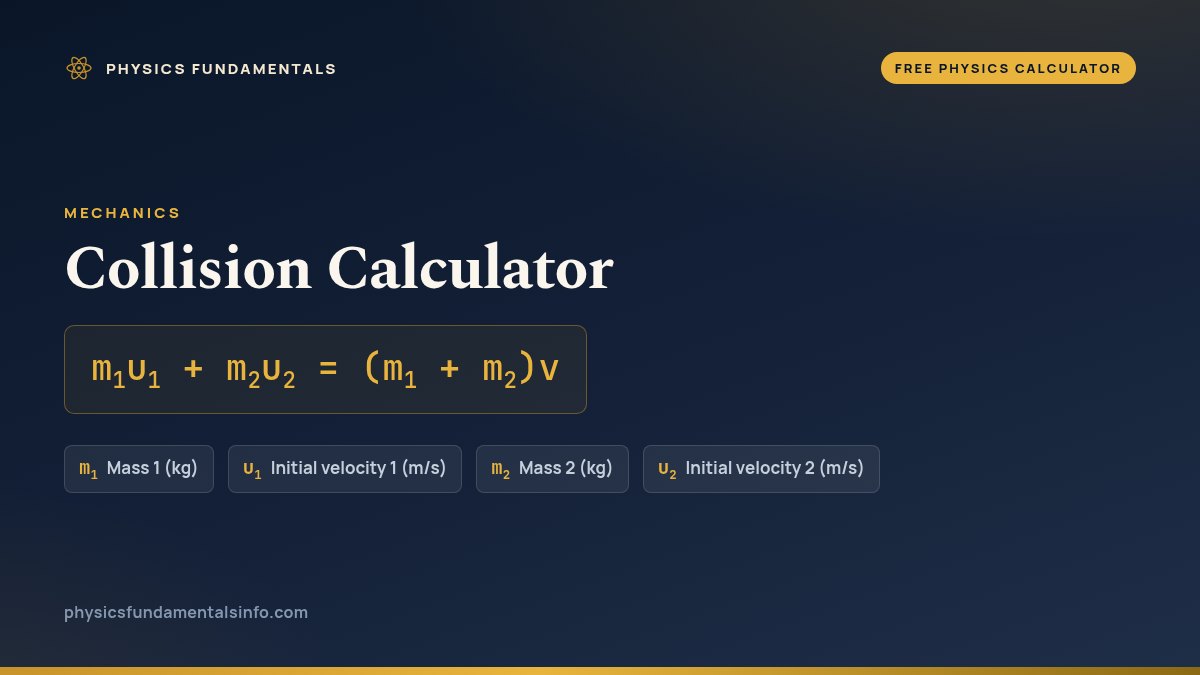
The collision calculator is a free online tool built on the formula m1u1 + m2u2 = (m1 + m2)v. Enter the values you already know, in whichever units suit you, and it solves for final velocities (elastic & inelastic) and shows every step of the substitution. Collision is final velocities in elastic and inelastic collisions.
| Symbol | Quantity | Default unit | Also accepts | Example value |
|---|---|---|---|---|
| m1 | Mass 1 | kg | g | 2 |
| u1 | Initial velocity 1 | m/s | km/h | 5 |
| m2 | Mass 2 | kg | g | 3 |
| u2 | Initial velocity 2 | m/s | km/h | -2 |
How to calculate a collision
Every collision obeys the conservation of momentum: the total momentum of the two objects just before they hit equals the total momentum just after. Writing momentum as mass times velocity, that is m1u1 + m2u2 = m1v1 + m2v2. Because momentum is a vector, you first choose a positive direction and enter any velocity in the opposite direction as a negative number.
What happens next depends on the type of collision. In a perfectly inelastic collision the two objects stick together and move off as one, so they share a single final velocity v = (m1u1 + m2u2) / (m1 + m2). This is the headline result of the calculator. In a perfectly elastic collision the objects bounce apart and kinetic energy is also conserved; solving the momentum and energy equations together gives v1’ = ((m1 − m2)u1 + 2m2u2) / (m1 + m2) and v2’ = ((m2 − m1)u2 + 2m1u1) / (m1 + m2). Real collisions usually fall between these two extremes.
To use the tool, enter both masses (m1 and m2) and both initial velocities (u1 and u2), each in your preferred units. The calculator converts everything to SI base units — kilograms and metres per second — works out the total momentum, then returns the inelastic final velocity, both elastic final velocities, and the conserved momentum, with the substituted numbers shown step by step. A useful sanity check: the total momentum after the collision must equal the value before it, whichever type of collision you assume. For the underlying idea, see our guide on conservation of momentum.
Worked example
A 2 kg cart moving right at 5 m/s strikes a 3 kg cart moving left at 2 m/s (so u2 = −2 m/s). The total momentum is p = 2·5 + 3·(−2) = 10 − 6 = 4 kg·m/s. If the carts couple together, the shared velocity is v = 4 / (2 + 3) = 0.8 m/s to the right. If instead they collide elastically, v1’ = ((2 − 3)·5 + 2·3·(−2)) / 5 = (−5 − 12)/5 = −3.4 m/s and v2’ = ((3 − 2)·(−2) + 2·2·5) / 5 = (−2 + 20)/5 = 3.6 m/s — cart 1 rebounds left and cart 2 is driven right, and the momentum still totals 4 kg·m/s.
Why it matters
Collision analysis underpins vehicle-safety and crumple-zone design, accident reconstruction, sports physics, particle-physics experiments, and the recoil of guns and rockets — anywhere two bodies interact briefly and you need to predict how they move afterwards.
Frequently asked questions
What is the difference between an elastic and an inelastic collision?
Both kinds conserve total momentum. In a perfectly elastic collision, kinetic energy is also conserved and the objects bounce apart. In a perfectly inelastic collision the objects stick together and move with one shared velocity, and the maximum possible amount of kinetic energy is lost (converted to heat, sound and deformation).
What is the formula for a perfectly inelastic collision?
When the two objects stick together, momentum conservation gives one combined velocity: v = (m1u1 + m2u2) / (m1 + m2). The numerator is the total momentum before the collision and the denominator is the total mass after they join.
What are the formulas for a one-dimensional elastic collision?
For a head-on elastic collision the final velocities are v1’ = ((m1 − m2)u1 + 2m2u2) / (m1 + m2) and v2’ = ((m2 − m1)u2 + 2m1u1) / (m1 + m2). These come from solving conservation of momentum and conservation of kinetic energy together.
Why do I use a negative velocity for an object moving the other way?
Momentum is a vector, so direction matters. Pick one direction as positive (for example, to the right) and enter velocities in the opposite direction as negative. A 2 m/s object heading left is entered as −2 m/s. The signs of the answers then tell you which way each object ends up moving.
Is momentum always conserved in a collision?
Total momentum is conserved whenever no net external force acts on the system during the collision. Because collisions happen over a very short time, the internal collision forces dominate over outside forces like friction, so momentum is conserved to a very good approximation. Kinetic energy, however, is only conserved in a perfectly elastic collision.
References & formula source
- Halliday, Resnick & Walker — Fundamentals of Physics, Chapter 9 (Center of Mass and Linear Momentum).
- Young & Freedman — University Physics with Modern Physics, Chapter 8 (Momentum, Impulse, and Collisions).
- NASA Glenn Research Center — Conservation of Momentum.
- Further reading: Collision — Wikipedia