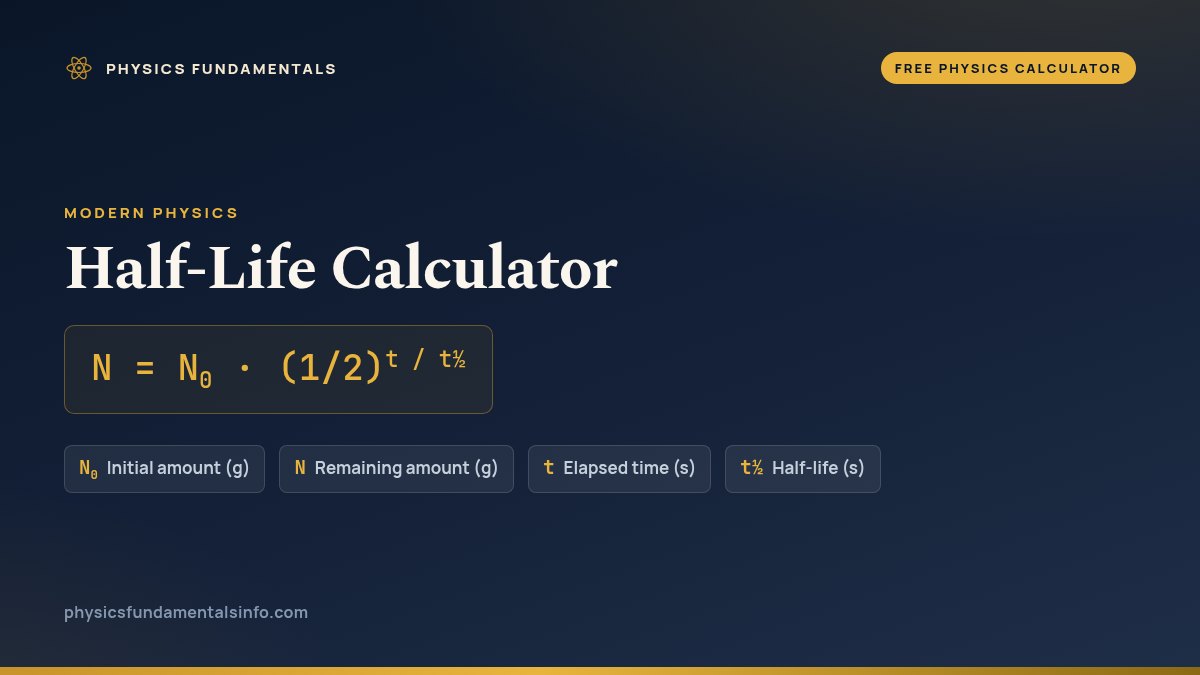
Half-life: the half-life (t½) is the time it takes for a radioactive quantity to fall to half its starting value, following N = N0·(1/2)^(t/t½). This free calculator solves for the remaining amount, initial amount, elapsed time or half-life — in any unit — and shows every step of the working.
What Is the Half-Life Calculator?
The Half-Life calculator is a free online tool built on the formula N = N0 · (1/2)t / t½. Enter the values you already know, in whichever units suit you, and it solves for remaining amount, time or half-life and shows every step of the substitution. Half-Life is time for a radioactive quantity to fall to half its value.
| Symbol | Quantity | Default unit | Also accepts | Example value |
|---|---|---|---|---|
| N0 | Initial amount | g | kg, mg | 100 |
| N | Remaining amount | g | kg, mg | 25 |
| t | Elapsed time | s | min, h, days, years | 11460 |
| t½ | Half-life | s | min, h, days, years | 5730 |
How to calculate half-life
Radioactive decay is exponential: in every fixed interval called the half-life, half of the remaining unstable atoms decay. If you start with an amount N0, the amount still present after a time t is N = N0 · (1/2)^(t / t½), where t½ is the half-life. After one half-life half remains, after two a quarter, after three an eighth, and so on.
There are four quantities in that equation, and knowing any three lets you find the fourth. First, choose the quantity you want — remaining amount, initial amount, elapsed time or half-life — in the calculator’s Solve for menu. Second, enter the three values you already know and pick their units; amounts can be grams, kilograms or milligrams, and times can be seconds, minutes, hours, days or years. The calculator converts everything to SI base units (seconds and grams) before solving, so you never mix units by hand. Third, read the answer with its worked steps, which show the formula, your numbers substituted in, and the result with units.
To rearrange for time, take logarithms of both sides: t = t½ · ln(N / N0) / ln(½). To find the half-life itself from a measured decay, use t½ = t · ln(½) / ln(N / N0). The calculator also reports the number of half-lives elapsed (n = t / t½), the percent remaining, and the decay constant λ = ln(2) / t½, which links the half-life to the rate of decay. Because decay is first-order, the half-life is a fixed property of each isotope and does not change with the quantity, temperature or chemical state.
The same exponential maths underpins related ideas in modern physics — the energy released when mass is converted in a decay is found with the E = mc² calculator, while the speeds of emitted particles connect to their kinetic energy. For a plain-language definition of the term, see the physics glossary.
Worked example
A sample of carbon-14 has an initial mass of 100 g. Carbon-14 has a half-life of 5,730 years, so after 11,460 years exactly two half-lives have passed. The amount remaining is N = N0 · (1/2)^(t / t½) = 100 · (1/2)^(11460 / 5730) = 100 · (1/2)² = 25 g. The calculator confirms 25 g, with the extras showing 2 half-lives, 25% remaining and a decay constant of about 3.84 × 10-¹² /s.
Why half-life matters
Half-life turns radioactive decay into a precise clock and a practical design parameter. It underpins radiocarbon and radiometric dating of fossils and rocks, the dosing and shelf-life of medical radioisotopes, the safe storage time of nuclear waste, and the calibration of radiation sources used in industry and research.
Frequently asked questions
What is the half-life formula?
The amount remaining after a time t is N = N0 · (1/2)^(t / T), where N0 is the initial amount and T is the half-life. Rearranged, the elapsed time is t = T · ln(N/N0) / ln(1/2), and the half-life is T = t · ln(1/2) / ln(N/N0). This calculator solves for whichever quantity you choose.
How do you calculate the half-life of a substance?
Measure how much is left (N) after a known time (t) starting from an initial amount (N0), then use T = t · ln(1/2) / ln(N/N0). For example, if a sample falls to one quarter of its starting mass in 11,460 years, two half-lives have passed, so the half-life is 5,730 years — the value for carbon-14.
What is the difference between half-life and decay constant?
The half-life T is the time for half the atoms to decay; the decay constant λ is the probability per unit time that any one atom decays. They are linked by λ = ln(2) / T, so a longer half-life means a smaller decay constant. The calculator reports λ alongside each answer.
How many half-lives until a sample is effectively gone?
After n half-lives the fraction remaining is (1/2)^n. After 7 half-lives less than 1% remains, and after 10 about 0.1% is left. A radioactive source is often treated as practically depleted after roughly 10 half-lives, though in principle some always remains.
Does half-life depend on the amount of material?
No. Radioactive decay is a first-order process, so the half-life is a fixed property of the isotope and does not depend on how much you start with, the temperature or the chemical form. Whether you have a gram or a tonne, half of it decays in exactly one half-life.
References & formula source
- Halliday, Resnick & Walker — Fundamentals of Physics, Chapter 42 (Nuclear Physics).
- Young & Freedman — University Physics with Modern Physics, §43.4 (Radioactivity and half-life).
- Krane — Introductory Nuclear Physics, Chapter 6 (Radioactive Decay).
- NIST — Atomic Weights and Isotopic Compositions; reference isotope half-lives.
- Further reading: Half-life — Wikipedia