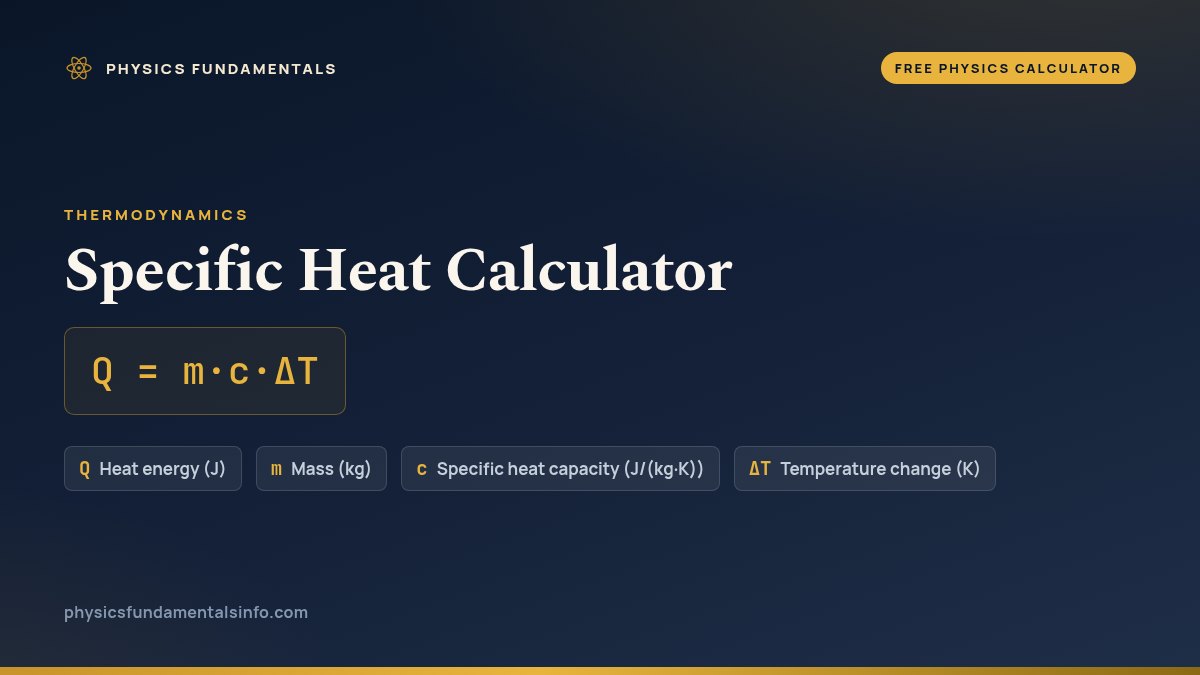
Specific heat: the heat energy (Q) needed to change the temperature of a mass is Q = m·c·ΔT, where c is the material’s specific heat capacity. This free calorimetry calculator solves for heat energy, specific heat capacity, mass or temperature change — in any unit — and shows every step of the working.
What Is the Specific Heat Calculator?
The specific heat calculator is a free online tool built on the formula Q = m·c·ΔT. Enter the values you already know, in whichever units suit you, and it solves for heat, mass, specific heat or ΔT and shows every step of the substitution. Specific Heat is heat energy to change a material temperature, Q = mcΔT.
| Symbol | Quantity | Default unit | Also accepts | Example value |
|---|---|---|---|---|
| Q | Heat energy | J | kJ, cal, kcal | 4186 |
| m | Mass | kg | g | 1 |
| c | Specific heat capacity | J/(kg·K) | — | 4186 |
| ΔT | Temperature change | K | °C | 1 |
How to calculate specific heat
The heat energy needed to warm or cool a substance is found with the calorimetry equation Q = m·c·ΔT. Here Q is the heat energy in joules, m is the mass in kilograms, c is the specific heat capacity in joules per kilogram per kelvin, and ΔT is the temperature change. Multiply the three together and you have the energy that flows in (positive ΔT, heating) or out (negative ΔT, cooling).
There are three steps. First, choose which quantity you want — heat energy, specific heat capacity, mass or temperature change — in the Solve for menu; the other three become your inputs. Second, enter the values you know and pick their units. For specific heat capacity you can choose a built-in material preset such as water, aluminium, iron or copper, or type your own value. The calculator converts joules, kilojoules and calories, and grams and kilograms, into SI base units automatically. Third, read the answer with the worked steps, which show the formula, your numbers substituted in, and the final value with units.
The equation rearranges three ways. To find the specific heat capacity of an unknown material, use c = Q / (m·ΔT). To find the mass that a known amount of heat will warm, use m = Q / (c·ΔT). To find how far the temperature rises, use ΔT = Q / (m·c). A key point: because a change of one kelvin is exactly the same size as a change of one degree Celsius, you can enter ΔT in K or °C and get the same result. For the energy released or absorbed when a material melts or boils — where the temperature does not change — you need latent heat instead, and for a definition of the underlying terms see the physics glossary. Once you have a value for Q, the first law of thermodynamics decides how much of it raises the temperature and how much leaves again as work — the first law calculator does that step.
Worked example
How much energy does it take to heat 0.5 kg of water from 20 °C to 80 °C? The temperature change is ΔT = 60 °C and water’s specific heat capacity is c = 4186 J/(kg·K). So Q = m·c·ΔT = 0.5 × 4186 × 60 = 125,580 J, about 126 kJ. Reading it the other way, if you put 125,580 J into 0.5 kg of water its temperature rises by ΔT = Q / (m·c) = 125580 / (0.5 × 4186) = 60 °C.
Why specific heat matters
Specific heat capacity explains why coastal climates are mild, why water is used as an engine and reactor coolant, why cooking times depend on the food, and how engineers size heaters, radiators and heat sinks. Materials with a high specific heat store more energy for the same temperature rise.
Frequently asked questions
What is the formula for specific heat?
The heat needed to change a substance’s temperature is Q = m·c·ΔT, where Q is heat energy in joules, m is mass in kilograms, c is the specific heat capacity in J/(kg·K), and ΔT is the temperature change. Rearranged, c = Q/(m·ΔT), m = Q/(c·ΔT) and ΔT = Q/(m·c).
What is specific heat capacity?
Specific heat capacity (c) is the amount of energy needed to raise the temperature of one kilogram of a substance by one kelvin (or one degree Celsius). Water has a high value of about 4186 J/(kg·K), which is why it heats up and cools down slowly compared with metals such as iron or copper.
What are the units of specific heat?
The SI unit of specific heat capacity is joules per kilogram per kelvin, J/(kg·K), which equals J/(kg·°C) because a change of one kelvin is the same size as a change of one degree Celsius. Heat energy Q is measured in joules, with calories and kilocalories as common alternatives (1 cal = 4.184 J).
Why does the temperature change use ΔT and not the absolute temperature?
Q = m·c·ΔT depends only on the change in temperature, not on where you start. Because a one-degree change is the same size in kelvin and in degrees Celsius, you get the same ΔT either way — so you can enter the temperature change in K or °C interchangeably in this calculator.
How much energy does it take to heat water?
Heating 1 kg of water by 1 °C takes about 4186 J, roughly one kilocalorie. To raise the same 1 kg from 20 °C to 100 °C (ΔT = 80 °C) needs Q = 1 × 4186 × 80 ≈ 334,880 J, or about 335 kJ — far more than the same mass of most metals would require.
Read more: What is specific heat capacity?
References & formula source
- Halliday, Resnick & Walker — Fundamentals of Physics, Chapter 18 (Temperature, Heat, and the First Law of Thermodynamics).
- Young & Freedman — University Physics with Modern Physics, §17.5 (Calorimetry and Phase Changes).
- NIST — Standard reference data for specific heat capacities of common substances.
- Further reading: Specific heat capacity — Wikipedia