SUVAT: five equations that connect displacement, initial and final velocity, acceleration and time for any motion at constant acceleration. Enter any three of s, u, v, a and t and this free calculator works out the remaining two, choosing the right equations for you and showing the complete motion.
What Is the SUVAT Calculator?
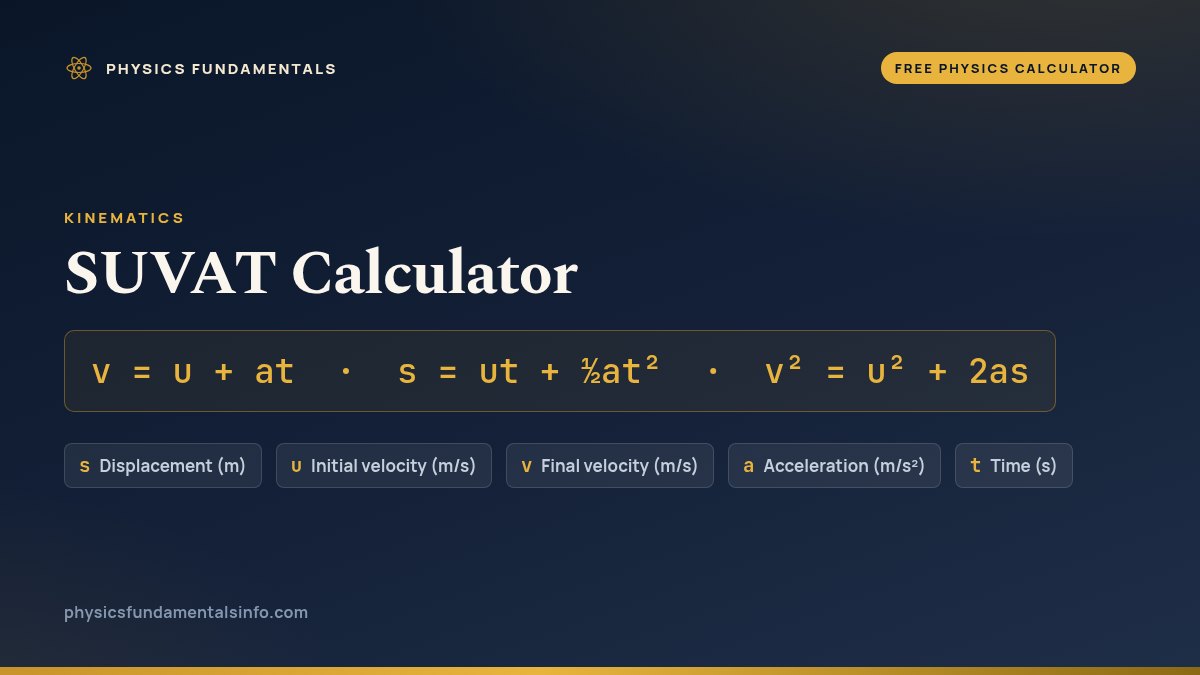
The SUVAT calculator is a free online tool built on the formula v = u + at · s = ut + ½at² · v² = u² + 2as. Enter the values you already know, in whichever units suit you, and it solves for any 2 of s, u, v, a, t and shows every step of the substitution. SUVAT is the five constant-acceleration equations — give any three, get the rest.
| Symbol | Quantity | Default unit | Also accepts | Example value |
|---|---|---|---|---|
| s | Displacement | m | km, cm | — |
| u | Initial velocity | m/s | km/h | — |
| v | Final velocity | m/s | km/h | — |
| a | Acceleration | m/s² | — | — |
| t | Time | s | — | — |
How to use the SUVAT equations of motion
The five SUVAT equations connect the five kinematic variables for any motion at constant acceleration — the name is just the initials of the variables they link: s (displacement), u (initial velocity), v (final velocity), a (acceleration) and t (time). The equations are v = u + at, s = ut + ½at², v² = u² + 2as, s = ½(u + v)t and s = vt − ½at². Each one deliberately leaves out a single variable, so once you know any three of the five you can always find the remaining two. For a full derivation and worked walkthrough, see our guide to the SUVAT equations.
This calculator has no “solve for” dropdown, because you do not choose one unknown — you supply any three knowns and get both missing values back. There are three steps. First, type in any three of s, u, v, a and t, leaving the other two boxes empty. Second, pick your units: displacement in metres, kilometres or centimetres, the velocities in m/s or km/h, acceleration in m/s² and time in seconds — everything is converted to SI before solving. Third, read the two values the calculator fills in, together with the complete list of s, u, v, a and t so you can see the whole motion at a glance.
It helps to know which equation does what. If you have u, a and t and want the final velocity, use v = u + at; for the displacement from u, a and t use s = ut + ½at²; when time is missing, v² = u² + 2as links the two velocities, the acceleration and the distance directly. The symmetric forms s = ½(u + v)t and s = vt − ½at² cover the cases where you know the average of the velocities, or the final velocity rather than the initial one. The calculator simply applies whichever of these fit your three inputs.
SUVAT only applies while the acceleration stays constant and the motion is in a straight line. For constant-speed motion with no acceleration the simpler average velocity relation v = d/t applies, and to find the acceleration on its own from a change in velocity see the acceleration calculator. For motion under gravity specifically — a special case with a ≈ 9.81 m/s² — the free fall calculator and the projectile motion calculator apply SUVAT to vertical and two-dimensional motion. You can also look up any term in the physics glossary.
Worked example
A car starts from rest (u = 0 m/s) and accelerates at a = 2 m/s² for t = 5 s. That is three known quantities — u, a and t — so the other two follow. The final velocity comes from v = u + at = 0 + 2 × 5 = 10 m/s, and the distance covered from s = ut + ½at² = 0 + ½ × 2 × 5² = 25 m. Enter u = 0, a = 2 and t = 5 in the calculator and it returns exactly these: v = 10 m/s and s = 25 m. As a check, the time-free equation agrees: v² = u² + 2as = 0 + 2 × 2 × 25 = 100, so v = 10 m/s.
Why it matters
SUVAT is the workhorse of introductory mechanics. It sets vehicle braking and acceleration distances, train and runway calculations, the rise and fall of a thrown ball, and the bulk of exam kinematics problems — any straight-line motion with steady acceleration. Mastering which three knowns map to which equation is one of the most reusable skills in physics, because the same five relations reappear, axis by axis, throughout projectile motion, free fall and dynamics.
Frequently asked questions
What are the five SUVAT equations?
The five constant-acceleration equations are v = u + at, s = ut + ½at², v² = u² + 2as, s = ½(u + v)t and s = vt − ½at². Here s is displacement, u initial velocity, v final velocity, a acceleration and t time. Each equation leaves out exactly one of the five variables, which is why knowing any three lets you find the other two.
How many values do I need to use a SUVAT calculator?
You need any three of the five variables s, u, v, a and t. With three independent values the motion is fully determined, so the calculator can work out the remaining two. Fewer than three leaves the problem underspecified; this tool asks for a minimum of three inputs before it solves.
When can I use the SUVAT equations?
Only when the acceleration is constant (uniform) and the motion is in a straight line. They work perfectly for free fall near Earth’s surface, vehicle braking and acceleration, and projectiles treated one axis at a time. If the acceleration changes with time, you need calculus-based kinematics instead.
Which SUVAT equation should I pick?
Choose the equation that contains your three known quantities and the unknown you want, while leaving out the variable you do not have. For example, if you know u, a and t but not v, use v = u + at; if you know u, v and a but not t, use v² = u² + 2as. This calculator selects the right equations for you automatically.
Does SUVAT handle deceleration and negative values?
Yes. Deceleration is simply a negative acceleration: enter a as a negative number when the object is slowing down, or a negative displacement or velocity when motion is in the opposite direction to your chosen positive axis. Keep your sign convention consistent across all five variables and the results stay correct.
References & formula source
- Young & Freedman — University Physics with Modern Physics, Chapter 2 (Motion Along a Straight Line: Motion with Constant Acceleration).
- Halliday, Resnick & Walker — Fundamentals of Physics, Chapter 2 (Motion Along a Straight Line: Constant Acceleration).
- Serway & Jewett — Physics for Scientists and Engineers, §2.6 (Analysis Model: Particle Under Constant Acceleration).
- Further reading: Equations of motion — Wikipedia