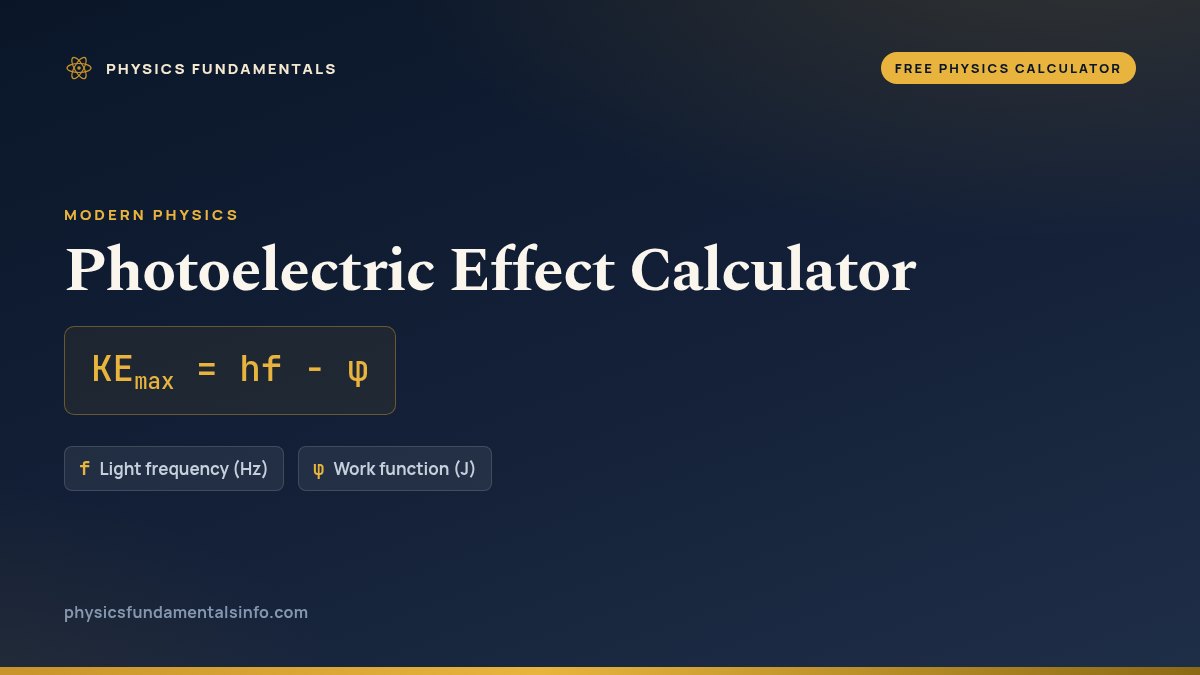
Photoelectric effect: when light of high enough frequency strikes a metal, it ejects electrons. The maximum kinetic energy of those electrons is KEmax = hf − φ. This free calculator finds that kinetic energy, the photon energy E = hf, and the threshold frequency f0 — with every step shown.
What Is the Photoelectric Effect Calculator?
The photoelectric effect calculator is a free online tool built on the formula KEmax = hf − φ. Enter the values you already know, in whichever units suit you, and it solves for max electron KE and threshold and shows every step of the substitution. Photoelectric Effect is maximum kinetic energy of photoelectrons, KE = hf − φ.
| Symbol | Quantity | Default unit | Also accepts | Example value |
|---|---|---|---|---|
| f | Light frequency | Hz | THz, PHz | 1000000000000000 |
| φ | Work function | J | eV | 2 |
How to calculate the photoelectric effect
The photoelectric effect is the emission of electrons from a metal when light shines on it. Albert Einstein explained it in 1905 by treating light as a stream of energy packets called photons, each carrying energy E = hf, where h is Planck’s constant (6.62607015 × 10-³4 J·s) and f is the light’s frequency. That insight won him the 1921 Nobel Prize and helped launch quantum physics.
To eject an electron, a single photon must supply at least the metal’s work function φ — the minimum energy binding an electron to the surface. Whatever energy is left over becomes the electron’s kinetic energy, so the most energetic electrons leave with KE_max = hf − φ. Enter the frequency and the work function above and the calculator converts everything to SI units, applies the equation, and reports the maximum kinetic energy in joules (and electronvolts).
Two related quantities fall straight out of the same physics. The photon energy E = hf tells you how much each photon delivers, and the threshold frequency f0 = φ / h is the lowest frequency that can free any electron at all. If the incident frequency is below f0, the photon energy is smaller than the work function, the kinetic energy would be negative, and no electrons are emitted — the calculator reports zero and flags that the threshold was not met. Crucially, increasing the light’s intensity adds more photons but does not raise f, so below threshold even a very bright beam ejects nothing.
For the photon side of the calculation on its own, see the photon energy calculator; to explore the wave nature of the ejected electrons, try the de Broglie wavelength calculator.
Worked example
Ultraviolet light of frequency f = 1.0 × 10¹5 Hz (1 PHz) falls on a metal with work function φ = 2.0 eV. First convert the work function: 2.0 eV = 2.0 × 1.602 × 10-¹9 = 3.20 × 10-¹9 J. The photon energy is E = hf = 6.626 × 10-³4 × 1.0 × 10¹5 = 6.63 × 10-¹9 J ≈ 4.14 eV. The maximum kinetic energy is therefore KE_max = 6.63 × 10-¹9 − 3.20 × 10-¹9 = 3.42 × 10-¹9 J ≈ 2.14 eV, and the threshold frequency is f0 = φ / h = 3.20 × 10-¹9 / 6.626 × 10-³4 ≈ 4.84 × 10¹4 Hz. Because f > f0, electrons are indeed emitted.
Why the photoelectric effect matters
It is the experiment that forced physics to accept light as quantised, underpinning modern quantum theory. Practically, it drives photomultiplier tubes, night-vision and image sensors, solar photovoltaic cells, and the photoelectron spectroscopy used to probe the electronic structure of materials.
Frequently asked questions
What is the photoelectric effect equation?
Einstein’s photoelectric equation is KE_max = hf − φ. The maximum kinetic energy of an ejected electron equals the photon energy (hf, where h is Planck’s constant) minus the work function φ, the minimum energy needed to free an electron from the metal’s surface.
What is the threshold frequency?
The threshold (or cutoff) frequency f0 is the lowest frequency of light that can eject electrons from a given metal. It is found from f0 = φ / h. Light below f0 produces no photoelectrons no matter how intense it is, because each photon simply carries too little energy.
Why does brighter light not always eject electrons?
Brightness raises the number of photons, not the energy each one carries. Emission depends on the frequency of the light, not its intensity. If the frequency is below the threshold, every photon is below the work function, so no electrons escape however bright the beam is — a key piece of evidence that light is quantised.
What is a work function?
The work function φ is the minimum energy needed to remove an electron from the surface of a particular metal. It is a property of the material, usually quoted in electronvolts: roughly 2.1 eV for caesium, 2.3 eV for sodium, 4.3 eV for aluminium and about 5.1 eV for platinum.
What units does this calculator use?
Enter frequency in Hz, THz (10^12 Hz) or PHz (10^15 Hz), and the work function in eV or J. The headline kinetic energy is reported in joules, with the electronvolt value shown alongside. All internal arithmetic uses SI units, so 1 eV = 1.602176634 × 10^-19 J.
References & formula source
- Halliday, Resnick & Walker — Fundamentals of Physics, Chapter 38 (Photons and Matter Waves).
- Young & Freedman — University Physics with Modern Physics, §38.1 (The Photoelectric Effect).
- NIST — CODATA recommended value of the Planck constant h = 6.62607015 × 10^-34 J·s.
- BIPM — The International System of Units (SI): the joule and the electronvolt.
- Further reading: Photoelectric effect — Wikipedia