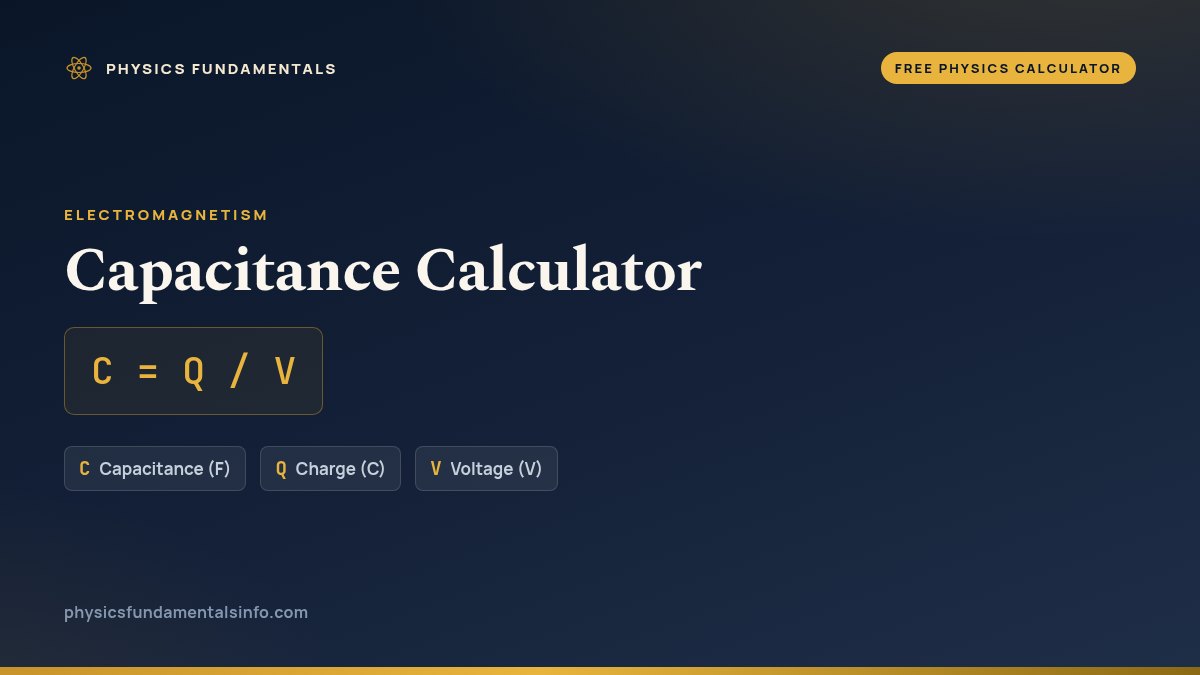
Capacitance: capacitance (C) is the amount of charge a capacitor stores for each volt across it, defined by C = Q/V. This free calculator solves for capacitance, charge or voltage — in any unit — and reports the stored energy, with every step of the working shown.
What Is the Capacitance Calculator?
The capacitance calculator is a free online tool built on the formula C = Q / V. Enter the values you already know, in whichever units suit you, and it solves for capacitance, charge or voltage and shows every step of the substitution. Capacitance from charge and voltage, plus stored energy.
| Symbol | Quantity | Default unit | Also accepts | Example value |
|---|---|---|---|---|
| C | Capacitance | F | mF, µF, nF, pF | — |
| Q | Charge | C | mC, µC, nC | 1 |
| V | Voltage | V | kV, mV | 10 |
How to calculate capacitance
Capacitance measures how much electric charge a component can hold for a given voltage. To calculate it, divide the charge stored on the capacitor by the voltage across its terminals: C = Q / V. The result is measured in farads (F), where one farad equals one coulomb per volt. Because a farad is enormous, practical capacitors are rated in microfarads (µF), nanofarads (nF) or picofarads (pF).
There are three steps. First, decide which quantity you want — capacitance, charge or voltage — and select it in the calculator’s Solve for menu. Second, enter the two values you already know and pick their units; the calculator converts everything to SI base units (coulombs and volts) behind the scenes, so you never have to convert by hand. Third, read the answer alongside the worked steps, which show the formula, your numbers substituted in, and the final value with its units. When you solve for capacitance, the calculator also reports the energy stored, E = ½CV², in joules.
The equation rearranges easily. If you know capacitance and voltage, the stored charge is Q = C × V. If you know charge and capacitance, the voltage is V = Q ÷ C. The key rule is to keep units consistent — mixing microcoulombs with volts without converting, for example, throws the answer off by a factor of a million. Letting the calculator handle the unit conversion removes that risk entirely.
Capacitance is a property of the capacitor itself: it is fixed by the plate area, the gap between the plates and the dielectric material, and does not change when you alter the charge or voltage. That is why C appears as a constant linking Q and V. To explore the force between the charges that capacitors separate, see the Coulomb’s law calculator; for how capacitors behave alongside resistors, the Ohm’s law calculator is a useful companion.
Worked example
A capacitor stores a charge of 60 µC when connected across a 12 V battery. Its capacitance is C = Q / V = 60×10-6 / 12 = 5×10⁻⁶ F = 5 µF. The energy held in the capacitor is E = ½CV² = ½ × 5×10-6 × 12² = 3.6×10⁻⁴ J = 0.36 mJ. Reading the relation the other way, that same 5 µF capacitor charged to 24 V would hold Q = C × V = 5×10-6 × 24 = 120 µC — twice the charge for twice the voltage.
Why capacitance matters
Capacitance underpins almost all electronics: capacitors smooth power supplies, set the timing of oscillators and filters, store energy in camera flashes and defibrillators, tune radios, and couple or block signals between stages of a circuit. Knowing how charge, voltage and stored energy relate to a capacitor’s value is the starting point for designing any of these.
Frequently asked questions
What is the formula for capacitance?
Capacitance (C) is the charge stored per unit voltage: C = Q/V. Divide the charge Q on the capacitor by the voltage V across it. The same relation rearranges to Q = C × V and V = Q ÷ C, so you can solve for any one of the three quantities.
What is the unit of capacitance?
The SI unit is the farad (F), defined as one coulomb per volt (1 F = 1 C/V). One farad is very large, so real capacitors are usually rated in microfarads (µF = 10^-6 F), nanofarads (nF = 10^-9 F) or picofarads (pF = 10^-12 F). This calculator converts between all of them.
How do you find the charge or voltage from capacitance?
Rearrange C = Q/V. To get the charge, multiply capacitance by voltage: Q = C × V. To get the voltage, divide the charge by the capacitance: V = Q ÷ C. Pick the quantity you want in the “Solve for” menu and the calculator handles the rearrangement.
How much energy does a capacitor store?
A charged capacitor stores energy E = ½CV² (equivalently ½QV or Q²/2C), measured in joules. Because the energy depends on the square of the voltage, doubling the voltage stores four times the energy. When you solve for capacitance, this calculator reports the stored energy automatically.
Does this formula depend on the type of capacitor?
No. C = Q/V is the general definition of capacitance and applies to every capacitor — parallel-plate, cylindrical, electrolytic or otherwise. The geometry and dielectric only determine the value of C itself; once you know C, the charge, voltage and energy relations are always the same.
References & formula source
- Halliday, Resnick & Walker — Fundamentals of Physics, Chapter 25 (Capacitance).
- Young & Freedman — University Physics with Modern Physics, Chapter 24 (Capacitance and Dielectrics).
- BIPM — The International System of Units (SI): the farad, coulomb and volt.
- Further reading: Capacitance — Wikipedia