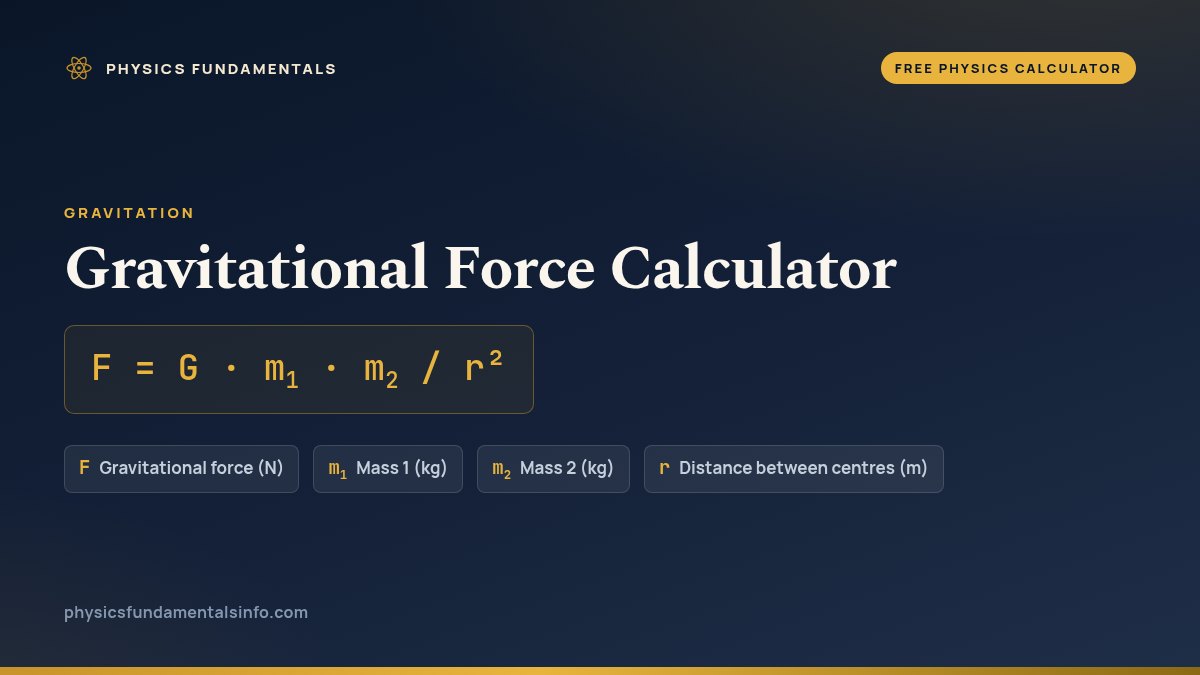
Gravitational force: the attractive force between any two masses, given by Newton’s law of universal gravitation F = G·m1·m2/r². This free calculator solves for the force, either mass, or the separation — in any unit — and shows every step of the working.
What Is the Gravitational Force Calculator?
The gravitational force calculator is a free online tool built on the formula F = G · m1 · m2 / r². Enter the values you already know, in whichever units suit you, and it solves for force, mass or distance and shows every step of the substitution. Gravitational attraction between two masses.
| Symbol | Quantity | Default unit | Also accepts | Example value |
|---|---|---|---|---|
| F | Gravitational force | N | kN | 686 |
| m1 | Mass 1 | kg | g, tonne | 5972000000000000327155712 |
| m2 | Mass 2 | kg | g, tonne | 70 |
| r | Distance between centres | m | km | 6371000 |
How to calculate gravitational force
Every pair of masses in the universe pulls on each other, and the strength of that pull is set by Newton’s law of universal gravitation: F = G·m1·m2 / r². Here m1 and m2 are the two masses in kilograms, r is the distance between their centres in metres, and G is the gravitational constant, 6.674 × 10-¹¹ N·m²/kg². The force comes out in newtons and always acts along the line joining the two centres.
There are three steps. First, decide what you want to find — the force, one of the masses, or the separation — and pick it in the calculator’s Solve for menu. Second, enter the three values you already know and choose their units (kilograms or tonnes for mass, metres or kilometres for distance); the calculator converts everything to SI base units behind the scenes, so you never have to convert by hand. Third, read the answer alongside the worked steps, which show the formula, your numbers substituted in, and the final value with units.
The equation rearranges cleanly. To find the separation that produces a given force, use r = sqrt(G·m1·m2 / F). To recover an unknown mass, use m1 = F·r² / (G·m2). The single rule that matters is the inverse-square law: because the r² sits in the denominator, doubling the distance cuts the force to a quarter, and halving it multiplies the force by four.
The same law explains everyday weight. Setting one mass to a planet’s and r to its radius gives the surface gravity g = G·M / r², which is why an object weighs W = m·g. To explore that, try the weight on other planets calculator, or the escape velocity calculator for the speed needed to break free.
Worked example
How hard does the Earth pull on a 70 kg person standing at its surface? Use the Earth’s mass m1 = 5.972 × 10²4 kg, the person’s mass m2 = 70 kg, and the Earth’s radius r = 6.371 × 10⁶ m. Then F = G·m1·m2 / r² = 6.674 × 10-¹¹ × 5.972 × 10²4 × 70 / (6.371 × 10⁶)² ≈ 686 N. Dividing by the mass gives 686 / 70 ≈ 9.8 m/s² — exactly the familiar value of g at the Earth’s surface, confirming the result.
Why gravitational force matters
Gravitation holds the cosmos together: it keeps planets in orbit, sets the tides, governs the paths of spacecraft, and shapes the formation of stars and galaxies. The same equation that predicts an apple’s fall also predicts the motion of the Moon — a unification that lies at the heart of classical physics.
Frequently asked questions
What is the formula for gravitational force?
Newton’s law of universal gravitation gives F = G·m1·m2 / r², where m1 and m2 are the two masses, r is the distance between their centres, and G is the gravitational constant, 6.674 × 10^-11 N·m²/kg². The force is attractive and acts along the line joining the two centres.
What is the value of the gravitational constant G?
The gravitational constant G is approximately 6.674 × 10^-11 N·m²/kg² (newton metres squared per kilogram squared). It is one of the smallest fundamental constants in physics, which is why gravity is by far the weakest of the four fundamental forces at everyday scales.
Why does gravitational force follow an inverse-square law?
Because the force spreads over the surface of an imaginary sphere centred on the mass, and a sphere’s area grows with r². Doubling the distance spreads the same influence over four times the area, so the force drops to a quarter. Triple the distance and the force falls to one ninth.
What is the difference between gravitational force and weight?
Weight is simply the gravitational force a planet exerts on an object at its surface, W = m·g. The gravitational-force law is the more general statement: it gives g = G·M / r² for the planet, and reduces to the familiar W = m·g near the surface. Use this calculator for any two masses at any separation.
How strong is the gravitational pull between two everyday objects?
Tiny. Two 1 kg masses 1 m apart attract with only about 6.674 × 10^-11 N — far too small to feel. Gravity becomes significant only when at least one body is astronomically massive, such as a planet or star, which is why we notice Earth’s pull but not the pull of a nearby person.
References & formula source
- Halliday, Resnick & Walker — Fundamentals of Physics, Chapter 13 (Gravitation).
- Young & Freedman — University Physics with Modern Physics, §13.1 (Newton’s Law of Gravitation).
- NIST — CODATA recommended value of the Newtonian constant of gravitation G = 6.674 × 10^-11 N·m²/kg².
- NASA — Planetary Fact Sheet: masses and radii of the Earth and other bodies.
- Further reading: Newton's law of universal gravitation — Wikipedia