Simple pendulum: the time for one full swing depends only on the pendulum's length and the local gravity — T = 2πsqrt(L/g). This free calculator solves for the period or the length, reads off the frequency, works on any planet preset, and shows every step of the working.
What Is the Pendulum Period Calculator?
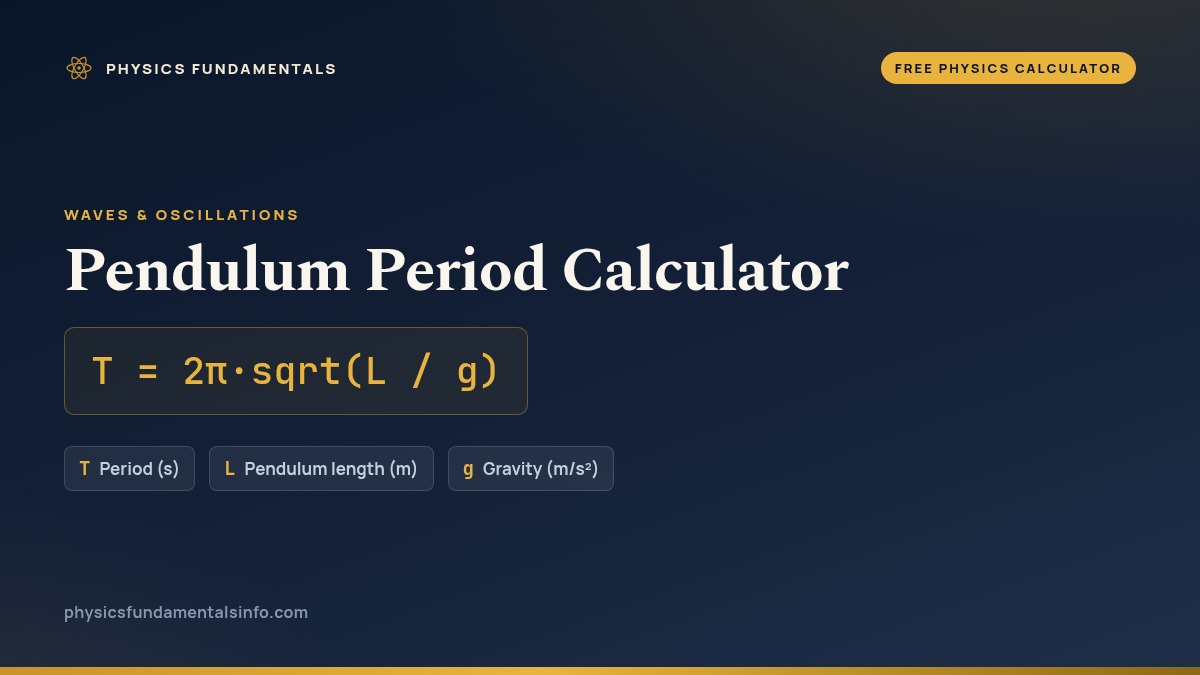
The pendulum period calculator is a free online tool built on the formula T = 2π·sqrt(L / g). Enter the values you already know, in whichever units suit you, and it solves for period, frequency, length, gravity and shows every step of the substitution. Swing time of a simple pendulum — independent of mass.
| Symbol | Quantity | Default unit | Also accepts | Example value |
|---|---|---|---|---|
| T | Period | s | — | 2.01 |
| L | Pendulum length | m | cm, mm | 1 |
| g | Gravity | m/s² | — | — |
How to calculate the period of a pendulum
A simple pendulum is a mass on a light string or rod, swinging under gravity. For small swings its period — the time for one complete back-and-forth — depends on just two things: the length L from the pivot to the centre of the bob, and the local acceleration due to gravity g. The relationship is T = 2π·sqrt(L / g), and the answer is a time in seconds.
There are three steps. First, decide what you want — the period T or the length L — and pick it in the calculator's Solve for menu. Second, enter the values you know: the length in metres, centimetres or millimetres, and gravity either as a number or via a planet preset (Moon, Mars, Earth or Jupiter). Third, read the answer with the worked steps, which show the formula, your numbers substituted in, the result in seconds, and the frequency f = 1/T in hertz alongside.
The most striking feature of this formula is what it leaves out. The period depends on neither the mass of the bob nor — for small angles — the amplitude of the swing. A heavy bob and a light one of the same length keep identical time, and a wide swing takes the same time as a narrow one. That reliability is precisely what made the pendulum the heart of accurate clocks for centuries, and it follows directly from the way a pendulum behaves as simple harmonic motion at small angles.
Two relationships are worth feeling directly. The period grows with the square root of length, so quadrupling the length only doubles the swing time — long clock pendulums swing slowly. And because g sits under the same root, weaker gravity means a slower swing: the same pendulum that ticks at 2 s on Earth would take about 5 s on the Moon. To explore the springs and oscillators behind this motion, see the Hooke's law calculator, or look up a term in the physics glossary.
Worked example
A pendulum of length L = 1.0 m swings on Earth, where g = 9.81 m/s². Its period is T = 2π·sqrt(L / g) = 2π·sqrt(1 / 9.81) = 2.01 s, and the frequency is f = 1/T = 1/2.01 = 0.50 Hz — about one swing every two seconds. Take the same pendulum to the Moon (g = 1.62 m/s²) and the period stretches to 2π·sqrt(1 / 1.62) = 4.94 s, more than twice as slow, while quadrupling the length to 4 m on Earth only doubles the period to about 4.0 s — a direct illustration of the square-root dependence on both length and gravity.
Why it matters
The simple pendulum underpins pendulum clocks, metronomes, the swinging mechanism of grandfather clocks, and seismometers. Because its period depends on g, a pendulum is also a classic way to measure the local strength of gravity, and it serves as the textbook gateway to simple harmonic motion and oscillations more broadly — anywhere a restoring force pulls a system back toward equilibrium.
Frequently asked questions
What is the formula for the period of a simple pendulum?
For small swings the period is T = 2πsqrt(L/g), where L is the length from the pivot to the centre of the bob and g is the acceleration due to gravity. The period is the time for one complete back-and-forth swing, returned here in seconds. The frequency is simply its reciprocal, f = 1/T.
Does the period of a pendulum depend on its mass or amplitude?
No. For small angles the period depends only on the length and on gravity — not on the mass of the bob, and not on the amplitude of the swing. This independence is exactly why a pendulum keeps such reliable time, and it is what made the pendulum the heart of accurate clocks for centuries.
Why is the small-angle approximation needed?
T = 2πsqrt(L/g) comes from approximating sin θ ≈ θ, which is accurate only for small swings. Below about 10–15° the error is well under 1%, so the formula is excellent for clocks and metronomes. For large amplitudes the true period grows slightly and the motion is no longer perfectly simple harmonic, so this calculator assumes the small-angle regime.
How does gravity change the period?
Gravity sits under the square root, so the period is inversely proportional to sqrtg. A pendulum swings slower where gravity is weaker: the same 1 m pendulum has a period of about 2.0 s on Earth but roughly 5.0 s on the Moon, where g is only 1.62 m/s². Use the planet presets to compare worlds instantly.
How long is a pendulum with a one-second swing?
A “seconds pendulum” that takes one second to swing from side to side has a full period of 2 s. Rearranging the formula, L = g·(T/2π)² = 9.81 × (2/2π)² ≈ 0.994 m on Earth — just under a metre. This calculator can solve for length directly: pick L in the “Solve for” menu and enter the period you want.
References & formula source
- Young & Freedman — University Physics with Modern Physics, §14.5 (The Simple Pendulum).
- Halliday, Resnick & Walker — Fundamentals of Physics, Chapter 15 (Oscillations).
- Serway & Jewett — Physics for Scientists and Engineers, Chapter 15 (Oscillatory Motion).
- Further reading: Pendulum — Wikipedia