Resistor combinations: wiring resistors in series adds their values (RT = R1 + R2 + …), while wiring them in parallel combines their reciprocals (1/RT = 1/R1 + 1/R2 + …). This free calculator works out both totals for up to four resistors and shows every step.
What Is the Resistor Calculator?
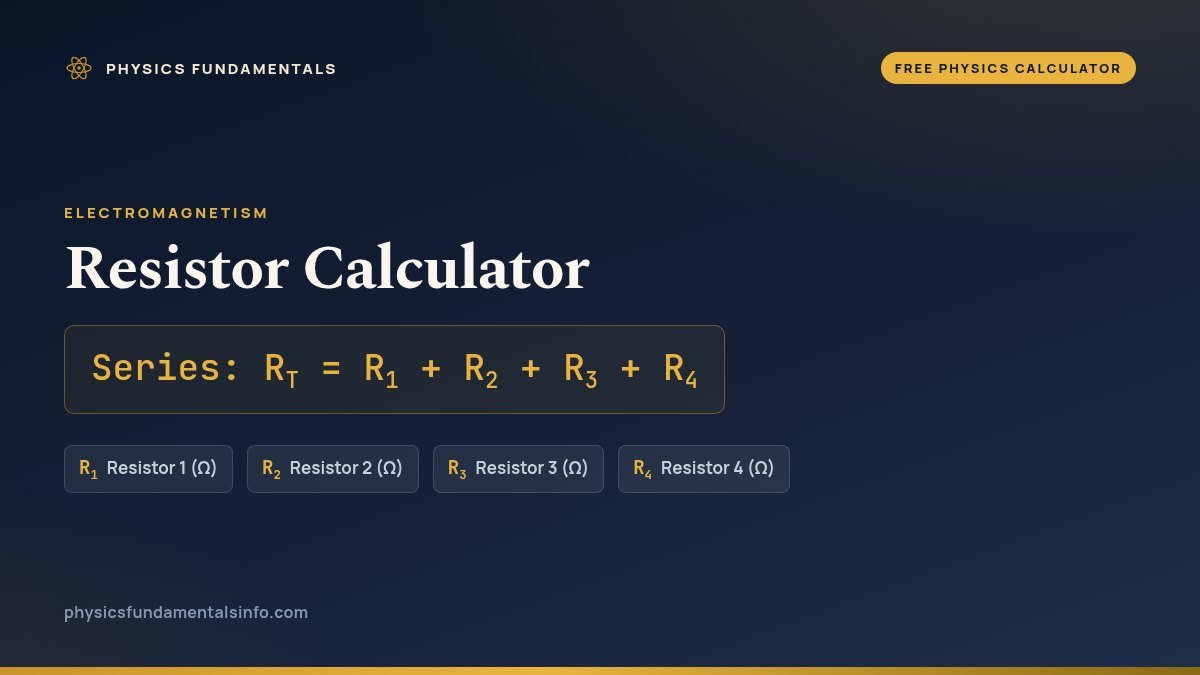
The resistor calculator is a free online tool built on the formula Series: RT = R1 + R2 + R3 + R4. Enter the values you already know, in whichever units suit you, and it solves for total series or parallel resistance and shows every step of the substitution. Resistor is total resistance of resistors wired in series or parallel.
| Symbol | Quantity | Default unit | Also accepts | Example value |
|---|---|---|---|---|
| R1 | Resistor 1 | Ω | mΩ, kΩ, MΩ | 100 |
| R2 | Resistor 2 | Ω | mΩ, kΩ, MΩ | 200 |
| R3 | Resistor 3 | Ω | mΩ, kΩ, MΩ | — |
| R4 | Resistor 4 | Ω | mΩ, kΩ, MΩ | — |
How to calculate total resistance
When resistors are connected together, their combined or total resistance depends on how they are wired. There are two basic arrangements, and most real circuits are built from combinations of the two.
In a series connection the resistors sit end to end, so the same current flows through each one in turn. The total resistance is simply the sum of the individual values: RT = R1 + R2 + R3 + … Because every resistor adds to the opposition, the series total is always greater than the largest single resistor.
In a parallel connection the resistors are wired side by side across the same two points, so the current splits between them. Here you add the reciprocals and invert the result: 1/RT = 1/R1 + 1/R2 + 1/R3 + … Giving the current extra paths makes it flow more easily, so the parallel total is always smaller than the smallest single resistor. For just two resistors there is a handy shortcut, RT = (R1 · R2) / (R1 + R2).
To use the calculator, enter each resistor value and pick its unit — ohms (Ω), milliohms (mΩ), kilohms (kΩ) or megohms (MΩ). Everything is converted to ohms automatically, so you can mix units freely. Two resistors are filled in to start; add a third and fourth if you need them, or leave them blank. Both totals appear at once. Once you have the total resistance, feed it into our Ohm’s law calculator to find the current and power; for the underlying relationship between voltage, current and resistance, see our guide on Ohm’s law.
Worked example
Suppose you have a 100 Ω and a 200 Ω resistor. In series the total is RT = 100 + 200 = 300 Ω. In parallel it is 1/RT = 1/100 + 1/200 = 0.015 Ω-¹, so RT = 1 / 0.015 ≈ 66.7 Ω — comfortably below the smaller 100 Ω resistor, exactly as expected for a parallel network.
Why it matters
Series and parallel resistance rules are the foundation of circuit design: they let engineers set currents with dropper resistors, build voltage dividers, share load between components and reach values that no single stock resistor provides. The same maths governs parallel wiring in buildings and the equivalent resistance of complex networks.
Frequently asked questions
How do you calculate resistors in series?
Resistors in series simply add up: R_total = R1 + R2 + R3 + … The total is always larger than the biggest single resistor, because the current must pass through every resistor in turn. For example, 100 Ω and 200 Ω in series give 300 Ω.
How do you calculate resistors in parallel?
For resistors in parallel, add the reciprocals and invert the result: 1/R_total = 1/R1 + 1/R2 + 1/R3 + … The total is always smaller than the smallest single resistor, because the current has more than one path. For two resistors there is a shortcut: R_total = (R1 × R2) / (R1 + R2).
Why is parallel resistance smaller than series resistance?
In series the current has a single route, so each resistor adds to the opposition and the total grows. In parallel the current splits between several routes, so it flows more easily overall and the combined resistance drops below that of any one resistor.
What happens if two equal resistors are in parallel?
Two equal resistors in parallel give exactly half the resistance of one. Two 100 Ω resistors in parallel make 50 Ω. More generally, n identical resistors of value R in parallel give R/n.
How does resistance relate to Ohm’s law?
Once you know the total resistance of a network, Ohm’s law (V = IR) tells you the current it draws from a given voltage, or the voltage needed for a target current. Combine this resistor calculator with our Ohm’s law calculator to size circuits and choose components.
References & formula source
- Halliday, Resnick & Walker — Fundamentals of Physics, Chapter 27 (Circuits: resistors in series and parallel).
- Young & Freedman — University Physics with Modern Physics, §26.1 (Resistors in Series and Parallel).
- NIST — Reference on Constants, Units, and Uncertainty: the ohm (Ω).
- Further reading: Series and parallel circuits — Wikipedia