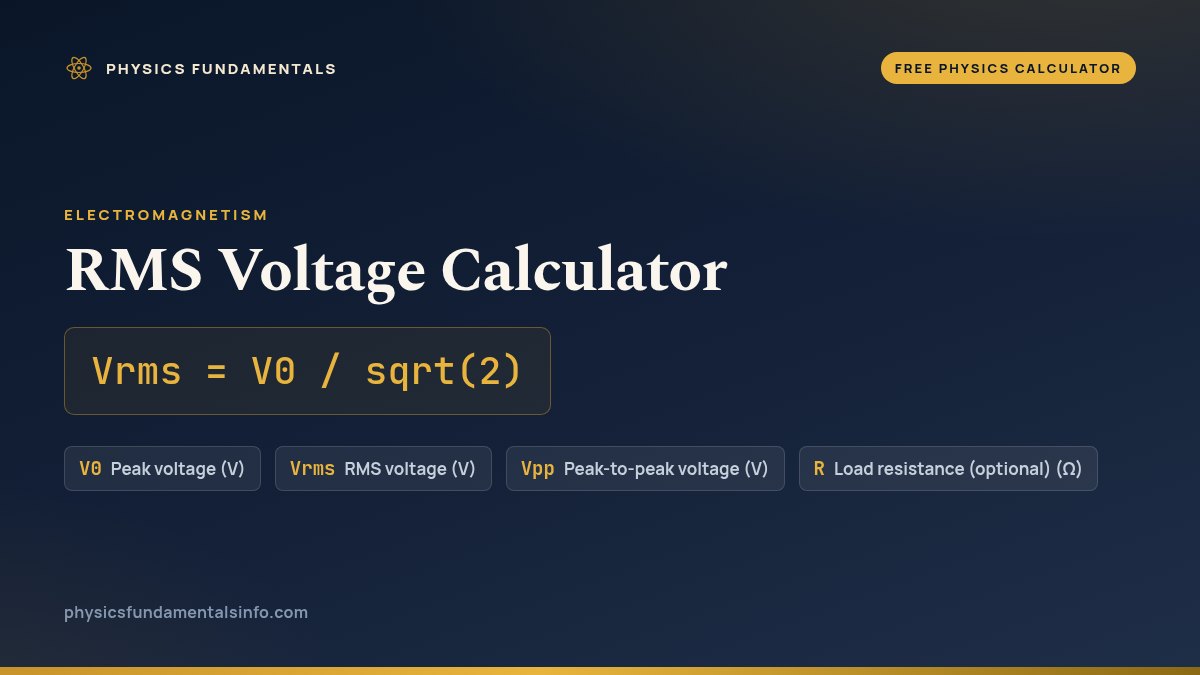
RMS voltage is the steady DC voltage that delivers the same average power as an alternating one. For a sine wave it is the peak divided by sqrt(2) — Vrms = V0/sqrt(2), about 0.707 of the peak. This free calculator converts between peak, RMS and peak-to-peak voltage, and gives the AC current and average power when you add a load resistance.
What Is the RMS Voltage Calculator?
The RMS voltage calculator is a free online tool built on the formula Vrms = V0 / sqrt(2). Enter the values you already know, in whichever units suit you, and it solves for RMS, peak, peak-to-peak voltage and shows every step of the substitution. Convert between peak, peak-to-peak and RMS voltage, plus AC power.
| Symbol | Quantity | Default unit | Also accepts | Example value |
|---|---|---|---|---|
| V0 | Peak voltage | V | — | 170 |
| Vrms | RMS voltage | V | — | — |
| Vpp | Peak-to-peak voltage | V | — | — |
| R | Load resistance (optional) | Ω | — | 100 |
How to calculate RMS voltage
An alternating voltage is always changing, so a single "voltage" for it has to be defined carefully. The most useful definition is the root-mean-square value: the equivalent steady DC voltage that would heat a resistor at the same average rate. For a sine wave the answer is beautifully simple — the RMS value is the peak amplitude divided by the square root of two, Vrms = V0/sqrt(2), roughly 0.707 times the peak. The other two forms follow at once: the peak is V0 = Vrms·sqrt(2) and the peak-to-peak swing is Vpp = 2·V0, the full distance from the bottom of the trough to the top of the crest.
To use the calculator, enter any one of the three voltage forms — peak, RMS or peak-to-peak — and clear the others; it fills in the rest. Add a load resistance R and it also returns the RMS current, I = Vrms/R from Ohm's law, and the average power, P = Vrms²/R. Average AC power must use the RMS voltage, never the peak: because power depends on voltage squared, using the peak would overstate it by exactly a factor of two. For the wider picture of how alternating and direct current differ, see the guide to AC vs DC current, or look up a term in the physics glossary.
One important caveat: the sqrt(2) factor is specific to a sine wave. It comes from the fact that the average of sine-squared over a cycle is exactly one half, so the root-mean-square is 1/sqrt(2). A square wave has an RMS value equal to its peak (factor 1), and a triangular wave uses 1/sqrt(3). Always confirm the waveform is sinusoidal before applying this calculator's result.
Worked example
European mains has a peak of about V0 = 325.27 V. Its RMS value is Vrms = 325.27 / sqrt(2) = 230.0 V — the familiar "230 volts" — and its peak-to-peak swing is Vpp = 2 × 325.27 = 650.54 V. Feed a 26.45 Ω heater from it and the RMS current is I = 230.0 / 26.45 = 8.696 A, delivering an average power of P = 230.0² / 26.45 = 2000 W — a two-kilowatt element. Note that computing the power from the 325 V peak instead would wrongly give 4 kW.
Why it matters
RMS voltage is the number stamped on mains outlets, transformers, batteries' AC equivalents, and virtually every AC specification, because it is the value that governs heating, power and safety. It underpins power-supply design, audio engineering, transmission-line ratings and the humble multimeter, which reports RMS by design. Understanding that mains "230 V" or "120 V" is an RMS figure — with a peak around 1.41 times higher — is essential for anyone sizing components or working safely with alternating current.
Frequently asked questions
What does RMS actually mean?
RMS stands for root-mean-square. For an alternating voltage it is the steady DC voltage that would deliver the same average power to a resistor. You square the waveform (so negative parts count as positive), take its average over a cycle, then take the square root — hence root-mean-square. For a sine wave that works out to the peak divided by sqrt(2), about 0.707 times the peak.
Why 0.707 and not 0.5?
Because power depends on voltage squared, not voltage, so the average is taken over the squared wave. The mean of sin squared over a full cycle is exactly one half, and the square root of one half is 1/sqrt(2) = 0.707. If you naively averaged the sine's magnitude instead you would get about 0.637, and if you halved the peak you would get 0.5 — both wrong for power. The 0.707 factor is what makes RMS the true DC-equivalent.
Is 230 V the peak or the RMS?
The 230 V (or 120 V in North America) quoted for mains electricity is the RMS value, not the peak. The peak is higher: 230 V RMS corresponds to a peak of about 325 V and a peak-to-peak swing of about 650 V. Meters and ratings almost always state RMS because that is the number that determines heating and power.
Does the sqrt(2) rule work for a square wave?
No — and this is the most common mistake. The Vrms = V0/sqrt(2) relationship is specific to a pure sine wave. A square wave has an RMS value equal to its peak (the factor is 1, not 0.707), and a triangular wave uses 1/sqrt(3). Always check the waveform before applying the sqrt(2) factor; this calculator assumes a sine.
How do I get power from RMS voltage?
Enter the load resistance R along with any voltage form, and the calculator computes the average power as P = Vrms squared divided by R, together with the RMS current I = Vrms/R. Average AC power always uses RMS values — using the peak voltage instead would overstate the power by a factor of two.
References & formula source
- Halliday, Resnick & Walker — Fundamentals of Physics, chapter on Alternating Current.
- Young & Freedman — University Physics with Modern Physics, chapter on Alternating Current.
- Irwin & Nelms — Basic Engineering Circuit Analysis, AC steady-state analysis chapter (RMS values and average power).
- Further reading: Root mean square — Wikipedia