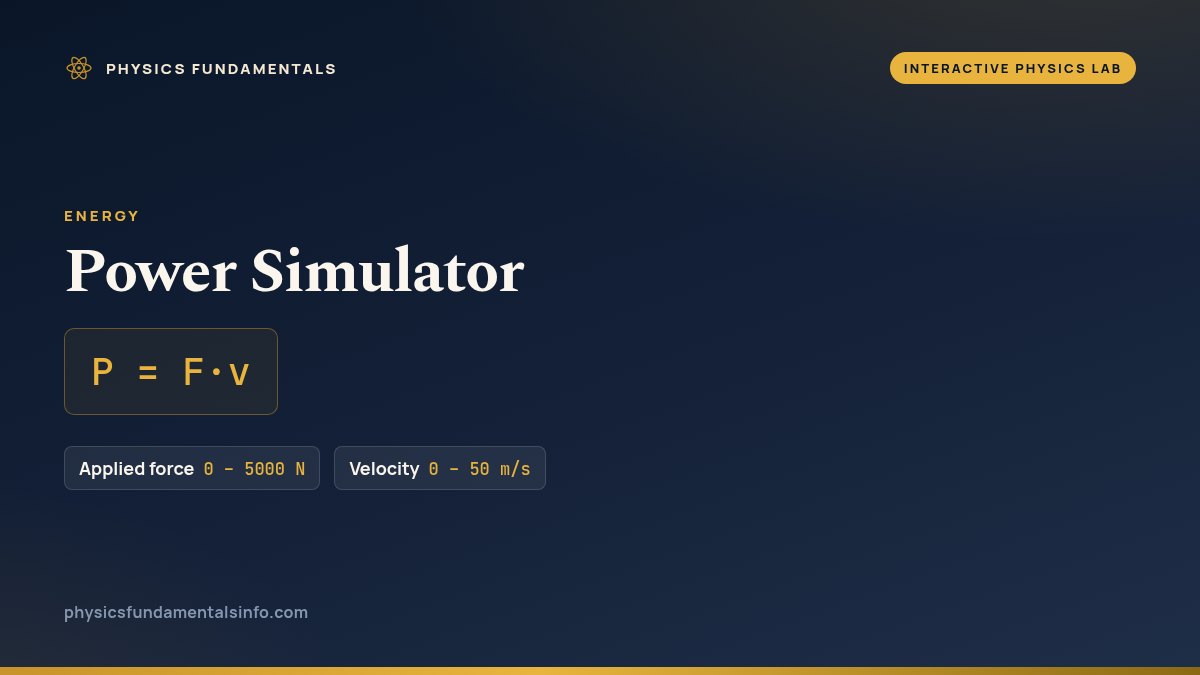
Power is the rate of doing work; for a force along the motion it is P = F·v. Drag the sliders below to change the applied force and the velocity, and watch the power respond in real time, shown in both watts and horsepower.
Power = Force × Velocity
Set the driving force and the speed it acts at. Power is how fast work is being done — watch the work meter climb.
P = F · v · 1 W = 1 J/s · 1 hp = 745.7 W
What Is the Power Simulator?
The power simulator is a free interactive physics lab that runs in your browser — nothing to install and no sign-up. Change the force and velocity and watch the power respond through P = F·v, in watts and horsepower.
| Control | Range | Step |
|---|---|---|
| Applied force | 0 – 5000 N | 50 |
| Velocity | 0 – 50 m/s | 0.5 |
Watching Power Climb as Force Meets Speed
Two machines can shift the same amount of work; the one that finishes sooner has more power. Power is the rate at which work is delivered, P = W/t in the average sense, and when a force pushes along the motion it becomes the instantaneous product P = F·v. This simulator makes that product visible: set the Applied force, F in newtons and the Velocity, v in metres per second, and the readout returns power in watts (one watt is one joule delivered each second), alongside the same figure in horsepower using the sim's conversion, 1 hp = 745.7 W.
Slide either control and watch the response. Because power depends on the two factors as a plain multiplication, doubling the force doubles the power, and doubling the velocity does the same. Slide the speed all the way down and the display reads “P = 0 W — no work is being done”: however hard the force pushes, nothing moves, so no energy transfers per second.
Keep the distinction sharp as you play: a large watt reading is a fast delivery, not a large total, and a modest source can still accumulate plenty of work given time. It mirrors a car holding speed against drag, where the engine must supply F·v. Put exact numbers behind a scenario with the power calculator, or browse the rest of our hands-on physics simulators.
Frequently asked questions
What is power?
Power is the rate of doing work — how fast energy is delivered: P = W/t, or P = F·v when a force acts along the motion. It is measured in watts (1 W = 1 J/s).
What is the difference between work and power?
Work is the total energy transferred; power is how quickly it is transferred. Two machines can do the same work, but the one that finishes sooner has more power.
How does power depend on force and speed?
For a force along the motion, P = F·v, so doubling either the force or the speed doubles the power. At zero speed the power is zero, however large the force, because nothing is moving.
How many watts are in a horsepower?
One horsepower is 745.7 watts. Horsepower is simply another unit of the same quantity, power — the sim shows both side by side.
References & formula source
- Halliday, Resnick & Walker — Fundamentals of Physics, Chapter 7 (Kinetic Energy and Work), power.
- Young & Freedman — University Physics with Modern Physics, §6.4 (Power).
- R. Nave — HyperPhysics, Georgia State University, "Power" section.
- Further reading: Power (physics) — Wikipedia