The SUVAT equations describe motion at constant acceleration: v = u + a·t and s = u·t + ½·a·t². Drag the sliders below to set the initial velocity, acceleration and time, and watch the displacement and final velocity respond in real time.
SUVAT Equations — Interactive Lab
Set the initial velocity, acceleration and time, then press play. Watch the object move while the velocity–time graph builds beneath it. All five equations update live.
The five equations, right now
Tip: a negative acceleration first slows the object, then sends it back — so the displacement (the shaded area) can become negative. Try u = 20, a = −10.
What Is the SUVAT Simulator?
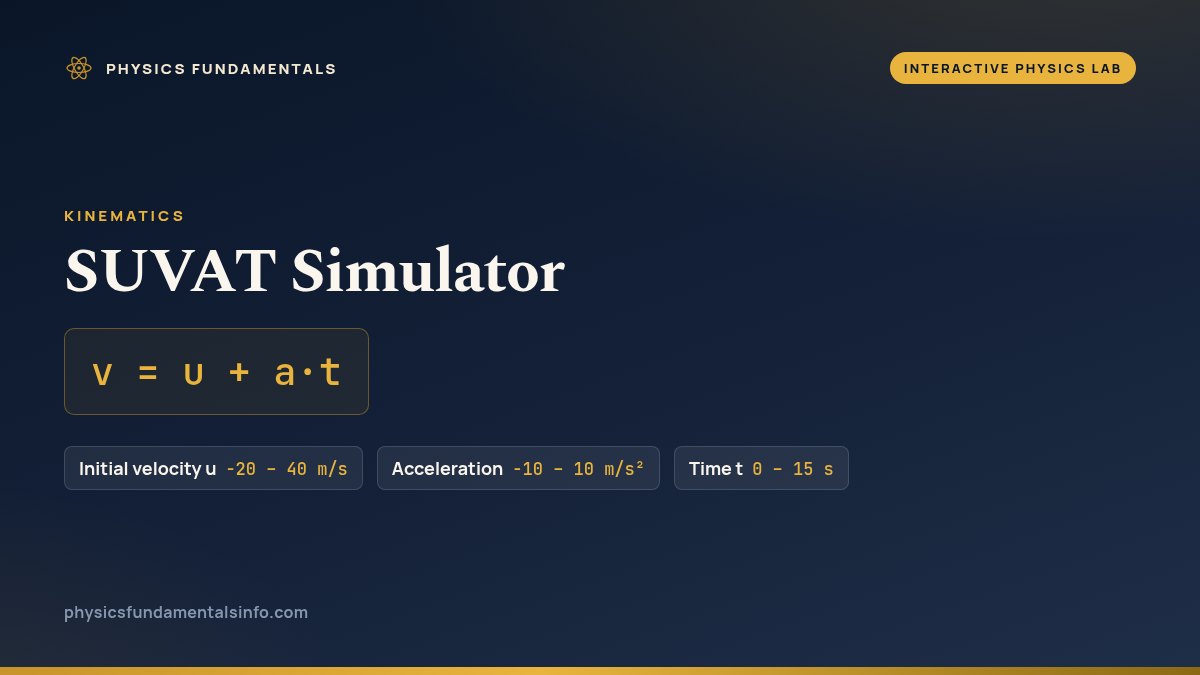
The SUVAT simulator is a free interactive physics lab that runs in your browser — nothing to install and no sign-up. Change the initial velocity, acceleration and time and watch displacement and final velocity respond through v = u + a·t.
| Control | Range | Step |
|---|---|---|
| Initial velocity u | -20 – 40 m/s | 1 |
| Acceleration | -10 – 10 m/s² | 0.5 |
| Time t | 0 – 15 s | 0.5 |
Fixing u, a and t to pin down where the ball is and how fast it's moving
Set three numbers on this simulator and everything else about the motion follows. The sliders Initial velocity u (m/s), Acceleration a (m/s²) and Time t (s) feed two equations at once: final velocity v = u + a·t tells you how fast the object is moving at that instant, while displacement s = u·t + ½·a·t² tells you where it has ended up. The readouts for s and v update together, so the same three inputs pin down both the position and the speed with no extra bookkeeping.
With the object moving forwards, slide a above zero and it speeds up; drag a below zero and it decelerates, then reverses. Watch the positive/negative-displacement indicator: because s is a vector, it can read negative or even zero. Push u forward against a negative a and you can send the ball out and back so s lands at 0 while it clearly covered ground — displacement is not the distance travelled. Notice too that with a nonzero, s is quadratic in t, so it never grows in a straight line.
One rule holds throughout: these formulas assume constant acceleration. A ball on a smooth ramp or a car braking at a steady rate fit them exactly; a skydiver whose acceleration keeps changing does not. Keep every value in SI units. To crunch specific figures, use the SUVAT calculator, or try a different motion sandbox over in the physics simulation collection.
Frequently asked questions
What are the SUVAT equations?
They describe motion at constant acceleration. This lab uses v = u + a·t and s = u·t + ½·a·t², where s is displacement, u the initial velocity, v the final velocity, a the acceleration and t the time.
When do the SUVAT equations apply?
Only when the acceleration is constant. They fit a ball rolling down a smooth ramp or a car braking at a steady rate, but not motion where the acceleration keeps changing, such as a skydiver whose acceleration falls as drag builds.
Is displacement the same as distance travelled?
No. Displacement is a vector — it can be negative or even zero. An object thrown straight up and returning to its start has zero displacement but has still travelled a real distance.
What does a negative acceleration mean?
A negative acceleration slows an object that is moving forwards, and can then drive it back the other way. Acceleration and displacement both carry a sign that records direction, not just size.
References & formula source
- Halliday, Resnick & Walker — Fundamentals of Physics, Chapter 2 (Motion Along a Straight Line).
- Young & Freedman — University Physics with Modern Physics, §2.4 (Motion with Constant Acceleration).
- R. Nave — HyperPhysics, Georgia State University, "Motion Equations" section.
- Further reading: Equations of motion — Wikipedia