Photon energy E
3.10 eV
Light ejects electrons from a metal only when each photon carries more energy than the work function. Drag the sliders below to set the wavelength, intensity and work function (or pick a metal), and watch emission switch on through Kmax = hc/λ - φ.
Light ejects electrons from a metal only when each photon carries more energy than the work function: Kmax = hc/λ − φ. Brighter light means more electrons, never faster ones — energy comes from the wavelength, not the intensity.
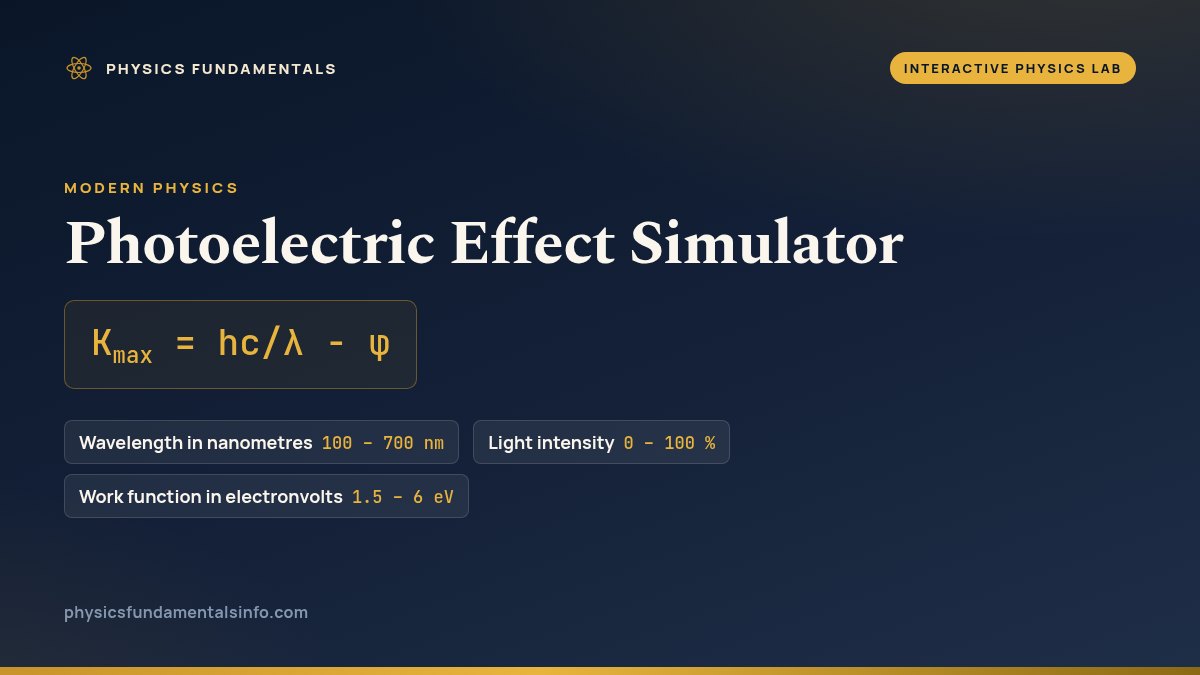
The photoelectric effect simulator is a free interactive physics lab that runs in your browser — nothing to install and no sign-up. Change the wavelength, intensity and work function and watch emission, stopping voltage and Kmax respond. It reports maximum kinetic energy kmax, photon energy and stopping as you drag the sliders.
| Control | Range | Step |
|---|---|---|
| Wavelength in nanometres | 100 – 700 nm | 1 |
| Light intensity | 0 – 100 % | 1 |
| Work function in electronvolts | 1.5 – 6 eV | 0.05 |
Shine light on a metal and, under the right conditions, electrons fly off its surface. This simulator lets you control exactly when that happens. Drag the wavelength slider to set the light's colour in nanometres, adjust the intensity slider to change how bright the beam is, and choose a target metal from the work-function / material presets: caesium (φ = 2.1 eV), sodium (2.3 eV), zinc (4.3 eV) or copper (4.7 eV). As you sweep the controls, watch the readouts update: photon energy E = hc/λ, maximum kinetic energy, stopping voltage, threshold wavelength, relative current, and whether emission is on or off.
The governing rule is Einstein's photoelectric equation, Kmax = hc/λ - φ, where the work function φ is the minimum energy needed to liberate an electron. Emission occurs only when each photon carries at least that much energy, meaning the wavelength must fall at or below the threshold λ0 = hc/φ. Push the wavelength past λ0 and the current drops to zero no matter how far you raise the intensity slider; a longer-wavelength photon simply lacks the energy to free anything.
Above threshold, intensity governs the number of electrons, never their speed: a brighter beam yields more current, but Kmax and stopping voltage depend solely on wavelength and φ. Emission is effectively instantaneous, the quantum behaviour classical waves could not explain. Explore further with the Photoelectric Effect calculator, the Photon Energy calculator, or the Electromagnetic Spectrum Simulator.
It is the emission of electrons from a metal surface when light of high enough frequency shines on it. Einstein explained it with the equation Kmax = hf - phi, where phi is the work function of the metal.
Because emission depends on the energy of each photon, not the total brightness. Blue light has enough energy per photon to beat the work function; red light does not, so no electrons are freed no matter how bright it is.
Above the threshold frequency, more intensity means more electrons emitted per second — a larger current — but it never increases their maximum kinetic energy. Only frequency and the work function set the electron energy.
The longest wavelength that can still eject electrons, lambda-0 = hc/phi. Light with a longer wavelength carries too little energy per photon and produces no emission at all, however intense.