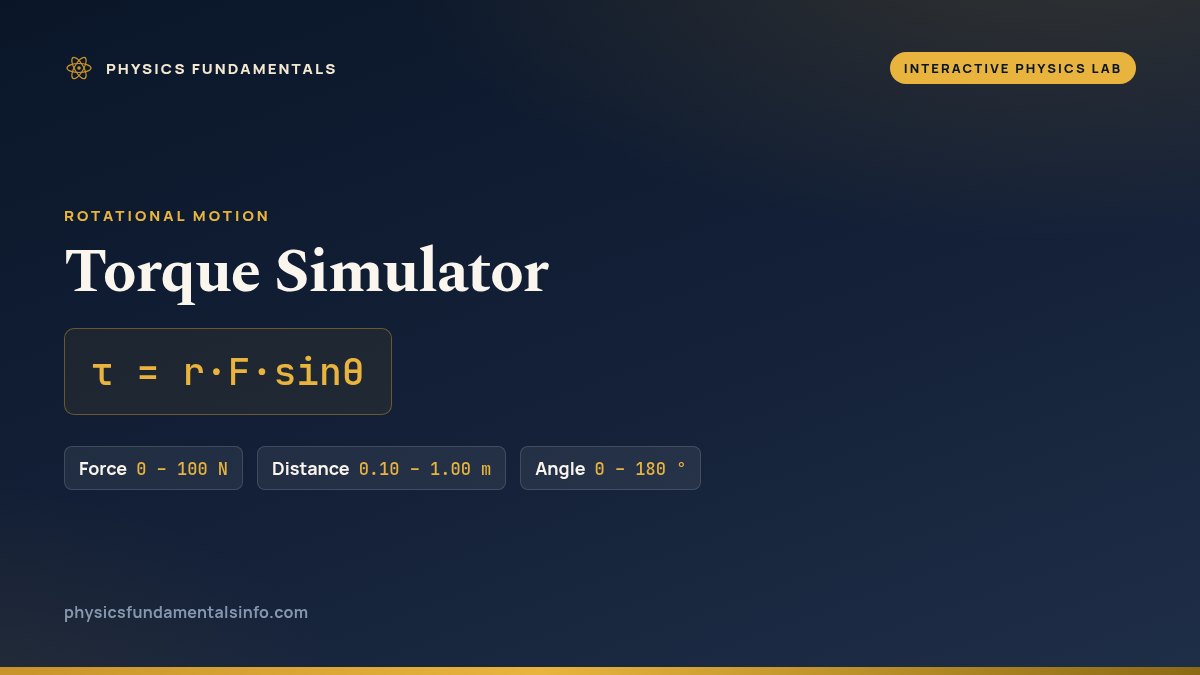
Torque is the turning effect of a force about a pivot: τ = r·F·sinθ. Drag the sliders below to change the applied force, the distance from the pivot and the angle, and watch the torque and the lever arm respond in real time.
Torque τ = r · F · sin θ
Drag the sliders — only the part of the force perpendicular to the arm (F sin θ) turns the bolt.
At θ = 90° the whole force turns the bolt. At θ = 0° none of it does. Doubling r doubles the torque.
What Is the Torque Simulator?
The torque simulator is a free interactive physics lab that runs in your browser — nothing to install and no sign-up. Change the applied force, distance and angle and watch the torque and lever arm respond through τ = r·F·sinθ.
| Control | Range | Step |
|---|---|---|
| Force | 0 – 100 N | 1 |
| Distance | 0.10 – 1.00 m | 0.01 |
| Angle | 0 – 180 ° | 1 |
Why the Same Push Can Turn Nothing or Everything
The identical applied force F can produce zero turning effect or the largest turning effect this simulator allows, and nothing but the angle θ decides which. Hold F and the distance r fixed, then sweep θ from 0° upward: the torque τ readout climbs from nothing to its peak at 90°, then falls back to zero by 180°. Same force, opposite outcomes.
What the angle slider is really tracking is the lever arm readout, r·sin(θ) — the perpendicular distance from the pivot to the force's line of action. Only the perpendicular slice of the force, F·sin(θ), does any turning; the part aimed straight along the arm is wasted, which is why pushing directly toward the pivot spins the object not at all. This kills the intuition that a big force must mean a big torque. Feed in a large F at θ near 0° and watch τ = r·F·sin(θ) stay pinned near zero.
Then work the other two sliders: doubling F doubles τ, and doubling r doubles it too, because torque rides on the lever arm, not force alone — the reason a longer wrench frees a stubborn bolt. Put numbers to your own bolts with the torque calculator, or wander the rest of our tinker-and-see physics sandbox shelf.
Where the ideal torque equation breaks down
The equation tells you the torque you apply, not whether anything turns. A seized bolt answers with a friction torque of its own, and until yours beats that breakaway value the readout can sit at 45.00 N·m with the bolt perfectly still. Even once it moves, friction under the head and in the threads swallows most of your effort: only something like a tenth of the applied torque becomes clamping tension. Tighten a dry thread and an oiled one to the same reading and they grip very differently.
The arm here is rigid and weightless; real ones are neither. A 1 m steel breaker bar weighs perhaps 2 kg, so about 20 N acting at its midpoint — some 10 N·m on the bolt before your hand touches it, held out horizontally. Long wrenches flex too, and fitting an extension or a universal joint changes both the distance and the direction the equation assumes.
Angle is exact in a simulator and impossible to hold steady in a workshop, but the error does not cost the same everywhere. Leave the defaults at 40 N and 0.50 m and slip from 90° to 80°: the torque falls from 20.00 to 19.70 N·m, under two per cent, which nobody would notice. Take the same 10° at the flat end of the swing and 10° reads 3.47 N·m against 6.84 N·m at 20°, nearly double. sinθ is flat near the top and steep near the bottom, so pulling roughly square is good enough while a shallow pull gives a figure you cannot trust.
The part of the force that does no turning does not vanish either. Set 20 N at 0.80 m and 45°: the sim reports 14.1 N turning the arm and an equal 14.1 N pressed straight along it into the pivot. Bearings, hinges and bolt shanks fail under exactly that load, which the torque figure never mentions. Nor does torque describe motion — the same 20.00 N·m spins up two objects at very different rates depending on how their mass is spread, the business of moment of inertia.
Where this is actually used
Wheel nuts are specified in torque, not force, because torque sets the stretch and so the grip in the stud. Push this sim to its ceiling — 100 N at 1.00 m, square on — and it reads 100.00 N·m, just short of the roughly 110 N·m a typical passenger car asks for. A real wheel wrench is nowhere near a metre long: set the distance to 0.45 m at the same 100 N and the torque drops to 45.00 N·m, so reaching spec takes about 240 N, the weight of a 24 kg load on the end.
A bicycle stem bolt runs the other way. Its spec is around 5 N·m and the long leg of a hex key is about 0.10 m, the shortest arm this sim allows; set r there with the force at 50 N and the readout is exactly 5.00 N·m. Fifty newtons is the weight of a 5 kg bag of flour, which is why carbon seatposts get crushed by riders who only meant to nip the bolt up.
Doors put the handle as far from the hinges as the frame allows, and one move here shows why. A light 20 N push at 0.80 m, square to the door, gives 16.00 N·m. Swing the angle to 45°, pushing partly along the door rather than across it, and the same push gives 11.31 N·m — close to 30 per cent thrown away for nothing.
Frequently asked questions
What is torque?
Torque is the turning effect of a force about a pivot: τ = r·F·sin(θ), where F is the force, r the distance from the pivot, and θ the angle between them. Equivalently it is the force multiplied by the perpendicular lever arm r·sin(θ).
When is torque at its maximum?
When the force acts at right angles to the arm (θ = 90°, so sin θ = 1). The torque falls to zero when the force points straight along the arm, toward or away from the pivot (θ = 0° or 180°), because then it has no turning effect at all.
Why does a longer spanner loosen a stiff bolt more easily?
Because torque grows with the distance r. A longer spanner gives a longer lever arm, so the same effort at the end produces more torque at the bolt. Doubling the length doubles the torque for the same force.
Does a bigger force always mean more torque?
No. Torque also depends on the distance and the angle. A large force aimed straight at the pivot produces zero torque, while a smaller force applied far out and at a right angle can produce much more. Only the perpendicular part of the force turns the object.
Why is torque measured in newton metres and not joules, when both are a force times a distance?
Because the distance is measured in a different direction. For work, the force and the displacement lie along the same line; for torque, the distance runs across the force, perpendicular to it. They are physically different quantities, so the newton metre of torque is deliberately never written as a joule.
References & formula source
- Halliday, Resnick & Walker — Fundamentals of Physics, Chapter 10 (Rotation) and Chapter 12 (Equilibrium).
- Young & Freedman — University Physics with Modern Physics, §10.1 (Torque).
- R. Nave — HyperPhysics, Georgia State University, "Torque" section.
- Further reading: Torque — Wikipedia