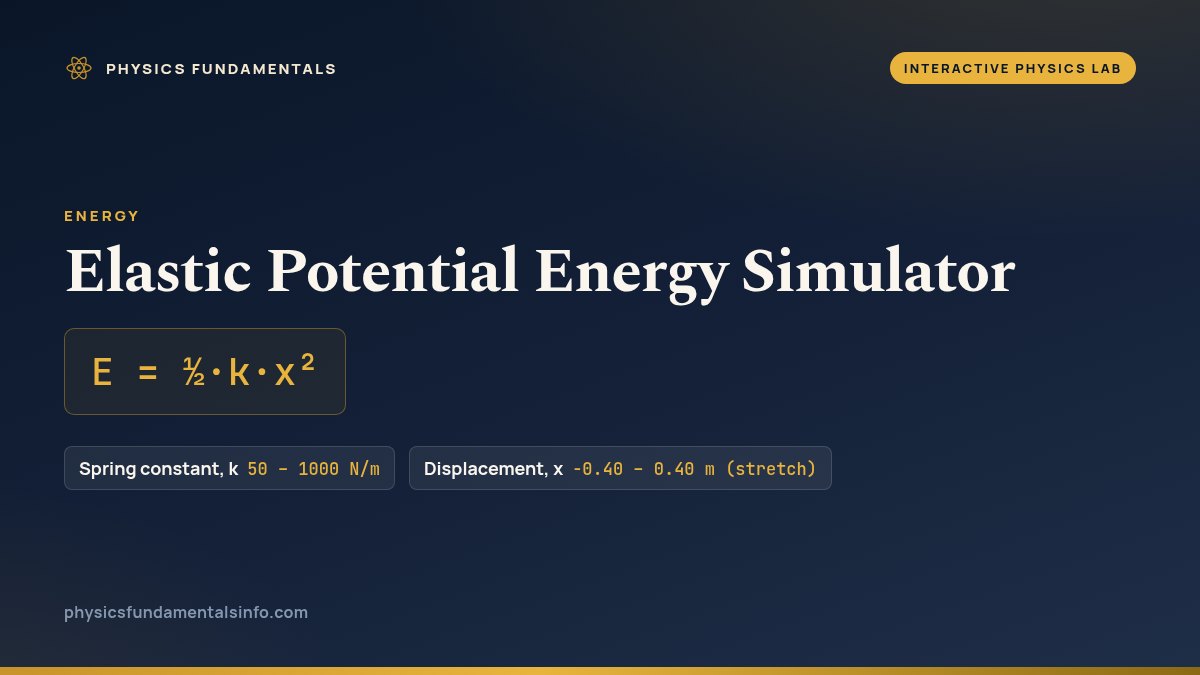
Elastic potential energy is the energy stored in a spring, E = ½·k·x². Drag the sliders below to change the spring constant and the displacement (stretch or compression), and watch the stored energy fill up in real time.
Elastic Potential Energy
Load the spring with the sliders and watch E = ½kx² fill up. Stretch it or squash it — because the energy depends on x², doubling the displacement quadruples the stored energy.
What Is the Elastic Potential Energy Simulator?
The elastic potential energy simulator is a free interactive physics lab that runs in your browser — nothing to install and no sign-up. Change the spring constant and displacement and watch the stored energy respond through E = ½·k·x².
| Control | Range | Step |
|---|---|---|
| Spring constant, k | 50 – 1000 N/m | 10 |
| Displacement, x | -0.40 – 0.40 m (stretch) | 0.01 |
Why a Spring's Stored Energy Grows with x²
The energy banked in a spring climbs faster than the stretch that loads it, because it follows the square of the displacement rather than the displacement itself — pull a little further and the store grows out of all proportion. This simulator makes that steep climb visible: set the Spring constant, k, drag the Displacement, x into either stretch or compression, and the elastic potential energy readout E = ½·k·x² fills up like a tank as you load the spring.
Because the displacement is squared, the stored energy scales as x²: slide to twice the displacement and E leaps by a factor of four; three times the stretch banks nine times the energy. Stiffness pulls its weight too, since E rises in direct proportion to k. Watch that the readout never dips below zero — whether you pull the spring out or squash it in, x² stays positive, so a compression stores exactly as much energy as a stretch of the same size.
That quadratic climb is what sets the stored energy apart from the restoring force F = kx, which grows only in straight-line proportion to x; the energy is simply the triangular area beneath that force line, ½·x·(kx). All of it holds while the spring stays inside its elastic limit. To follow the linear force that partners this energy, open the Hooke's law calculator, or step through the rest of our interactive physics labs.
Frequently asked questions
What is elastic potential energy?
It is the energy stored in a stretched or compressed spring, E = ½·k·x², where k is the spring constant and x is the displacement from the spring's natural length.
What happens to the energy if you stretch the spring twice as far?
It quadruples. The energy depends on the square of the displacement (E is proportional to x²), so doubling x multiplies the energy by four and tripling it by nine.
Does compressing a spring store energy too?
Yes. Because x² is positive whether x is a stretch or a compression, squashing a spring stores exactly as much energy as stretching it the same distance.
How is the stored energy different from the spring force?
The restoring force F = kx grows in straight-line proportion to the displacement, while the stored energy E = ½·k·x² grows with its square. The energy is the triangular area under the force-extension line.
References & formula source
- Halliday, Resnick & Walker — Fundamentals of Physics, Chapter 8 (Potential Energy and Conservation of Energy).
- Young & Freedman — University Physics with Modern Physics, §7.2 (Elastic Potential Energy).
- R. Nave — HyperPhysics, Georgia State University, "Elastic Potential Energy" section.
- Further reading: Elastic energy — Wikipedia