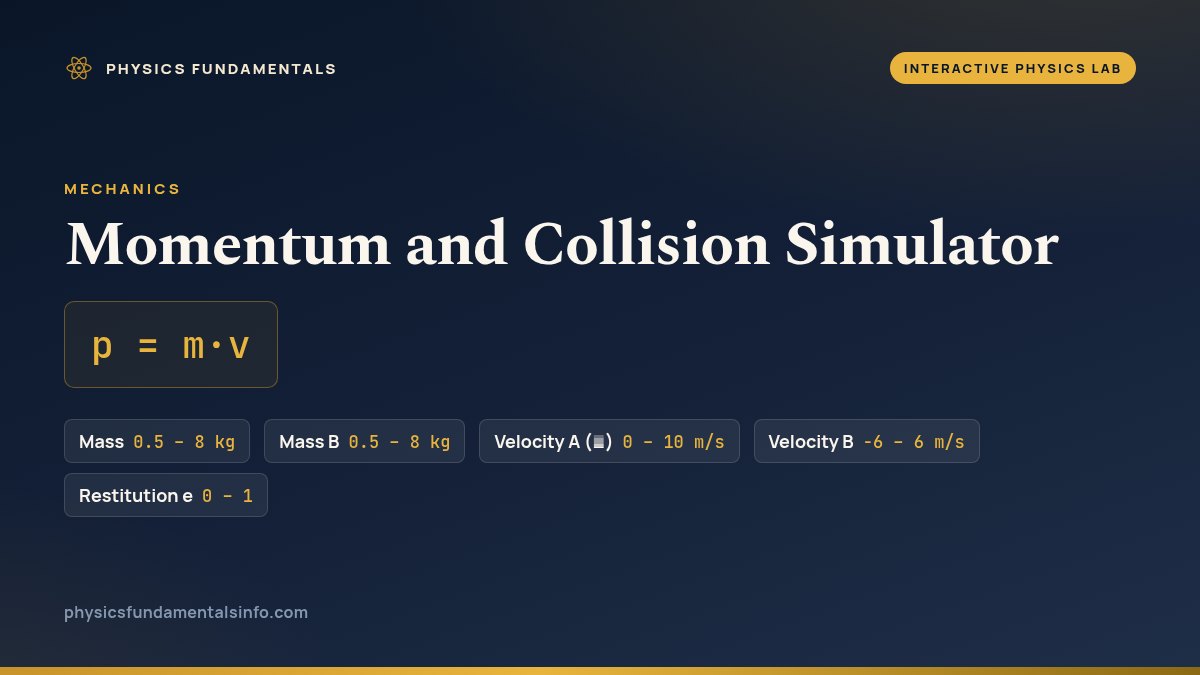
Momentum (p = m·v) is conserved in every collision of an isolated system. Drag the sliders below to set the two masses, their velocities and the restitution, run the collision, and watch the total momentum stay constant while kinetic energy survives only a perfect bounce.
Momentum & Collisions
Set the masses, speeds and bounciness, then run the collision. Total momentum stays constant; kinetic energy only survives a perfectly elastic hit (e = 1).
What Is the Momentum and Collision Simulator?
The momentum and collision simulator is a free interactive physics lab that runs in your browser — nothing to install and no sign-up. Set the masses, velocities and restitution and watch momentum stay constant through every collision.
| Control | Range | Step |
|---|---|---|
| Mass | 0.5 – 8 kg | 0.5 |
| Mass B | 0.5 – 8 kg | 0.5 |
| Velocity A (→) | 0 – 10 m/s | 0.5 |
| Velocity B | -6 – 6 m/s | 0.5 |
| Restitution e | 0 – 1 | 0.05 |
Watch the Momentum Ledger Balance Before and After the Hit
One number on this simulator refuses to change no matter how the carts meet. Set Mass A, Mass B, and the signed Velocity A and Velocity B, then read the Total momentum printed above the track. Run the collision and the same figure reappears afterward, because the isolated pair obeys m_A·v_A + m_B·v_B = m_A·v_A' + m_B·v_B'. Nudge either velocity negative so the bodies rush at each other and the totals can nearly cancel, a reminder that momentum is a vector and its sign carries direction.
Now drag Restitution e from top to bottom. At e = 1 the collision is perfectly elastic, the carts spring apart, and kinetic energy survives intact. At e = 0 they lock together and coast off as one perfectly inelastic lump; anywhere between, some energy bleeds into heat, sound, and deformation.
Here is the trap the readout dismantles: through every one of those settings the momentum total held steady, yet the kinetic energy held steady only at e = 1. Momentum is the true invariant; kinetic energy is not — the energy that leaves in a crunch turns into heat, sound and deformation, while the momentum books always balance. Balance those books by hand at our momentum calculator, or wander into the rest of our interactive physics workbench.
Frequently asked questions
What is the conservation of momentum?
In an isolated system with no net external force, the total momentum stays the same before and after a collision: m_A·v_A + m_B·v_B is unchanged. It holds for every kind of collision, gentle or violent.
Is momentum conserved in all collisions?
Yes — in both elastic and inelastic collisions, as long as no outside force acts on the pair. Momentum is never 'lost' in the collision itself; it only changes if something external, like friction or a wall, pushes on the system.
When is kinetic energy conserved in a collision?
Only in a perfectly elastic collision, where the restitution e = 1. In inelastic collisions (e < 1) the total momentum still stays constant, but some kinetic energy is converted into heat, sound and deformation.
What is the coefficient of restitution?
It measures how bouncy a collision is, from 0 to 1. At e = 1 the objects rebound perfectly and kinetic energy is conserved; at e = 0 they stick together and move off as one; values in between lose some energy while conserving momentum.
References & formula source
- Halliday, Resnick & Walker — Fundamentals of Physics, Chapter 9 (Center of Mass and Linear Momentum).
- Young & Freedman — University Physics with Modern Physics, §8.3–8.4 (Momentum Conservation; Collisions).
- R. Nave — HyperPhysics, Georgia State University, "Collisions" / conservation of momentum section.
- Further reading: Momentum — Wikipedia