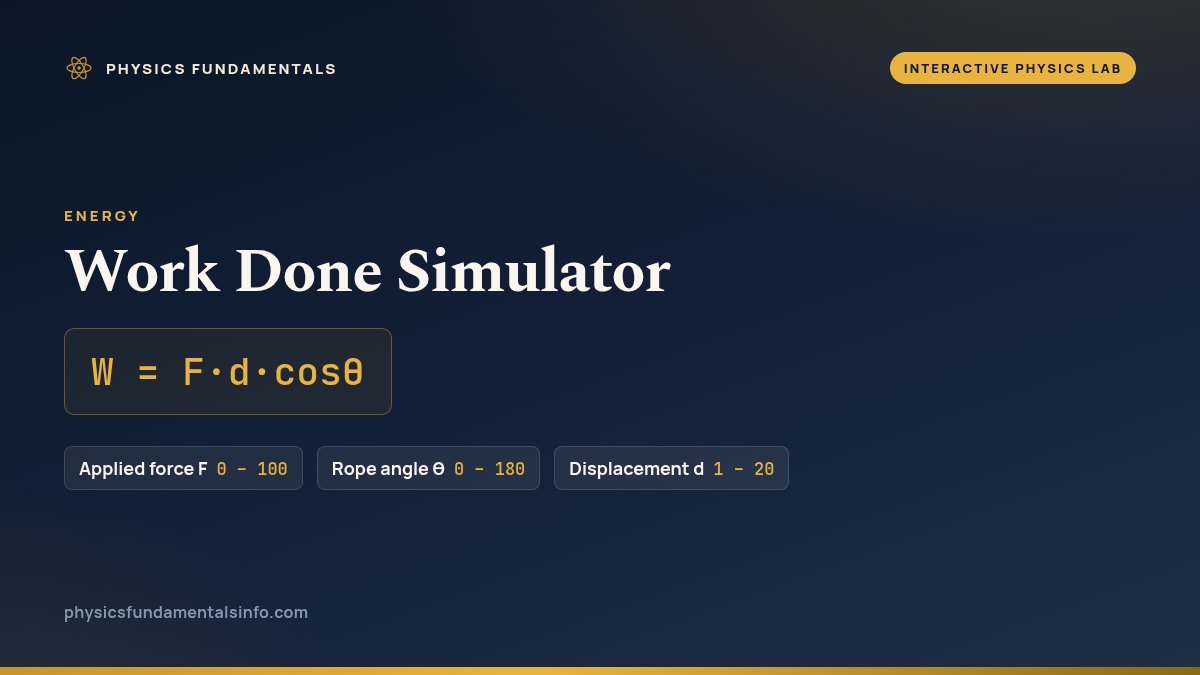
Work is done when a force moves an object along its direction: W = F·d·cosθ. Drag the sliders below to change the applied force, the rope angle and the displacement, and watch the work done — and the component along the motion — respond in real time.
Work Done W = F·d·cos θ
Only the force component along the motion does work. At θ = 90° the rope pulls straight up — the crate gains no energy from it.
What Is the Work Done Simulator?
The work done simulator is a free interactive physics lab that runs in your browser — nothing to install and no sign-up. Change the force, angle and displacement and watch the work respond through W = F·d·cosθ.
| Control | Range | Step |
|---|---|---|
| Applied force F | 0 – 100 | 1 |
| Rope angle θ | 0 – 180 | 1 |
| Displacement d | 1 – 20 | 1 |
Where the Angle Decides How Much of Your Force Counts
Pushing hard only registers as work when the push actually moves the object and lines up with the direction it travels. This simulator makes that condition visible: set the Applied force F in newtons, tilt the Rope angle θ, and stretch the Displacement d in metres, then watch the readout resolve W = F·d·cos(θ) into joules.
The key panel is the component along motion, F·cos(θ) — the only slice of your pull that does work as a crate slides across the floor. Hold the rope flat at θ = 0° and every newton goes into the drag, so work peaks. Raise it and the useful share shrinks; at θ = 90° the force stands perpendicular and cos(90°) = 0, so W collapses to nothing — the same reason gravity does zero work on a bag carried level across a room. Push past 90° and the indicator flips to negative work: the force now opposes the motion and energy leaves the object.
Drop d to zero and the answer stays zero no matter how enormous the force — push a wall that will not budge and you do no work on it, however hard you strain. Notice too that nothing here asks how long the trip took; timing belongs to power, not work. Confirm your numbers with the work and power calculator, then line up the figures behind another force-and-energy model on our physics simulation shelf.
Where the ideal work equation breaks down
The formula this simulator solves assumes the force stays constant for the whole journey, and that the angle stays constant with it. Set θ = 30° and the sim holds the rope at exactly 30° from the first metre to the twentieth. Haul a real sled on a shoulder rope and the angle steepens as the sled closes on you, while your grip fades over the distance. The honest version adds up F·cosθ over every small step of the path, so treat the sim as a calculator for one segment at a time.
Second, the number in the Work done box is the work done by that one force, not the energy the crate ends up with. Set F = 100 N, θ = 0°, d = 20 m and the readout gives 2000.0 J, but a crate on a real floor will not gain 2000 J of kinetic energy. Friction is doing negative work over the same 20 m, and so is air resistance. What the work-energy theorem equates to the change in kinetic energy is the net work, summed over every force acting. Reading this readout as "energy gained" gets you the right arithmetic and the wrong physics.
Third, "displacement" means the displacement of the point where the force is applied, and that stops matching the object's motion the moment the object is not rigid. The classic trap is a driven wheel: static friction from the road accelerates the car, yet the contact patch is instantaneously at rest against the road, so that force does no work at all. Crouch and jump and the floor's normal force does no work on you either — the floor never moves — yet you leave the ground with kinetic energy, paid for internally by your legs.
Fourth, zero mechanical work is not zero effort. Set θ = 90° and the badge reads Zero work at 0.0 J whatever force you dial in, which is exactly right: a perpendicular force turns an object without changing its speed, the reason a centripetal force does no work on an orbit. Yet hold a heavy box still and you are exhausted within a minute, because your muscle fibres burn chemical energy cycling an isometric contraction. Metabolic cost and mechanical work are different quantities.
Where this is actually used
Handle angles on pushed machines. A walk-behind mower, a floor polisher or a warehouse trolley is driven along a handle set well above the horizontal, and only the horizontal share of that push moves it. Set F = 100 N, θ = 60°, d = 20 m and the sim reports a component along motion of 50.0 N and 1000.0 J of work — exactly half the 2000.0 J the same push delivers at θ = 0°. Handle height is therefore a real engineering decision, not styling: every degree you are forced to lean down is force you paid for and did not use.
Hoisting on a crane. Here the geometry is the good case — the cable tension is vertical, the load rises vertically, cosθ = 1, and every newton counts. A tower crane raising a 2000 kg load through 40 m does m·g·h, about 785 kJ of work against gravity, and that figure sizes the motor: delivering it in 30 seconds needs roughly 26 kW at the drum before losses. The angle term is also why operators keep the load directly under the hook, since a cable swung off vertical spends part of its tension sideways, lifting nothing.
Braking, and the value of a minus sign. Push the angle past 90° and the sim flips to Negative work — energy out: at F = 40 N, θ = 120°, d = 10 m the readout is -200.0 J. That sign is the entire business of a brake. A 1500 kg car at 30 m/s carries about 675 kJ of kinetic energy, and friction pads must do that much negative work to stop it, dumping the lot as heat in the discs. A regenerative brake does the same negative work on the car but steers the energy into a battery instead of the air.
Frequently asked questions
What is work in physics?
Work is done when a force moves an object along its direction of travel: W = F·d·cos(θ), measured in joules, where θ is the angle between the force and the displacement.
When does a force do no work?
When it acts perpendicular to the motion (θ = 90°, so cos θ = 0) or when there is no displacement at all. Gravity does no work on a bag carried level across a room, and pushing an immovable wall does no work on it.
Can work be negative?
Yes. When the force opposes the motion — the angle between them is between 90° and 180° — the work is negative, meaning the force removes energy from the object. Friction and braking do negative work.
Does work depend on how fast it is done?
No. Work is the force times the distance moved along it, independent of the time taken. How fast the work is done is a separate quantity — power.
Is work a vector or a scalar?
Work is a scalar. It is the dot product of the force and displacement vectors, so the answer is a single number in joules with no direction attached to it. The minus sign on negative work is not a direction either — it only records that the force is taking energy out of the object rather than putting it in.
References & formula source
- Halliday, Resnick & Walker — Fundamentals of Physics, Chapter 7 (Kinetic Energy and Work).
- Young & Freedman — University Physics with Modern Physics, §6.1–6.2 (Work).
- R. Nave — HyperPhysics, Georgia State University, "Work" section.
- Further reading: Work (physics) — Wikipedia