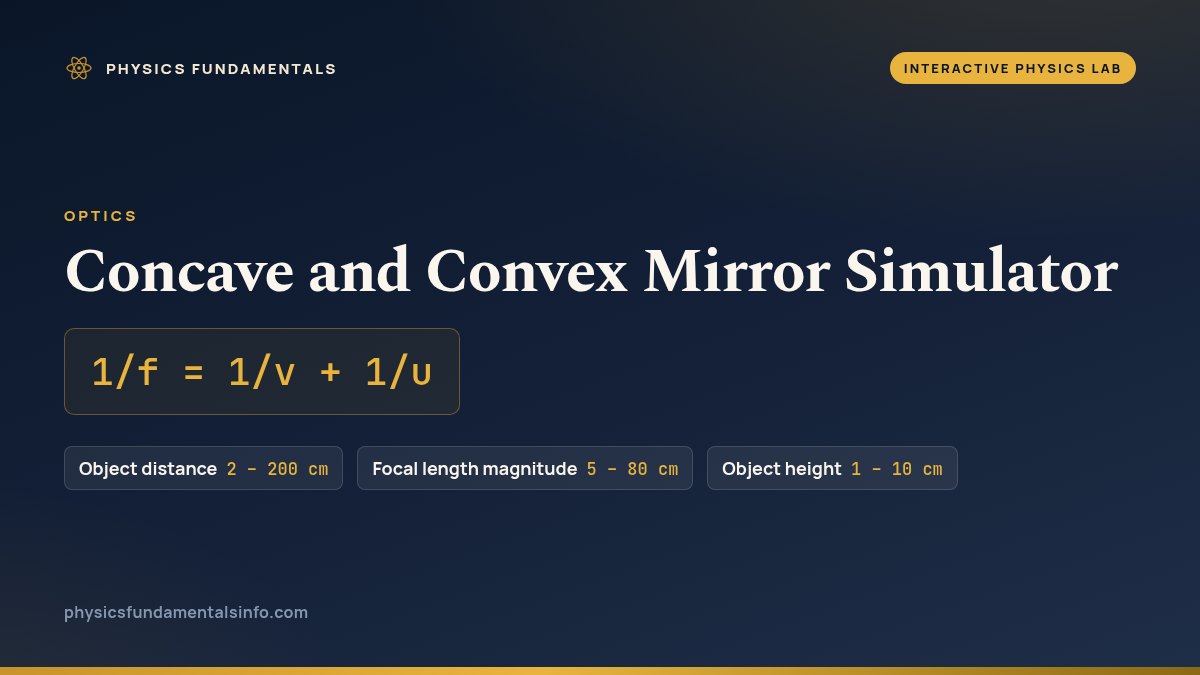
A concave mirror converges light and a convex mirror spreads it out. Move the object along the axis and flip the curvature to watch real and virtual images form through the mirror equation 1/f = 1/v + 1/u.
What Is the Concave and Convex Mirror Simulator?
The concave and convex mirror simulator is a free interactive physics lab that runs in your browser — nothing to install and no sign-up. Move the object and flip the curvature to see real and virtual images form through 1/f = 1/v + 1/u. It reports image 1/f as you drag the sliders.
| Control | Range | Step |
|---|---|---|
| Object distance | 2 – 200 cm | 1 |
| Focal length magnitude | 5 – 80 cm | 1 |
| Object height | 1 – 10 cm | 0.5 |
Reading the Mirror Equation on a Ray Bench
Every curved mirror obeys one relationship, 1/f = 1/v + 1/u, with the focal length equal to half the radius of curvature, f = R/2. Drag the Object distance slider and the bench traces the standard rays and solves for the image distance v and the magnification m = -v/u. A positive v means a real image formed in front of the mirror; a negative v means a virtual image that only appears to sit behind it.
On a concave mirror the image changes character as the object moves. Beyond the centre of curvature it is real, inverted and shrunk; between the focus and the centre it is real, inverted and magnified; and once the object slips inside the focal point it flips to virtual, upright and enlarged — the make-up-mirror case. Slide past the focus and watch the readout swing from “Real, inverted” to “Virtual, upright,” with the reflected rays turning parallel at the focal point itself, where no image forms.
A convex mirror is simpler and never changes its mind: for any object it returns a virtual, upright, diminished image with a magnification between zero and one, which is exactly why it is used for wide-angle car and security mirrors. Put precise numbers on any case with the lens and mirror calculator, compare it with its refracting cousin in the concave vs convex lens simulator, or explore more of our interactive physics labs.
Frequently asked questions
What is the difference between a concave and a convex mirror?
A concave mirror curves inward and converges light, so it can form real or virtual images depending on where the object sits. A convex mirror curves outward and diverges light, so it always forms a small, upright, virtual image. In the sign convention here, concave has a positive focal length and convex a negative one.
What image does a concave mirror form?
It depends on the object distance. Beyond the centre of curvature the image is real, inverted and diminished; at the centre it is real, inverted and the same size; between the focus and centre it is real, inverted and magnified; and inside the focal point it becomes virtual, upright and magnified — the shaving or make-up mirror.
Why does a convex mirror always give a smaller image?
Because a diverging mirror only ever produces a virtual, upright image between zero and full size (0 < m < 1) for any real object. That wide, shrunken field of view is why convex mirrors are used as car and shop security mirrors.
What is the mirror equation?
1/f = 1/v + 1/u, where u is the object distance, v the image distance and f the focal length (f = R/2, half the radius of curvature). A positive v means a real image in front of the mirror; a negative v means a virtual image behind it.
References & formula source
- Halliday, Resnick & Walker — Fundamentals of Physics, Chapter 34 (Images).
- Young & Freedman — University Physics with Modern Physics, §34.2 (Reflection at a Spherical Surface).
- R. Nave — HyperPhysics, Georgia State University, "Mirror Equation" / curved mirror section.
- Further reading: Curved mirror — Wikipedia