A simple pendulum is a bob on a string swinging under gravity. Drag the sliders below to change the length, the strength of gravity and the starting angle, and watch the swing and its measured period respond in real time.
What Is the Simple Pendulum Simulator?
The simple pendulum simulator is a free interactive physics lab that runs in your browser — nothing to install and no sign-up. Change the length, gravity and starting angle and watch the period respond.
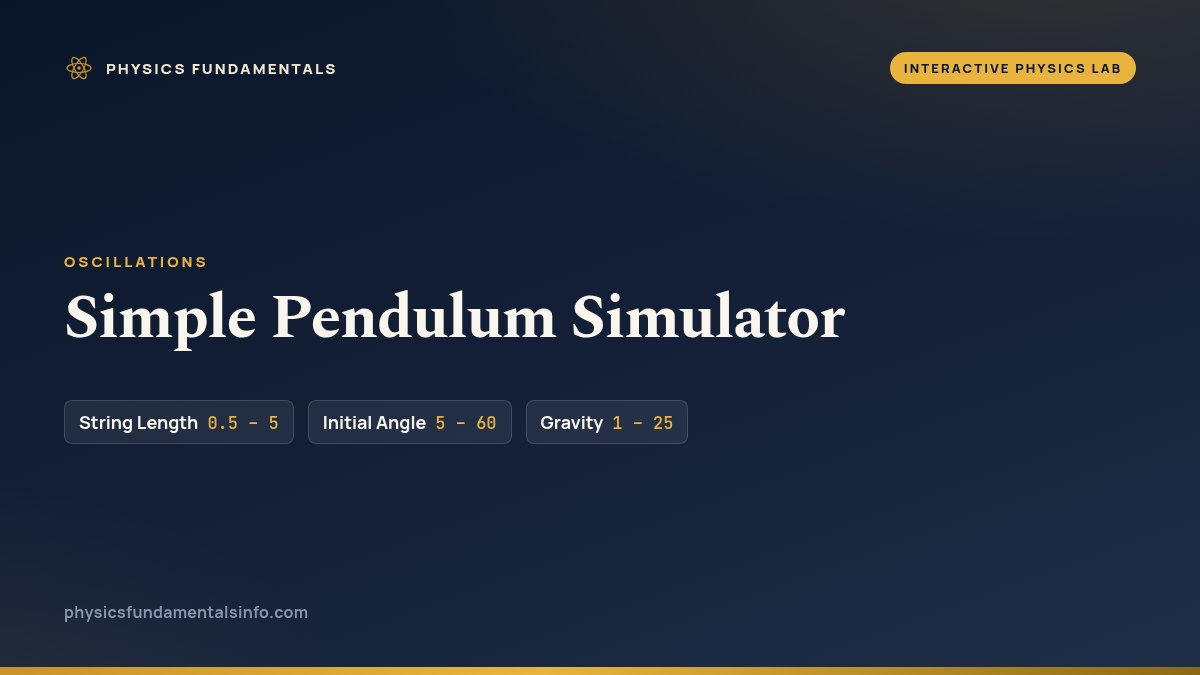
| Control | Range | Step |
|---|---|---|
| String Length | 0.5 – 5 | 0.1 |
| Initial Angle | 5 – 60 | — |
| Gravity | 1 – 25 | 0.1 |
What Sets a Pendulum's Rhythm
A weight on a string, a playground swing, the slow tick of an old grandfather clock — every simple pendulum keeps time the same way. Give the bob a small push and it traces the same arc over and over, and the surprising part is what decides how long each swing takes. Not the weight. For a small swing, hardly even how far you pull it back. The whole story lives in one line: T = 2π·sqrt(L/g), where the period T depends on just two things — the length L and the local gravity g.
That is why a heavy bob and a light one, dropped from the same small angle, stay in step. Lengthen the string and each swing slows; carry the clock to the Moon, where g is weaker, and it slows too. Watch the bob itself: at the extremes it is briefly moving at zero speed, yet this is where the restoring force and acceleration are strongest — it is turning around hard, not resting. At the bottom the speed peaks and the along-arc (tangential) acceleration drops to nothing — though the bob is still accelerating, now straight up toward the pivot: the centripetal acceleration that holds it on its arc.
So experiment. Change the length and the gravity and watch the timing shift; then hold both fixed and nudge the starting angle — small swings barely change T, but push past roughly 15° and the real period runs longer than the formula promises. Check any swing against the pendulum period calculator, then explore more in the interactive labs library.
Frequently asked questions
What does the period of a pendulum depend on?
For small swings the period follows T = 2π·sqrt(L/g), so it depends on only two things: the length of the pendulum and the local strength of gravity. It does not depend on the mass of the bob, and — as long as the swing stays small — barely on how far you pull it back.
Does a heavier bob swing faster?
No. The period is independent of mass, so a heavy bob and a light one of the same length, released from the same small angle, keep in step. Gravity accelerates every mass equally, so the extra weight is exactly offset by the extra inertia.
Does the starting angle change the period?
For small angles, hardly at all — that is the small-angle approximation the formula relies on. Push the amplitude past about 15°, though, and the real period grows longer than T = 2π·sqrt(L/g) predicts, because the approximation breaks down.
Where is the pendulum accelerating the most?
At the two ends of the swing. There the bob's speed is momentarily zero, but it is not resting — the restoring force and the along-arc acceleration are at their maximum, which is what whips it back toward the middle. At the bottom the speed peaks while that along-arc acceleration falls to zero.
References & formula source
- Halliday, Resnick & Walker — Fundamentals of Physics, Chapter 15 (Oscillations).
- Young & Freedman — University Physics with Modern Physics, §14.5 (The Simple Pendulum).
- R. Nave — HyperPhysics, Georgia State University, "Simple Pendulum" section.
- Further reading: Pendulum — Wikipedia