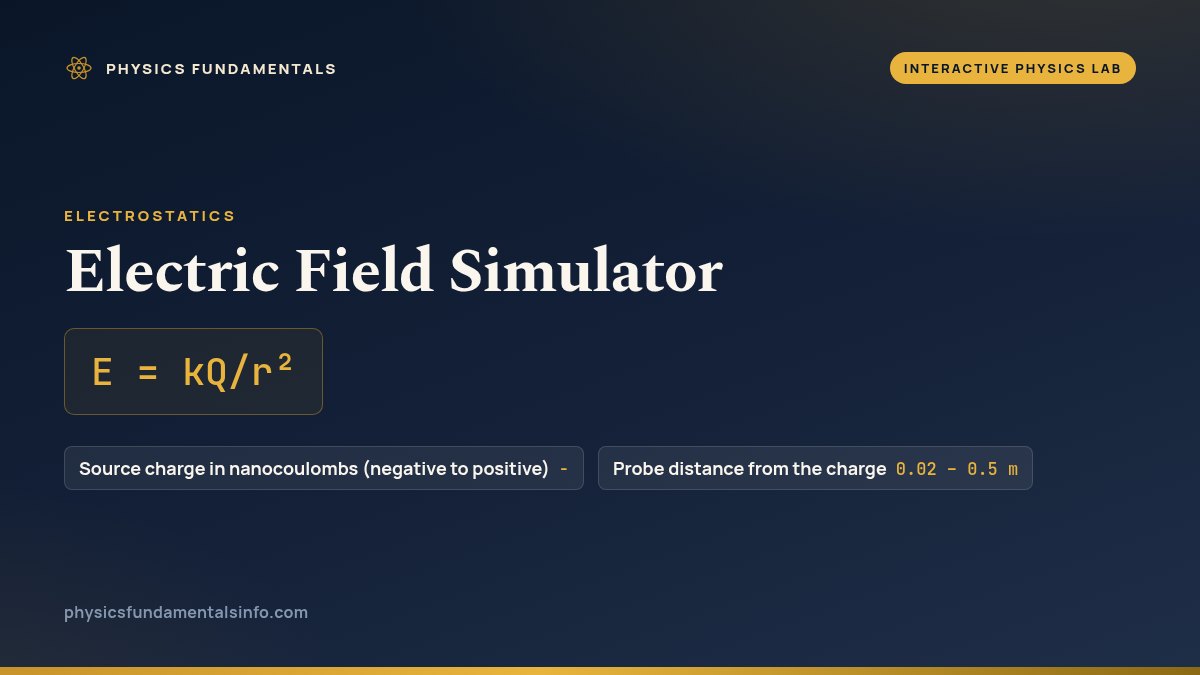
The electric field of a point charge fills the space around it, E = kQ/r². Drag the sliders below to change the source charge and the probe distance, and watch the field strength — and the force it puts on a test charge — respond in real time.
Electric Field of a Point Charge
The field around a point charge follows E = kQ/r² — pointing away from a positive charge, toward a negative one, and falling off as 1/r². Drag the probe (or use the slider) to read the field and the force it would put on a 1 nC test charge.
What Is the Electric Field Simulator?
The electric field simulator is a free interactive physics lab that runs in your browser — nothing to install and no sign-up. Change the charge and probe distance and watch the field of a point charge respond through E = kQ/r². It reports field strength and force on a 1 nC test charge as you drag the sliders.
| Control | Range | Step |
|---|---|---|
| Source charge in nanocoulombs (negative to positive) | -10 – 10 nC | 0.5 |
| Probe distance from the charge | 0.02 – 0.5 m | 0.005 |
Mapping the Invisible Field a Point Charge Casts Around Itself
Every point charge stains the space around it with an invisible influence, a value waiting at each location that any other charge would feel the instant it arrived. This simulation makes that map visible. Set the source with the Charge Q slider and read the field strength at a chosen point as E = kQ/r², where k = 8.99×10⁹ N·m²/C². The field-view toggle paints the surrounding arrows, pointing away from a positive Q and toward a negative one, so the sign of the source flips the whole pattern.
Drag the probe or set Probe distance r to sample any spot. The readout obeys an inverse-square law: halve r and the field quadruples; double r and it collapses to a quarter. Push Q higher and E rises in direct proportion. Notice the field is there at the probe whether or not anything sits in it, because E belongs to the source charge and the point in space alone.
The force needs a partner. Only when you place a charge in that field does it feel F = qE, and this sim reports that force on a fixed 1 nC test charge. Change Q or r and both readouts update together, letting you separate what the source broadcasts from what a second charge experiences. Verify the numbers with the electric field calculator, or open another interactive build from our full simulation shelf.
Frequently asked questions
What is the electric field of a point charge?
It is E = kQ/r², where k = 8.99×10^9 N·m²/C², Q is the charge and r the distance from it. The field points away from a positive charge and toward a negative one.
What happens to the field if you halve the distance?
It quadruples. The field obeys an inverse-square law (E is proportional to 1/r², not 1/r), so halving r multiplies the field by four and doubling r cuts it to a quarter.
What is the difference between the field and the force?
The field E exists in the space around the source charge whether or not anything is there. A second charge q placed in it feels a force F = qE. The field belongs to the source; the force needs the test charge.
Which way does the electric field point?
Away from a positive charge and toward a negative one. Reverse the sign of the source charge and every field arrow flips direction.
References & formula source
- Halliday, Resnick & Walker — Fundamentals of Physics, Chapter 22 (Electric Fields).
- Young & Freedman — University Physics with Modern Physics, §21.4 (Electric Field and Electric Forces).
- R. Nave — HyperPhysics, Georgia State University, "Electric Field" section.
- Further reading: Electric field — Wikipedia