All three of Newton's laws live in one sliding block. Drag the sliders below to set the applied force and mass, toggle friction, and watch the net force decide whether — and how fast — the block accelerates through F_net = m·a.
Force & Acceleration Lab
a = Fnet / mVelocity resets to zero whenever you change a control or press Reset. Friction never pushes the block backward — net force is clamped at zero.
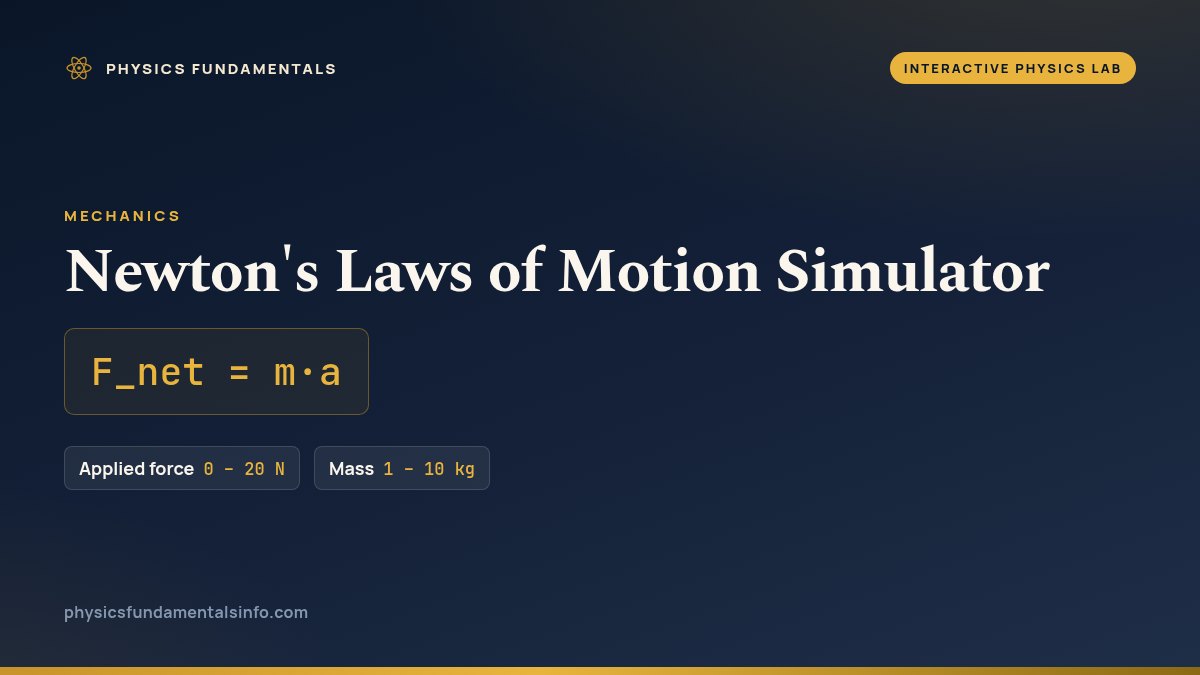
What Is the Newton's Laws of Motion Simulator?
The Newton's laws of motion simulator is a free interactive physics lab that runs in your browser — nothing to install and no sign-up. Change the applied force, mass and friction and watch all three laws at work through the net force.
| Control | Range | Step |
|---|---|---|
| Applied force | 0 – 20 N | 1 |
| Mass | 1 – 10 kg | 1 |
All Three of Newton's Laws in One Block
Part of your push is cancelled the moment you flip the kinetic-friction switch on. That resisted slice is the trap hiding inside F = ma: the F is the net force, not the number on the “Applied force” slider. With friction ON the lab computes F_net = F_applied - friction, and only the leftover accelerates the mass. Set an applied force too small to overcome friction and F_net stays at zero, so the net force cannot start the block moving.
That standstill is Newton's first law. Zero net force means an object keeps doing what it was doing: at rest it stays at rest, and once moving it glides at constant velocity forever. A force is what changes motion, never what maintains it. Now let the second law drive the readout: acceleration equals net force over mass, so F_net = m·a rearranges to a = F_net/m. Double the net force and the acceleration doubles; double the Mass and the same net force yields half the acceleration, force and inertia pulling in opposite directions.
The third law lives in the friction itself: the ground pushes back on the block exactly as hard as the block presses on the ground, equal and opposite forces acting on two different bodies. Once these three rules click, revisit the pure F=ma case in the Newton's second law lab, run clean numbers through the Newton's second law calculator, then explore the rest of our physics interactive sandboxes.
Frequently asked questions
What are Newton's three laws of motion?
First law: an object stays at rest or moves at constant velocity unless a net force acts on it. Second law: the net force equals mass times acceleration, F = ma. Third law: every force has an equal and opposite reaction force acting on a different body.
Why does the block not move when the applied force is small?
Because friction resists it. Until the applied force is large enough to overcome friction, the net force stays at zero, so the block does not accelerate and will not start moving.
What is the difference between the applied force and the net force?
The applied force is what you push with; the net force is what remains after friction and any other opposing forces are subtracted. Only the net force appears in F = ma and drives the acceleration.
What is a Newton's third-law pair?
Two equal, opposite forces acting on two different bodies. When the block presses down on the ground, the ground pushes back on the block with exactly the same size force. Because the pair acts on different objects, it never cancels the block's own motion.
References & formula source
- Halliday, Resnick & Walker — Fundamentals of Physics, Chapter 5 (Force and Motion I).
- Young & Freedman — University Physics with Modern Physics, §4.1–4.6 (Newton's Laws of Motion).
- R. Nave — HyperPhysics, Georgia State University, "Newton's Laws" section.
- Further reading: Newton's laws of motion — Wikipedia