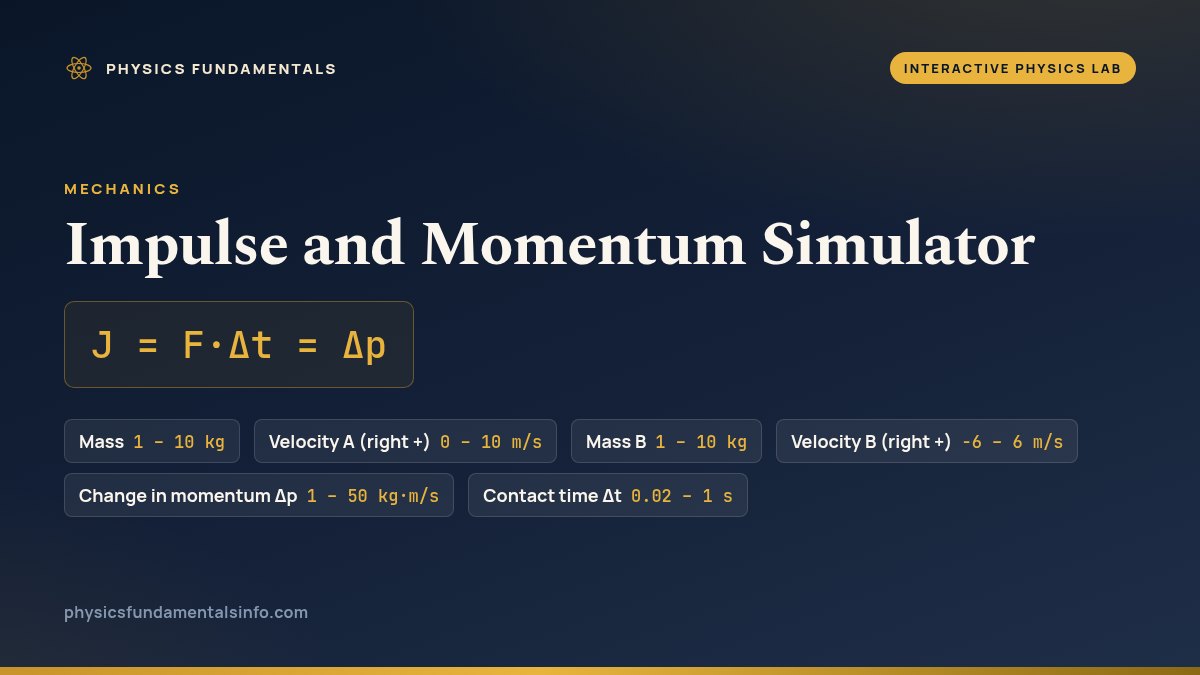
Impulse and momentum are two halves of one equation: momentum is what a moving object carries, and impulse is the force-time product that changes it, J = F·Δt = Δp. Drag the sliders below to set two masses, two velocities and a contact time, and watch momentum, impulse and force respond together.
Momentum is conserved in every collision. Kinetic energy is conserved only when the collision is elastic.
The shaded area is the impulse and stays fixed. Stretch the contact time and the force drops — the physics behind airbags and a soft catch.
What Is the Impulse and Momentum Simulator?
The impulse and momentum simulator is a free interactive physics lab that runs in your browser — nothing to install and no sign-up. Set two masses and velocities and watch impulse, momentum and force play out through J = F·Δt = Δp.
| Control | Range | Step |
|---|---|---|
| Mass | 1 – 10 kg | 1 |
| Velocity A (right +) | 0 – 10 m/s | 1 |
| Mass B | 1 – 10 kg | 1 |
| Velocity B (right +) | -6 – 6 m/s | 1 |
| Change in momentum Δp | 1 – 50 kg·m/s | 1 |
| Contact time Δt | 0.02 – 1 s | 0.02 |
Impulse: Why a Longer Stop Hurts Less
Your car is doing 30 and you have to stop. Whether you brake gently or slam into a wall, your change in momentum is identical — the same Δp either way. What differs is the time you take to lose it. That is the whole idea behind impulse: J = F·Δt = Δp. Momentum p = m·v is what you carry; impulse is what you must deliver to change it, and it equals that momentum change exactly (the impulse-momentum theorem, J = m·Δv).
Now rearrange for force: F = Δp/Δt. Force is the rate at which momentum changes, so the same Δp can arrive as a huge force over a blink, or a gentle force spread across a long moment. Drag the Time slider up and watch the force readout fall while the impulse stays fixed. That single relationship explains airbags, crumple zones, and bending your knees on landing — each one stretches Δt to shrink F. Push Time down and the force spikes: the sudden stop is the one that breaks bones.
In an isolated collision the total momentum is conserved, and the two bodies trade equal, opposite impulses. Set Mass A, Velocity A, Mass B and Velocity B, then read each p, J and F side by side. For a numeric check drop values into the impulse calculator, or explore two carts meeting in the momentum lab and the rest of the interactive physics collection.
Where the ideal impulse-momentum picture breaks down
The two collision buttons are not two options but the two ends of a scale: the coefficient of restitution, 1 for perfectly elastic, 0 for sticking. Steel bearings come in near 0.9, a tennis ball on a hard court around 0.75, modelling clay close to 0. Send 2 kg at 4 m/s into a stationary 1 kg and the lab offers either 1.33 and 5.33 m/s, or 2.67 m/s for both. Real carts land between those answers, and this lab has no dial for it.
Impulse mode hides a second idealisation in plain sight. The shaded block is a rectangle — constant force for the whole contact. A real contact force starts at zero, peaks as the surfaces compress, then falls back. Only the area is trustworthy, so the readout prints the average force, never the worst instant. At Δp = 20 kg·m/s and Δt = 0.20 s it reads 100 N; shape that impulse as a half sine wave and the peak is π/2 times higher, 157 N, or triangular and it is 200 N. Design a helmet liner to the average and you under-size it twofold.
Nothing here deforms, either. The carts swap velocities in a single frame, as though contact took no time; in a real impact the bumper is already moving at a different speed from the passenger. That deformation is where the missing energy goes: couple 10 kg at 2 m/s to a stationary 10 kg and momentum holds at 20.00 kg·m/s while kinetic energy falls from 20.0 J to 10.0 J. Those 10 J are the bent metal, the warmed buffer and the bang you hear.
Finally, the track is a straight line and every hit is square. Strike off-centre and the bodies spin: momentum still balances, but energy goes into rotation and the straight-line speeds fall below what this lab predicts. Momentum also balances only for an isolated system, and since the lab computes both totals from the same law they always agree — while a real air track leaks a little to friction between the photogates.
Where this is actually used
Seat belts and airbags. In Impulse mode, set Δp to 50 kg·m/s and Δt to 0.02 s: the force reads 2500 N. Drag Δt to 1.00 s and the identical momentum change needs 50 N, a fifty-fold cut bought with time alone. At human scale a 75 kg occupant at 14 m/s (about 50 km/h) carries 1050 kg·m/s: stopped in 0.05 s that averages 21,000 N; spread over 0.3 s by belt and airbag, 3,500 N.
Railway couplers. Two wagons coupling is the sticking case, equal masses, one at rest. Run Mass A 10 kg at 2 m/s into Mass B 10 kg at 0 m/s, Inelastic: both leave at 1.00 m/s, momentum reads 20.00 kg·m/s before and after, and kinetic energy halves from 20.0 J to 10.0 J. That half holds for any equal-mass coupling from rest — about 17 kJ for two 30-tonne wagons closing at 1.5 m/s, which is why couplers sit behind a sprung draft gear.
Choosing a reactor moderator. A head-on elastic hit hands over the fraction 4·mA·mB/(mA+mB)2 of the incoming energy. Set both masses to 1 kg with A at 5 m/s: A stops dead at 0.00 m/s and B carries away the whole 12.5 J. Make B 10 kg and send A in at 10 m/s: A rebounds at -8.18 m/s keeping two thirds of the 50.0 J, handing over 33%. That is the argument for moderating neutrons with light nuclei — water or graphite, not lead.
Frequently asked questions
What is impulse?
Impulse is force multiplied by the time it acts, J = F·Δt, and it equals the change in momentum, Δp. Its units are newton-seconds (N·s), the same as momentum.
What is the impulse-momentum theorem?
It states that the impulse on an object equals its change in momentum: F·Δt = Δp = m·Δv. A force acting over a time interval changes how much momentum an object carries.
Why do airbags and crumple zones reduce injury?
Because they extend the time Δt over which momentum changes. Since F = Δp/Δt, spreading the same change in momentum over a longer time lowers the peak force on the body.
Is momentum conserved in a collision?
Yes. In an isolated system with no external force, the total momentum before a collision equals the total after. The two bodies exert equal and opposite impulses on each other.
In a collision, does the heavier object hit the lighter one harder?
No. The contact forces are equal and opposite, so the impulses are too. Send a 1 kg cart at 10 m/s into a stationary 10 kg cart and choose Elastic: the lab returns -8.18 m/s and 1.82 m/s, so each cart's momentum changes by about 18.2 kg·m/s. Same impulse — but the lighter cart's velocity changes ten times as much.
References & formula source
- Halliday, Resnick & Walker — Fundamentals of Physics, Chapter 9 (Center of Mass and Linear Momentum).
- Young & Freedman — University Physics with Modern Physics, §8.1–8.3 (Momentum, Impulse, and Collisions).
- R. Nave — HyperPhysics, Georgia State University, "Impulse of Force" section.
- Further reading: Impulse (physics) — Wikipedia