Projectile motion is what happens to anything launched near the ground and left to gravity — a ball, a jet of water, a long jump. Drag the sliders below to change the launch angle, speed and gravity, and watch the trajectory, range, maximum height and flight time respond in real time.
What Is the Projectile Motion Simulator?
The projectile motion simulator is a free interactive physics lab that runs in your browser — nothing to install and no sign-up. Change the launch angle, initial velocity and gravity and watch the range, height and flight time respond.
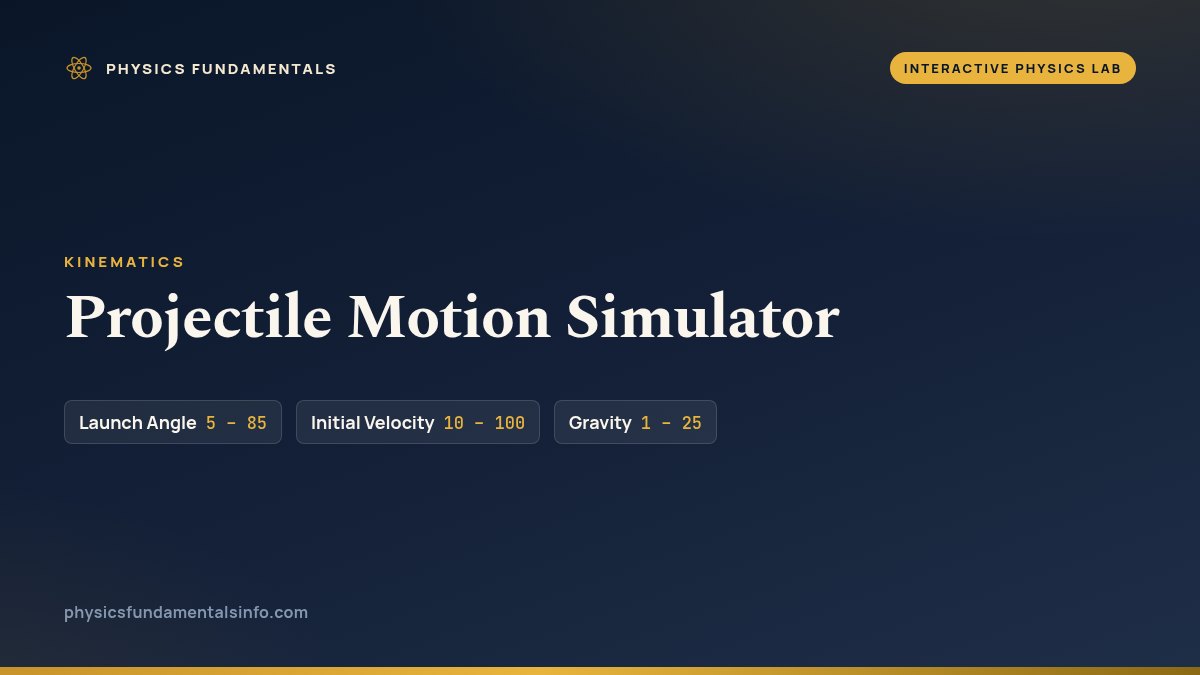
| Control | Range | Step |
|---|---|---|
| Launch Angle | 5 – 85 | — |
| Initial Velocity | 10 – 100 | — |
| Gravity | 1 – 25 | 0.1 |
How projectile motion works
A projectile is anything moving under gravity alone after it is launched — a thrown ball, a kicked football, a jet of water from a hose. The key to understanding it is that the motion splits into two independent parts. Horizontally, nothing pushes or pulls the object (ignoring air), so it keeps a constant horizontal velocity. Vertically, gravity pulls steadily downward, so the object slows on the way up, its vertical velocity briefly reaching zero at the peak — it is still moving horizontally there, and gravity keeps pulling at a full 9.8 m/s² — then it speeds up on the way down. The two motions happen at the same time but never interfere, which is the idea the whole topic is built on.
The simulator lets you set three things: the launch angle, the initial velocity and the strength of gravity. From them it finds the range with R = v²·sin(2θ) / g. Because sin(2θ) is largest when the angle is 45°, that angle gives the greatest range on flat ground; move above or below it and the range falls off symmetrically, so 30° and 60° land the same distance away. The maximum height is set by the vertical component of the launch velocity and by gravity — not by the horizontal component — and the flight time by how long gravity takes to bring the projectile back down.
Try this in the simulator
Set the angle to 45° for maximum range, then compare 30° and 60° and watch them land together. Push gravity up to Jupiter's 24.8 m/s² and every throw falls short. Real projectiles also meet air resistance, which this ideal model leaves out — that is why a badminton shuttlecock, dragged hard by the air, drops far shorter than the frictionless formula predicts, while a driven golf ball actually flies farther because backspin gives it lift. To crunch the numbers for any launch, use the projectile motion calculator, or explore more simulations in the interactive labs library.
Frequently asked questions
What is projectile motion?
Projectile motion is the motion of an object thrown or launched near the ground and then moving under gravity alone. It splits into two independent parts: a constant horizontal velocity, and a vertical motion that slows on the way up and speeds up on the way down under gravity. The two happen at once but never affect each other.
Why does a 45° launch give the maximum range?
On flat ground the range is R = v²·sin(2θ)/g, and sin(2θ) is largest when 2θ = 90°, i.e. θ = 45°. Above or below 45° the range falls off symmetrically, so a 30° and a 60° launch at the same speed land the same distance away.
Does a heavier projectile travel farther?
No. In the ideal model the trajectory does not depend on mass — gravity gives every object the same acceleration, so a heavy ball and a light ball launched identically follow the same path. Mass only matters once air resistance is included, which this simulator leaves out.
Why do real projectiles not match the formula?
The formula assumes no air resistance. Real objects meet drag: a badminton shuttlecock, with huge drag, falls far shorter than the frictionless prediction, while a spinning golf ball can fly farther because backspin gives it lift. The simulator shows the ideal, drag-free case.
References & formula source
- Halliday, Resnick & Walker — Fundamentals of Physics, Chapter 4 (Motion in Two and Three Dimensions).
- Young & Freedman — University Physics with Modern Physics, §3.3 (Projectile Motion).
- R. Nave — HyperPhysics, Georgia State University, "Trajectories" / projectile motion section.
- Further reading: Projectile motion — Wikipedia