A charge moving across a magnetic field feels a sideways force, F = qvB, that curves it into a circle. Drag the sliders below to change the charge, speed, field strength and mass, and watch the force and the circle's radius respond in real time.
Magnetic Field & the Lorentz Force
A charge fired across a uniform field (× = into the page) feels a force F = qvB that is always sideways — so it curves into a circle of radius r = mv/(qB). The force only ever turns the particle: its speed never changes.
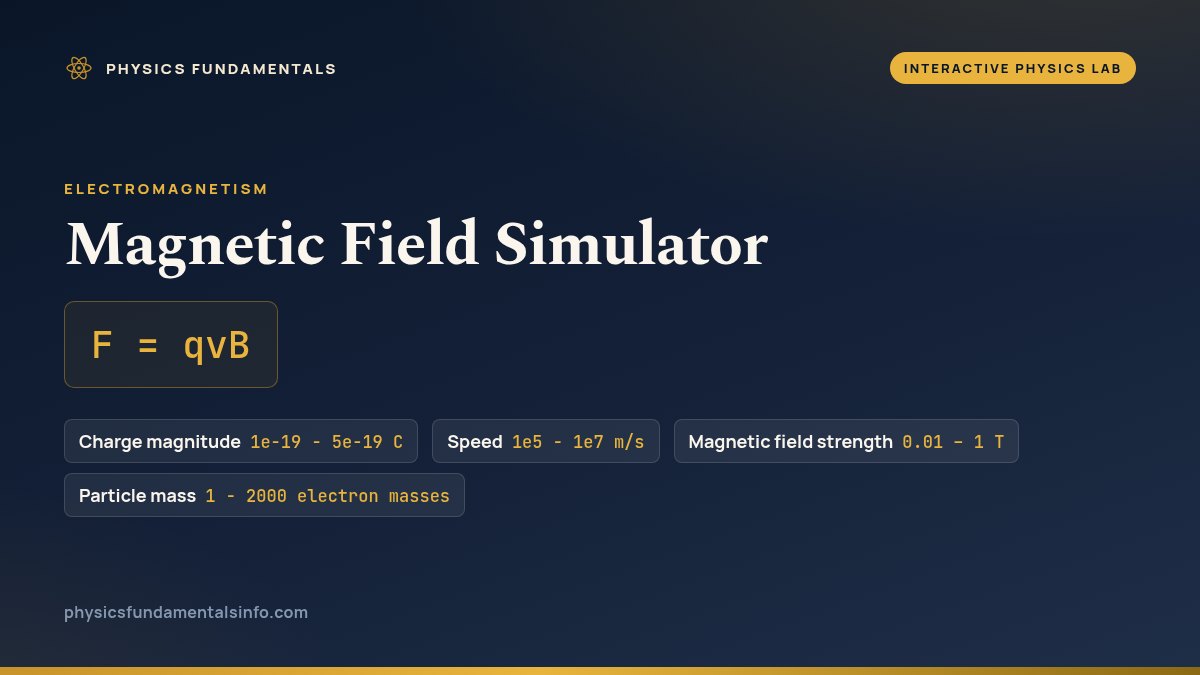
What Is the Magnetic Field Simulator?
The magnetic field simulator is a free interactive physics lab that runs in your browser — nothing to install and no sign-up. Change the charge, speed and field and watch a moving charge curve through F = qvB into a circle of radius r. It reports magnetic force, radius, Period and speed constant — set by you, unchanged by as you drag the sliders.
| Control | Range | Step |
|---|---|---|
| Charge magnitude | 1e-19 - 5e-19 C | — |
| Speed | 1e5 - 1e7 m/s | — |
| Magnetic field strength | 0.01 – 1 T | 0.01 |
| Particle mass | 1 - 2000 electron masses | — |
Watch F = qvB Turn a Charge Without Ever Speeding It Up
Some forces only steer. A magnetic force pushes a moving charge strictly to the side of wherever it is heading, so it can never add energy to the motion or drain any away — it can only bend the path. This sim makes that visible: fire a charged particle across a uniform field pointing into the page (drawn as ×) and watch it wheel around in a closed circle instead of flying straight.
Set the Charge, the Speed v, the Magnetic field strength B, and the Mass (in electron masses), then pick a particle. The force readout follows F = q·v·B: raise the charge, the speed, or the field and the sideways push grows. Because that push always aims perpendicular to the velocity, it does no work — the speed you set stays fixed while only the direction keeps rotating. Drop v to zero and the force vanishes entirely; a still charge feels nothing.
The radius readout r = m·v/(q·B) is where the shape lives. A heavier or faster particle sweeps a wider circle; a bigger charge or stronger field pulls a tighter one. That is the magnetic force serving as the centripetal force, since q·v·B = m·v²/r rearranges straight into that radius — the same physics that curves ions in a mass spectrometer. Put numbers to it with the magnetic field calculator, or bend more particles across our full set of physics simulators.
Frequently asked questions
What is the force on a charge moving through a magnetic field?
It is F = qvB when the velocity is perpendicular to the field, where q is the charge, v the speed and B the field strength. The force is always perpendicular to the motion.
Why doesn't a magnetic force change a particle's speed?
Because the force is always perpendicular to the velocity, it does no work — it can only change the direction of motion, not the speed. So the particle circles at a constant speed.
What sets the radius of the circle?
The radius is r = mv/(qB). A heavier or faster particle traces a wider circle; a larger charge or a stronger field makes a tighter one.
What happens if the charge is not moving?
Nothing — the magnetic force F = qvB is zero when v = 0. A charge has to be moving (and not straight along the field) to feel any magnetic force.
References & formula source
- Halliday, Resnick & Walker — Fundamentals of Physics, Chapter 28 (Magnetic Fields).
- Young & Freedman — University Physics with Modern Physics, §27.2–27.4 (Magnetic Force; Motion of Charged Particles).
- R. Nave — HyperPhysics, Georgia State University, "Magnetic Force" / Lorentz force section.
- Further reading: Magnetic field — Wikipedia