Density is mass per unit volume: ρ = m/V. Drag the sliders below to set an object's mass and volume (which fixes its density) and choose a fluid, then watch whether it floats or sinks and how deep it rides.
Density & Floatation Lab
Set the block’s mass and volume (that fixes its density), then choose the fluid. Watch whether it floats or sinks — and how deep it rides.
Floats when object density < fluid density. Submerged fraction = ρ / ρfluid.
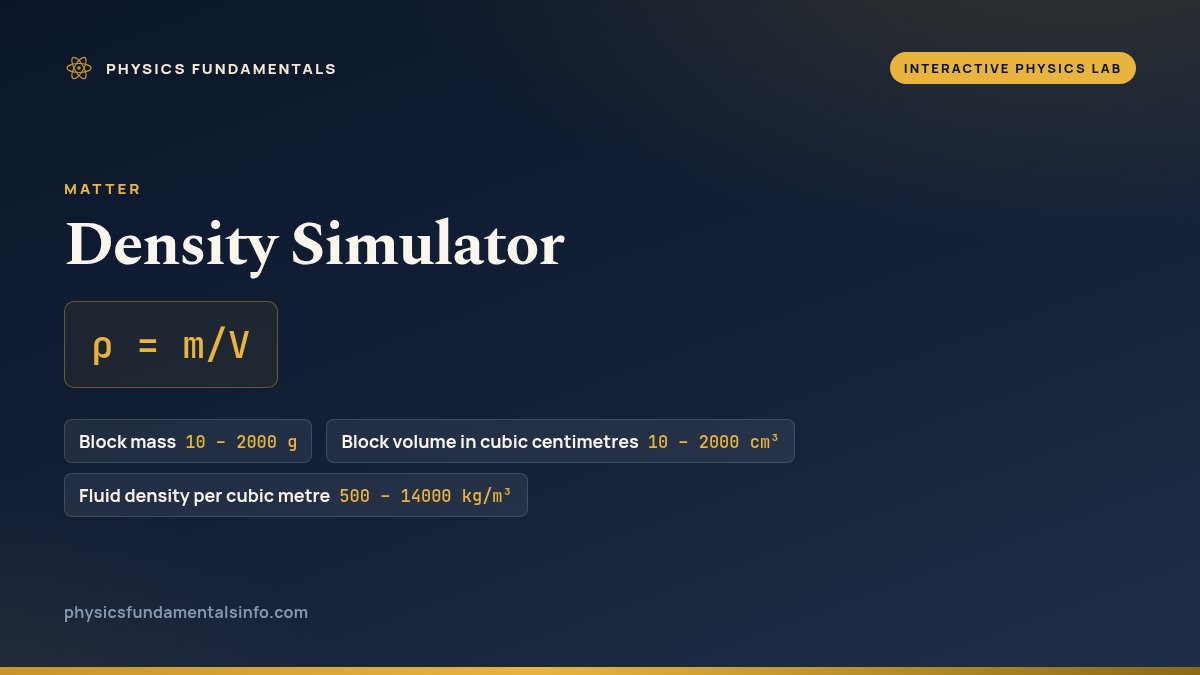
What Is the Density Simulator?
The density simulator is a free interactive physics lab that runs in your browser — nothing to install and no sign-up. Change an object's mass and volume and watch its density respond through ρ = m/V.
| Control | Range | Step |
|---|---|---|
| Block mass | 10 – 2000 g | 1 |
| Block volume in cubic centimetres | 10 – 2000 cm³ | 1 |
| Fluid density per cubic metre | 500 – 14000 kg/m³ | 10 |
What the Mass and Volume sliders reveal about density
Density is a ratio — the amount of mass packed into a given space, mass divided by the volume it fills, written ρ = m/V. What makes it worth its own simulator is that the amount never enters into it: density describes the material, not how much you happen to have. This sim lets you set that mass and volume directly. The Mass slider (in grams) and the Volume slider (in cubic centimetres) feed a single Object density readout, and that ratio is what the whole panel is built around.
Because it is a ratio, density is intensive. Halve the block and both mass and volume fall together, so their quotient holds steady — a chip and a slab of one material share a single value. Drag the sliders and the pattern separates cleanly: more mass at a fixed volume raises the density, while more volume at a fixed mass thins the same stuff out and lowers it. Mind the units, too — grams over cubic centimetres gives g/cm³, and 1 g/cm³ = 1000 kg/m³, so water reads 1.0 g/cm³ or 1000 kg/m³.
Float or sink is only the downstream consequence: an object floats when its density falls below the fluid's, and the submerged fraction settles at ρ_object / ρ_fluid. For the forces behind that outcome, step over to the buoyancy simulator. Check a number against the density calculator, or browse every experiment waiting on the physics labs shelf.
Frequently asked questions
What is density?
Density is how much mass is packed into a given volume, ρ = m/V. It is an intensive property of the material — a fixed value for a given substance, independent of how much of it you have.
Does a bigger object have a higher density?
No. Density is a ratio, so a large lump and a small chip of the same material have exactly the same density — halve the object and both its mass and volume halve, leaving the ratio unchanged. Size does not change density.
What decides whether something floats or sinks?
The comparison of densities. An object floats when its density is less than the fluid's and sinks when it is greater; if they are equal it hovers. A floating object rides with a fraction ρ_object / ρ_fluid of itself submerged.
How do you convert g/cm³ to kg/m³?
Multiply by 1000. Water, for example, is about 1 g/cm³, which is the same as 1000 kg/m³. Watch the units when comparing an object's density with a fluid's.
References & formula source
- Halliday, Resnick & Walker — Fundamentals of Physics, Chapter 14 (Fluids), density and Archimedes.
- Young & Freedman — University Physics with Modern Physics, §12.1 (Density).
- R. Nave — HyperPhysics, Georgia State University, "Density" section.
- Further reading: Density — Wikipedia