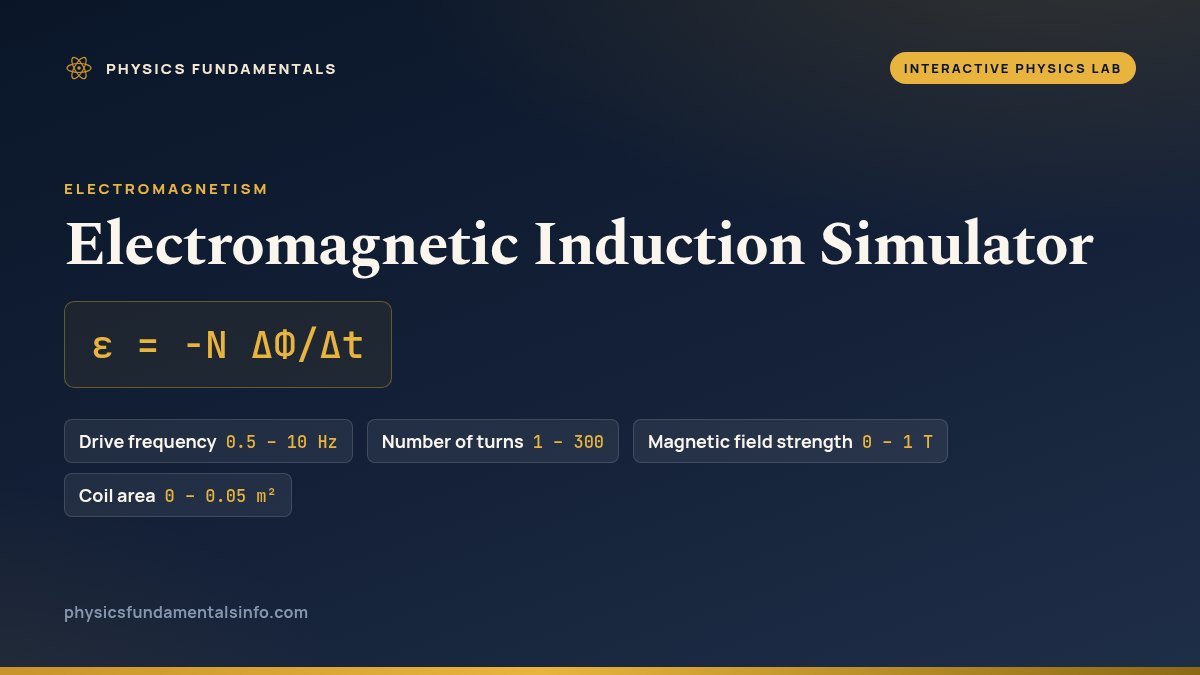
A magnet driven through a coil makes the flux rise and fall, and a changing flux induces a voltage. Drag the sliders below to set the drive frequency, turns, field and coil area, and watch Faraday's law ε = -N ΔΦ/Δt play out live.
Electromagnetic Induction
A magnet driven back and forth through a coil makes the flux rise and fall, and a changing flux induces a voltage: ε = -N(ΔΦ/Δt). Faster motion, more turns, a stronger field or a bigger coil all raise the EMF — and the current reverses on every return stroke (Lenz's law).
What Is the Electromagnetic Induction Simulator?
The electromagnetic induction simulator is a free interactive physics lab that runs in your browser — nothing to install and no sign-up. Change the coil turns, field, area and drive frequency and watch Faraday's law in action. It reports induced EMF ε, flux Φ and Current as you drag the sliders.
| Control | Range | Step |
|---|---|---|
| Drive frequency | 0.5 – 10 Hz | 0.5 |
| Number of turns | 1 – 300 | 1 |
| Magnetic field strength | 0 – 1 T | 0.05 |
| Coil area | 0 – 0.05 m² | 0.002 |
The Rate of Change, Not the Field Itself, Drives the EMF
Faraday's law is deceptively simple: ε = -N ΔΦ/Δt. The induced voltage depends on how fast the flux through the coil changes, never on how much flux is present at any instant. Push the Turns N slider from 1 toward 300 and the peak EMF climbs in direct proportion; the same happens as you raise Field B or Coil area A, since the per-turn flux is Φ = A·B·cos(φ). Crank the Drive frequency f and the effect is even sharper, because ω = 2πf multiplies the rate directly.
Watch the two traces and the deep misconception dissolves. Driving the coil sinusoidally gives ε = N·A·B·ω·sin(φ), with peak ε0 = N·A·B·ω. The EMF is largest exactly where the flux sweeps through zero — the moment it changes fastest — and the EMF collapses to zero when the flux reaches its maximum and momentarily stops changing. Peak flux and peak EMF sit a full 90 degrees out of phase, so the readouts never crest together.
The minus sign is Lenz's law: on every return stroke the induced current reverses to oppose the changing flux, which is why the Current I = ε/R trace flips sign against the fixed R = 10 Ω load. Pause and Reset to isolate each quarter-cycle, then take the ideas further with the Faraday's law calculator, explore what sets the field itself in the Magnetic Field Simulator, or browse the full collection of interactive physics labs.
Frequently asked questions
What is Faraday's law of electromagnetic induction?
Faraday's law states that the EMF induced in a coil equals the number of turns times how fast the magnetic flux through it changes. A faster-changing flux, more turns, a stronger field or a larger coil area all raise the induced EMF.
When is the induced EMF largest?
When the flux is changing fastest, which happens as it passes through zero — not when the flux itself is largest. The peak EMF and the peak flux are a quarter-cycle (90 degrees) apart.
What is Lenz's law?
The induced current always flows in the direction that opposes the change in flux that produced it. That opposition is the minus sign in Faraday's law and a direct consequence of energy conservation.
What increases the induced voltage in this simulator?
Raising the drive frequency, the number of turns, the magnetic field strength, or the coil area all increase the peak EMF, since the peak equals N times A times B times omega, with omega = 2 pi f.
References & formula source
- Halliday, Resnick & Walker — Fundamentals of Physics, Chapter 30 (Induction and Inductance).
- Young & Freedman — University Physics with Modern Physics, §29.1–29.3 (Faraday's Law; Lenz's Law).
- R. Nave — HyperPhysics, Georgia State University, "Faraday's Law" section.
- Further reading: Faraday's law of induction — Wikipedia