Heat moves three ways — conduction, convection and radiation — and only radiation crosses empty space. Drag the sliders below to change the temperatures, conductivity, thickness and emissivity, and compare the three transfer rates in real time.
Heat Transfer: Three Ways
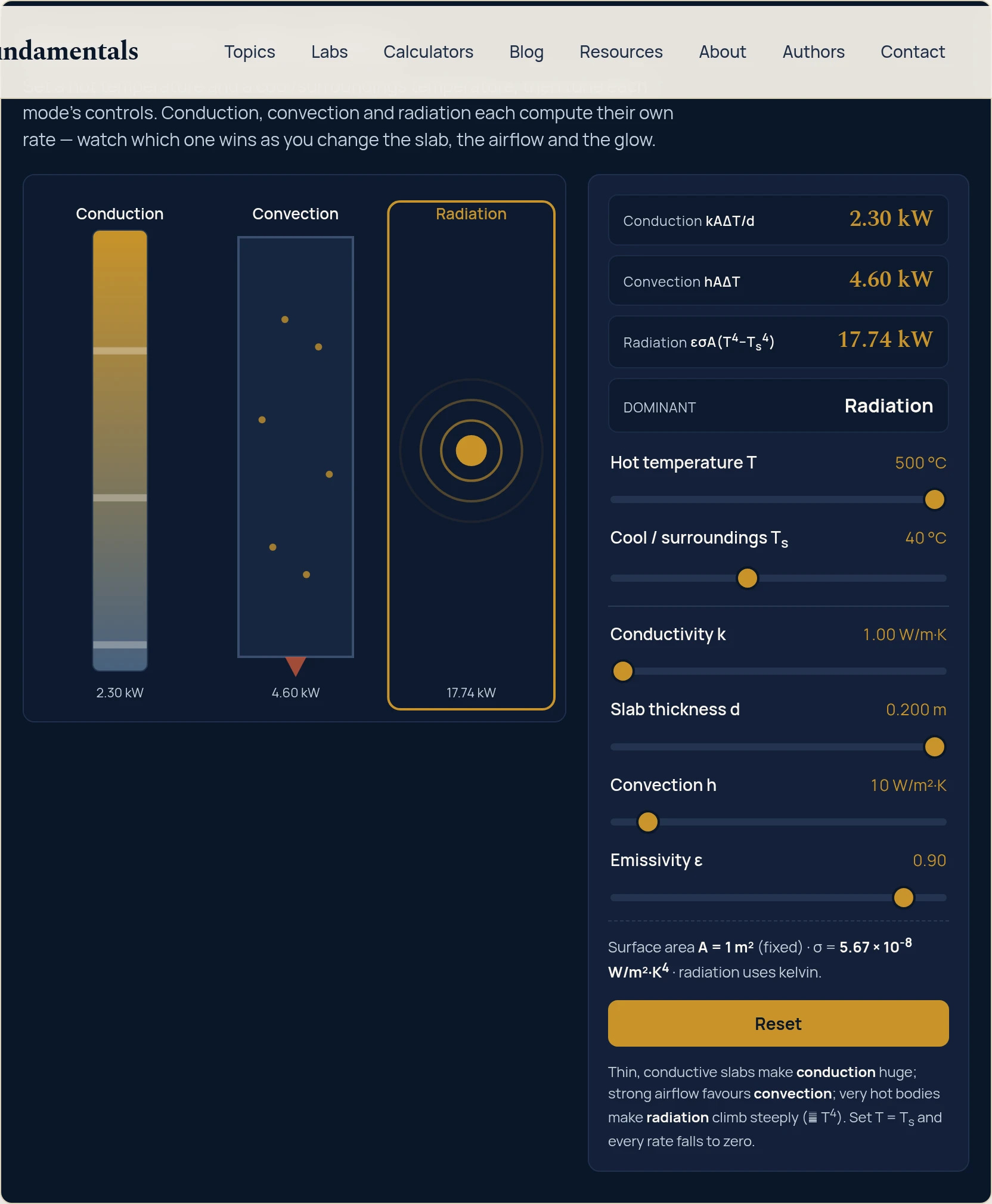
Set a hot temperature and a cool/surroundings temperature, then tune each mode's controls. Conduction, convection and radiation each compute their own rate — watch which one wins as you change the slab, the airflow and the glow.
Load a real surface
Each button sets all six sliders to a recognisable piece of hardware and lets the simulator work out the three rates. The confirmation line quotes the lab's own readouts, not a stored answer.
Pick a surface above, or drag the sliders yourself.
What Is the Heat Transfer Simulator?
The heat transfer simulator is a free interactive physics lab that runs in your browser — nothing to install and no sign-up. Change the temperatures, conductivity, thickness and emissivity and compare conduction, convection and radiation. It reports conduction kAΔT/d, convection hAΔT and radiation εσa as you drag the sliders.
| Control | Range | Step |
|---|---|---|
| Hot temperature Celsius | 50 – 500 °C | 1 |
| Cool or surroundings temperature Celsius | 0 – 100 °C | 1 |
| Thermal conductivity per metre kelvin | 0.02 – 400 W/m·K | 0.01 |
| Slab thickness | 0.001 – 0.20 m | 0.001 |
| Convective heat transfer coefficient per square metre kelvin | 2 – 100 W/m²·K | 1 |
| Emissivity | 0 – 1 | 0.01 |
How to use the heat transfer simulator
- Set the temperature difference. Hot temperature T runs from 50 to 500 °C and Cool / surroundings Ts from 0 to 100 °C. Every one of the three rates is driven by the gap between them, so this is the pair that moves all three readouts at once.
- Build the conduction path. Conductivity k (0.02 to 400 W/m·K) and Slab thickness d (1 mm to 200 mm) feed
Conduction k·A·ΔT/dand nothing else. Raising k or thinning the slab speeds conduction up; a thick, low-k slab is what the word insulation means. - Set the airflow. Convection h (2 to 100 W/m²·K) feeds
Convection h·A·ΔTalone. Leave it near 2 to 10 for still air, push it towards 100 for a fan. - Set the surface finish. Emissivity ε (0 to 1) scales
Radiation ε·σ·A·(T4 − Ts4). Nothing else on the page changes when you move it, which makes it the cleanest way to see how much of a hot surface's loss is radiant. - Read the winner. The three rate boxes update live and the Dominant line names whichever is largest; the artwork speeds up and brightens to match. Reset returns the lab to 200 °C, 20 °C, k = 50, d = 0.050 m, h = 25 and ε = 0.90.

Worked example: change one control at a time
Start from Reset and move a single slider per step. Every figure below is the string the simulator itself printed for those slider positions, read back out of the running lab rather than worked out on paper — if the table and the tool ever disagree, the tool is right.
| Step | Setting changed | Conduction | Convection | Radiation | Dominant |
|---|---|---|---|---|---|
| Start (Reset) | 200 °C, k = 50, d = 0.050 m | 180.00 kW | 4.50 kW | 2.18 kW | Conduction |
| Make the slab 4× thicker | d 0.050 → 0.200 m | 45.00 kW | 4.50 kW | 2.18 kW | Conduction |
| Swap steel for mineral wool | k 50 → 0.04 W/m·K | 36.0 W | 4.50 kW | 2.18 kW | Convection |
| Raise the hot face to 500 °C | T 200 → 500 °C | 96.0 W | 12.00 kW | 17.86 kW | Radiation |
| Polish the surface | ε 0.90 → 0.05 | 96.0 W | 12.00 kW | 992.1 W | Convection |
Read down the rows and the three routes sort themselves out. Row 1 to row 2: quadrupling the thickness divides conduction by exactly four, from 180.00 kW to 45.00 kW, while convection and radiation do not move at all — they are surface effects and have no idea how thick the wall behind them is. Row 2 to row 3: swapping steel for mineral wool at the same thickness takes conduction from 45.00 kW to 36.0 W, a factor of 1,250, and for the first time the Dominant readout stops saying Conduction. That single step is the entire argument for lagging. Row 3 to row 4: raising the hot face from 200 to 500 °C not quite triples the temperature difference, which duly not-quite-triples convection from 4.50 kW to 12.00 kW — but radiation goes from 2.18 kW to 17.86 kW, more than eight times, because it answers to the fourth power of absolute temperature rather than to the difference. Row 4 to row 5: the surface finish alone, ε from 0.90 to 0.05, drops radiation from 17.86 kW to 992.1 W and hands the lead back to convection. Same temperature, same wall, eighteen times less radiant loss.
Every readout is per square metre. The lab fixes the area at A = 1 m² and prints it under the sliders, which is what makes the three numbers directly comparable. Check it against row 1 if you like: k·A·ΔT/d with k = 50, ΔT = 180 K and d = 0.050 m gives 180 kW only if A is exactly 1 m².
Formula and symbol reference
Three independent equations run side by side in this lab, sharing only the area and the temperature difference. The ranges marked “in this lab” are the simulator's own displayed values at the ends of its slider travel.
| Symbol | Meaning | SI unit | Typical range |
|---|---|---|---|
| k | Thermal conductivity of the slab | watt per metre kelvin, W/m·K | 0.02 to 400 W/m·K in this lab. Mineral wool is about 0.04, firebrick 1, steel 50, aluminium 205, copper 400. |
| d | Slab thickness, measured along the heat path | metre, m | 0.001 to 0.200 m in this lab. |
| A | Heat-transfer area, fixed by the lab | square metre, m² | 1 m², not adjustable — the lab prints it under the sliders, so every readout is a rate per square metre. |
| T | Hot-face temperature (entered in °C, used in kelvin) | kelvin, K | 50 to 500 °C in this lab, which is 323 to 773 K. |
| Ts | Cool side / surroundings temperature | kelvin, K | 0 to 100 °C in this lab. |
| ΔT | Temperature difference driving every route, T − Ts | kelvin, K | 0 to 500 K in this lab. At ΔT = 0 all three readouts show 0.00 W. |
| h | Convective heat-transfer coefficient of the surface | watt per square metre kelvin, W/m²·K | 2 to 100 W/m²·K in this lab. Still air sits near the bottom of that band, a fan or a stiff wind near the top. |
| ε | Emissivity of the hot surface, 0 for a perfect mirror and 1 for a black body | dimensionless | 0 to 1 in this lab. Polished aluminium is around 0.05, oxidised steel 0.8, matt paint and brick around 0.9. |
| σ | Stefan-Boltzmann constant, fixed by the lab | W/m²·K4 | 5.67 × 10⁻⁸ W/m²·K4, not adjustable. |
| Conduction rate | Q/t = k·A·ΔT/d | watt, W | 5.00 W to 200.00 MW in this lab — a range of forty million, wider than the other two routes put together. |
| Convection rate | Q/t = h·A·ΔT | watt, W | 100.0 W to 50.00 kW in this lab. |
| Radiation rate | Q/t = ε·σ·A·(T4 − Ts4) | watt, W | 0.00 W to 19.94 kW in this lab, the maximum reached at ε = 1 with a 500 °C face and 0 °C surroundings. |
Three Routes for Heat, One That Needs Nothing
You feel heat travel three different ways, but only one of them can cross empty space. When you touch a warm mug, conduction carries energy through the solid ceramic, particle to particle. The sim reports that rate as kAΔT/d: a bigger thermal conductivity k, a wider area A, or a larger temperature gap ΔT all speed it up, while a thicker slab d slows it down. That is exactly why a fluffy jacket, thick and barely conductive, keeps you warm. Slide the Thermal conductivity and Slab thickness controls and watch the conduction readout swing.
Now let a fluid do the work. Convection moves heat by physically carrying warm material away, so its rate hAΔT climbs with the Convection coefficient h and the temperature difference. The third path abandons matter entirely. Radiation leaves every warm surface as electromagnetic waves at rate εσAT^4, where T is the absolute temperature in kelvin. That fourth power bites hard: double the absolute temperature and radiated power jumps sixteen-fold. Push the Hot temperature slider high and the radiation figure runs away from the others.
Only radiation needs no medium at all, which is how sunlight pours across the vacuum of space to warm the Earth. Test each mode yourself, then size a real wall with the thermal conduction calculator or branch into another hands-on experiment in the physics simulation collection.

Frequently asked questions
What are the three ways heat is transferred?
Conduction (through a solid, particle to particle), convection (carried by a moving fluid), and radiation (as electromagnetic waves). Only radiation can cross a vacuum.
What does the rate of conduction depend on?
On Q/t = k·A·ΔT/d — the thermal conductivity k, the area A, the temperature difference ΔT and the thickness d. Thicker or less conductive materials conduct more slowly, which is why they insulate.
Why does radiation matter so much at high temperature?
Radiated power follows Stefan's law, ε·σ·A·T^4, with T the absolute temperature. Because of the fourth power, doubling the absolute temperature raises the radiated power sixteen-fold.
How does heat from the Sun reach the Earth?
By radiation. Conduction and convection both need matter, but radiation travels as electromagnetic waves and crosses the vacuum of space, so sunlight can warm the Earth.
What area does the simulator assume?
One square metre, fixed, printed under the sliders. Every readout is therefore a rate per square metre of surface, which is what makes the three routes directly comparable: at the default settings the lab shows 180.00 kW of conduction against 4.50 kW of convection and 2.18 kW of radiation.
Which of the three routes wins?
It depends entirely on the settings, and the Dominant readout names the winner. Set a thin metal slab (k = 50 W/m·K, d = 0.005 m, 150 °C) and conduction runs away at 1.30 MW against 1.30 kW of convection. Insulate the same surface instead (k = 0.04 W/m·K, 50 mm, 60 °C) and conduction falls to 32.0 W, below both the 320.0 W of convection and the 251.8 W of radiation.
Why does turning the emissivity down help so much on a hot surface?
Because emissivity scales the radiated power directly. In the lab, a 500 °C surface radiating into 20 °C surroundings gives 17.86 kW at ε = 0.90; drop ε to 0.05 for a polished metal finish and the same surface radiates 992.1 W — eighteen times less, for no change in temperature at all.
What happens when the two temperatures are equal?
All three rates go to zero. Set the hot face and the surroundings to the same value and the lab prints 0.00 W for conduction, convection and radiation, and the Dominant readout shows a dash. Heat transfer needs a temperature difference; without one there is no net flow in either direction.
References & formula source
- Halliday, Resnick & Walker — Fundamentals of Physics, Chapter 18 (Heat Transfer Mechanisms).
- Young & Freedman — University Physics with Modern Physics, §17.7 (Mechanisms of Heat Transfer).
- R. Nave — HyperPhysics, Georgia State University, "Heat Transfer" section.
- Incropera & DeWitt — Fundamentals of Heat and Mass Transfer, Chapter 1 (conductivity, convection coefficient and emissivity tables).
- Further reading: Heat transfer — Wikipedia