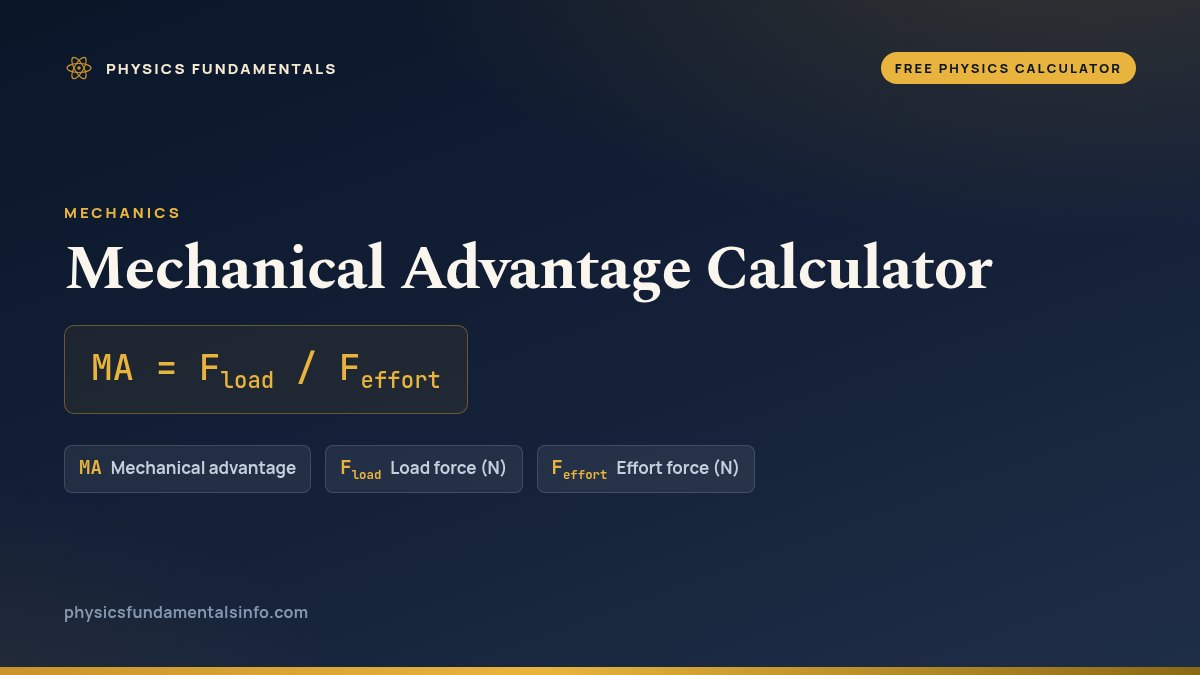
Mechanical advantage measures how much a simple machine multiplies your force. The actual value is the load force divided by the effort force, MA = Fload/Feffort; the ideal value comes from the geometry, IMA = deffort/dload; and their ratio is the efficiency. This free calculator solves for any of them, in any unit, with every step shown.
What Is the Mechanical Advantage Calculator?
The mechanical advantage calculator is a free online tool built on the formula MA = Fload / Feffort. Enter the values you already know, in whichever units suit you, and it solves for MA, load force, effort force, IMA, or efficiency and shows every step of the substitution. Mechanical Advantage is the force-for-distance trade of a lever, pulley or ramp — MA, IMA and efficiency.
| Symbol | Quantity | Default unit | Also accepts | Example value |
|---|---|---|---|---|
| MA | Mechanical advantage | — | — | 3.27 |
| Fload | Load force | N | kN | 4905 |
| Feffort | Effort force | N | kN | 1500 |
How to calculate mechanical advantage
Every simple machine — a lever, a pulley system, a ramp, a screw, a wheel and axle — makes a job easier by trading force for distance. Push with a smaller force, but over a longer path, and the same amount of work moves the load. Mechanical advantage is the number that captures the deal: how many times larger the output (load) force is than the input (effort) force.
There are two versions worth keeping apart. The actual mechanical advantage is the real force ratio, MA = Fload / Feffort. The ideal mechanical advantage is fixed by geometry alone and ignores friction, IMA = deffort / dload — the distance the effort moves divided by the distance the load moves. Because real machines waste some input work to friction, the actual value is always the smaller of the two, and dividing one by the other gives the machine's efficiency: efficiency = AMA / IMA, a fraction between 0 and 1.
Pick the mode that matches what you know. Use Force ratio to move between MA, load force and effort force; Distance ratio to get the ideal mechanical advantage from the effort and load distances; and Efficiency to relate the actual and ideal figures. In each mode the “Solve for” menu chooses the unknown and the rest become inputs.
Friction is the reason efficiency is never 100%. To see where it comes from, try the friction calculator; to work with the input and output work and power directly, or the torque that balances a lever, follow the related tools below, or look up a term in the physics glossary.
Worked example
Start with the geometry. A lever moves its effort 6.00 m while the load rises 1.50 m, so the ideal mechanical advantage is IMA = deffort/dload = 6.00 / 1.50 = 4.00. Now measure the forces: a 4905 N load is lifted by a 1500 N effort, giving an actual mechanical advantage of MA = Fload/Feffort = 4905 / 1500 = 3.27. The machine's efficiency is the ratio of the two, efficiency = AMA / IMA = 3.27 / 4.00 = 0.8175, or about 81.8% — the missing 18% is lost to friction.
Why it matters
Mechanical advantage is the design language of every tool that multiplies force: bottle jacks and hydraulic lifts, gear trains and bicycle drivetrains, block-and-tackle rigging, wrenches and bolt cutters, ramps and loading docks, even the levers of the human skeleton. Knowing the ideal ratio tells you the best you could do; comparing it with the actual ratio tells you how much friction is costing you.
Frequently asked questions
What units does mechanical advantage have?
None — mechanical advantage is a pure ratio. Actual mechanical advantage (MA) is load force divided by effort force, and ideal mechanical advantage (IMA) is effort distance divided by load distance; in both cases the units cancel, leaving a dimensionless number. Efficiency, being one ratio divided by another, is also dimensionless and is usually written as a fraction or a percentage.
What is the difference between ideal and actual mechanical advantage?
Ideal mechanical advantage (IMA) is set purely by the geometry of the machine — the ratio of the distances the effort and load move — and assumes no friction. Actual mechanical advantage (AMA or MA) is the real force ratio you measure, load force over effort force, and is always smaller than the IMA because friction wastes some of the input work. Their ratio is the efficiency: efficiency = AMA / IMA.
Can mechanical advantage be less than 1?
Yes. A mechanical advantage below 1 means the effort force is larger than the load force — you trade force for extra speed or distance instead of gaining force. A class-3 lever, such as a fishing rod, tweezers or the human forearm, works this way: the effort is applied between the fulcrum and the load, giving an IMA less than 1 but moving the load a greater distance.
How do I solve for the effort force if I know MA and the load?
Rearrange MA = F_load / F_effort to F_effort = F_load / MA. In this calculator, choose the “Force ratio” mode and set the “Solve for” menu to effort force, then enter the load force and the mechanical advantage. For example, a 4905 N load with a mechanical advantage of 3.27 needs an effort of 4905 / 3.27 ≈ 1500 N.
Why does my calculated efficiency come out above 100%?
A passive simple machine can never output more work than it takes in, so a genuine efficiency above 100% is impossible — the calculator rejects it. It almost always means the actual and ideal mechanical advantages have been swapped: efficiency is AMA / IMA (actual over ideal), and the actual value is the smaller of the two. Enter the ideal (geometric) figure as IMA and the measured force ratio as AMA.
References & formula source
- Halliday, Resnick & Walker — Fundamentals of Physics, chapters on work & kinetic energy and on rotation and torque.
- Young & Freedman — University Physics, chapter on equilibrium and elasticity (static equilibrium and torque).
- R. Nave — HyperPhysics, Georgia State University, "Simple Machines" section.
- Further reading: Mechanical advantage — Wikipedia