A balance beam is in equilibrium when the turning effects cancel: m1·d1 = m2·d2. Drag the sliders below to set each side's mass and its distance from the pivot, and watch the two moments decide whether the beam balances or tips.
Equilibrium & the Balance Beam
A beam is in balance when the turning effects cancel: τ = F·d = m·g·d on each side must be equal (Στ = 0). Drag the masses (or use the sliders) — bigger mass or longer arm means more torque and the beam tips that way.
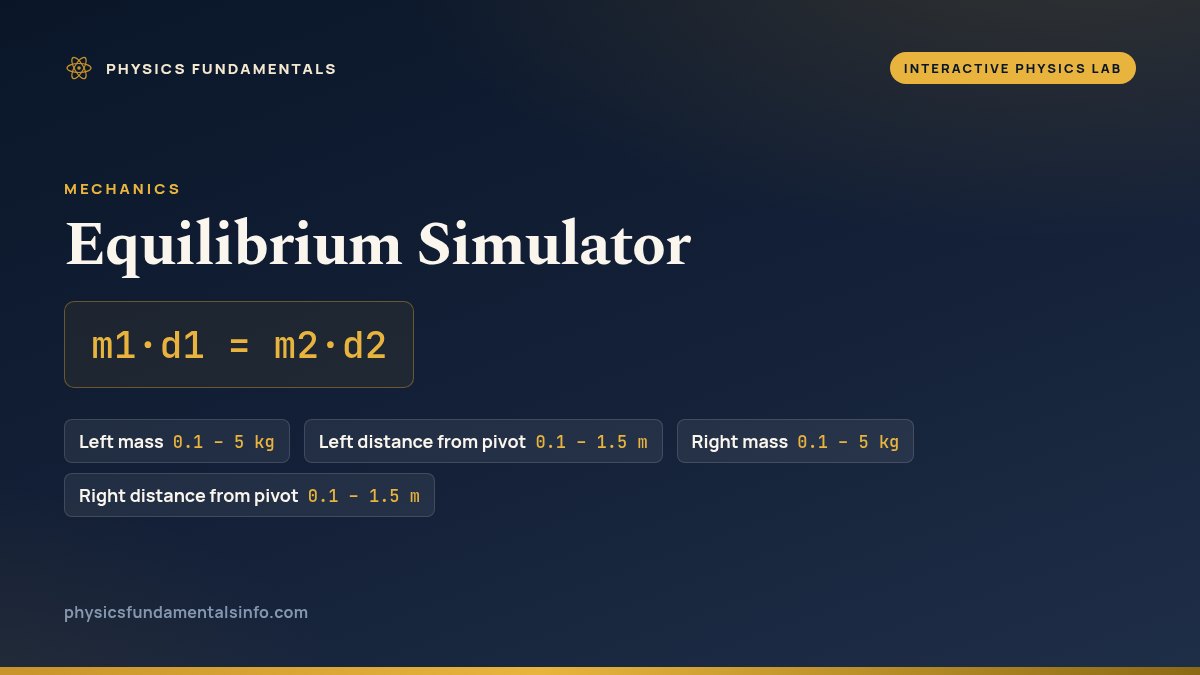
What Is the Equilibrium Simulator?
The equilibrium simulator is a free interactive physics lab that runs in your browser — nothing to install and no sign-up. Change the masses and their distances on a balance beam and watch the principle of moments balance the beam. It reports Status, Left torque τ1, Right torque τ2, Net torque Στ and Support force as you drag the sliders.
| Control | Range | Step |
|---|---|---|
| Left mass | 0.1 – 5 kg | 0.1 |
| Left distance from pivot | 0.1 – 1.5 m | 0.1 |
| Right mass | 0.1 – 5 kg | 0.1 |
| Right distance from pivot | 0.1 – 1.5 m | 0.1 |
Why a Small Mass Far Out Can Balance a Big One
A light weight sitting far out on the beam can balance a heavy weight parked close to the pivot, and that surprises most people. The reason is that balance never depends on mass alone. What counts is the moment each side produces — the force times its perpendicular distance from the pivot. Because weight is mass times gravity, each side's turning effect is m·g·d. Distance pulls its full weight in that product, so a modest mass with a long lever arm competes directly with a bulky mass sitting near the middle.
Slide the four controls and watch the two moment readouts. The beam settles when the clockwise and anticlockwise moments cancel: m1·g·d1 = m2·g·d2. Since g is identical on both ends, it drops straight out, leaving the clean rule m1·d1 = m2·d2. Tip either product higher than the other and the status flips to tipping; match them and it reads balanced. Starting from a balanced beam, double the Left mass and you must halve the Left distance from pivot to bring it level again.
Full equilibrium asks for two things at once: the net force must be zero and the net moment about the pivot must be zero. On this beam the pivot's support already supplies whatever upward force is needed, so your whole job is matching the two moments. Push the idea further with the torque calculator, or line up your next build at the full simulation shelf.
Where the ideal balance beam breaks down
The first thing this model quietly hands you is a beam that never interferes. Its 1 kg is real enough to appear in the support force — 58.9 N at the default settings, rather than the 49.1 N the two loads alone would need — but because it is pivoted exactly at its own centre it contributes no moment whatsoever. Real beams rarely oblige. Pivot a metre rule at the 40 cm mark and its own weight acts 10 cm out, adding a moment before you load anything onto it. That term is what turns a school balance-beam experiment from arithmetic into a measurement.
BALANCED is a tolerance, not an identity. Set the left side to 1.0 kg at 1.0 m and the right to 0.9 kg at 1.1 m: the torques read 9.8 and 9.7 N·m, the net torque shows −0.10 N·m, and the status still says BALANCED. The sim calls anything under a tenth of a newton-metre level because a real beam does too. Pivot friction, draughts and the knife edge's finite width give every physical balance a threshold below which it will not move: tiny for an analytical balance, enormous for a playground see-saw.
The loads are points, and they stay put. A real hanging load swings, changing its perpendicular distance as it goes, and a child on a see-saw shifts their centre of mass every time they lean.
And balanced is not the same as stable. The moment condition says the beam will not start turning; it says nothing about what happens after a nudge. That depends on where the pivot sits relative to the combined centre of mass: below it, the smallest disturbance runs away, which is why a tightrope walker's pole is heavy and drooping. Above it, the beam returns on its own. This simulator only ever answers the first question.
Where this is actually used
Because g stands on both sides of m1·g·d1 = m2·g·d2 it cancels, and that is why the two-pan beam balance outlived every rival. Balance the default setup, 2.0 kg at 1.2 m against 3.0 kg at 0.8 m, and both torques read 23.5 N·m. Take the apparatus to the Moon, where gravity is about a sixth of Earth's, and both torques shrink by the same sixth: the beam stays level. A beam balance compares masses. A spring scale weighs.
A tower crane is this beam with a mast under the pivot. Set the left mass to 5.0 kg at 0.4 m and the right to 2.0 kg at 1.0 m: both torques read 19.6 N·m and it balances — a heavy counterweight held close in against a lighter load reaching far out. That constant product is a crane's entire load chart. A machine rated to lift 8 tonnes at 10 m radius handles only about 2 tonnes at 40 m, because what it can resist is a moment, not a mass. Real charts fall away faster still, for the reason above: the jib has weight of its own.
Your forearm runs the same sum backwards, and loses. Set the left side to 5.0 kg at 0.2 m against 1.0 kg at 1.0 m: both torques read 9.8 N·m, so a five-to-one distance ratio buys a five-to-one force advantage. The biceps attaches roughly 5 cm from the elbow while a held object sits about 30 cm out, putting that ratio the wrong way round, near six to one. Hold a 5 kg dumbbell, a weight of some 49 N, and the biceps must pull with around 300 N. Skeletal levers trade force away for speed and reach.
Frequently asked questions
What is the principle of moments?
A pivoted beam balances when the total clockwise moment equals the total anticlockwise moment: m1·d1 = m2·d2 (the g's cancel). A moment is a force times its perpendicular distance from the pivot.
How can a small mass balance a bigger one?
By sitting further from the pivot. Balance depends on the product mass × distance, not on mass alone, so a small mass far out can match a large mass close in.
What are the conditions for equilibrium?
Two must hold at once: the net force is zero, and the net moment (torque) about any point is zero. On a balance beam that reduces to matching the two moments.
If I double a mass, what keeps the beam balanced?
Halve its distance from the pivot (or double the moment on the other side). The product mass × distance must stay equal on both sides.
Why doesn't the support force change when I slide a mass along the beam?
Because the two conditions for equilibrium are independent. The support force answers 'net force = 0', so it only carries the total weight: at the default setting it reads 58.9 N — the 2.0 kg and 3.0 kg loads plus the 1.0 kg beam. Slide the left mass in from 1.2 m to 0.4 m and the beam tips right, yet the support force still reads 58.9 N. Distance enters only the second condition, 'net moment = 0'.
References & formula source
- Halliday, Resnick & Walker — Fundamentals of Physics, Chapter 12 (Equilibrium and Elasticity).
- Young & Freedman — University Physics with Modern Physics, §11.1–11.2 (Conditions for Equilibrium; Torque).
- R. Nave — HyperPhysics, Georgia State University, "Torque and Rotational Equilibrium" section.
- Further reading: Mechanical equilibrium — Wikipedia