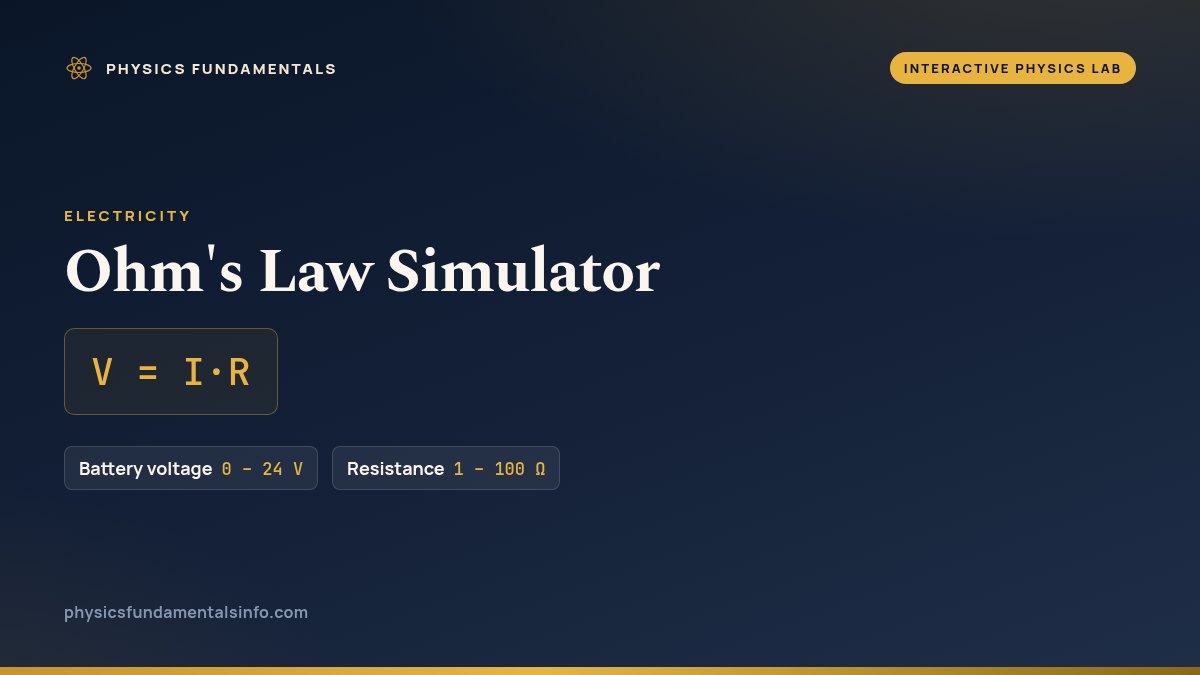
Ohm's law links the voltage across a resistor, the current through it and its resistance: V = I·R. Drag the sliders below to change the voltage and the resistance, and watch the current in the loop respond in real time.
Ohm’s Law Lab
Adjust the voltage and resistance, then watch how the current and dissipated power respond.
What Is the Ohm's Law Simulator?
The Ohm's law simulator is a free interactive physics lab that runs in your browser — nothing to install and no sign-up. Change the voltage and resistance and watch the current respond through V = I·R, with the ohmic physics explained.
| Control | Range | Step |
|---|---|---|
| Battery voltage | 0 – 24 V | 0.5 |
| Resistance | 1 – 100 Ω | 1 |
Ohm's Law: Voltage, Current, and Resistance
Connect a battery across a single resistor with a couple of wires, and a steady current settles into the loop within an instant. Three quantities describe what is happening: the voltage the battery supplies, the current pushed through the resistor, and the resistance that opposes that current. Ohm's law ties them together in one compact statement, V = I·R, which rearranges to I = V/R and R = V/I depending on which quantity you want to find.
Here is the crucial point for a metal resistor held at constant temperature — an ohmic conductor. Its resistance is a fixed property, set by the material, its length and thickness, and its temperature; it does not change when you alter the voltage. So double the voltage and you exactly double the current, because the ratio V/I stays put — and that constant ratio simply is the resistance. Plot voltage against current and you get a straight line through the origin whose slope is R. Contrast that with a filament lamp: as more current heats the wire, its resistance rises, so its V–I graph bends into a curve rather than a straight line. The lamp is the classic non-ohmic exception.
Explore it directly below. Raise the Voltage slider and watch the current climb in step; nudge the Resistance slider and see the same voltage push a smaller current through a stiffer resistor. For worked numbers, try the Ohm's law calculator, or browse more experiments in the interactive labs library.
Frequently asked questions
What is Ohm's law?
Ohm's law states V = I·R: the voltage across a resistor equals the current through it times its resistance. It rearranges to I = V/R and R = V/I, so knowing any two of the three quantities gives the third.
Does resistance change when you increase the voltage?
Not for an ohmic conductor such as a metal at constant temperature. Its resistance is a fixed property of the material and its dimensions, so doubling the voltage simply doubles the current and the ratio V/I — the resistance — stays the same.
What does the slope of a voltage-current graph tell you?
For an ohmic resistor, plotting voltage against current gives a straight line through the origin whose slope is the resistance R. A curved V–I graph means the resistance is not constant.
What is a non-ohmic conductor?
One that does not keep a constant resistance, so it disobeys the straight-line form of Ohm's law. A filament lamp is the classic example: as current heats the wire its resistance rises, so its voltage-current graph bends into a curve instead of a straight line.
References & formula source
- Halliday, Resnick & Walker — Fundamentals of Physics, Chapter 26 (Current and Resistance).
- Young & Freedman — University Physics with Modern Physics, §25.2–25.3 (Resistivity and Ohm's Law).
- R. Nave — HyperPhysics, Georgia State University, "Ohm's Law" section.
- Further reading: Ohm's law — Wikipedia