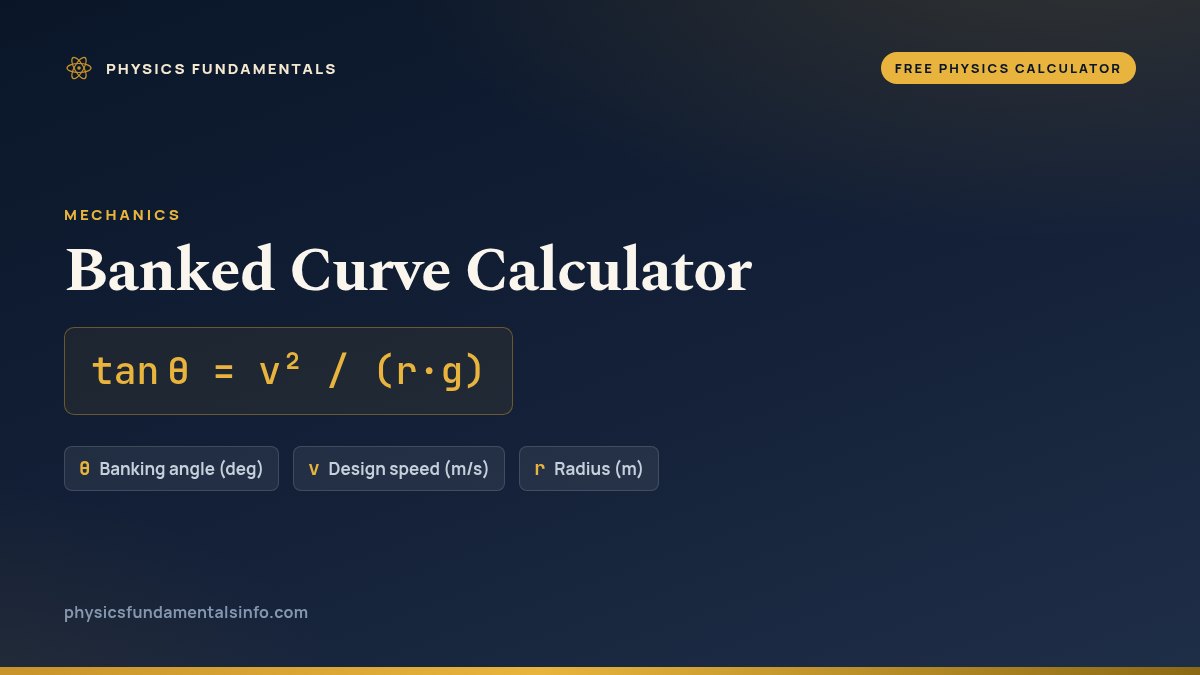
Banked curve: a tilted bend designed so that the road’s normal force supplies the centripetal force. The ideal banking angle satisfies tan θ = v² / (r·g). This free calculator solves for the banking angle, the design speed or the radius — in any unit — and shows every step of the working.
What Is the Banked Curve Calculator?
The banked curve calculator is a free online tool built on the formula tan θ = v² / (r·g). Enter the values you already know, in whichever units suit you, and it solves for banking angle, speed or radius and shows every step of the substitution. Banked Curve is ideal banking angle or speed for a curve.
| Symbol | Quantity | Default unit | Also accepts | Example value |
|---|---|---|---|---|
| θ | Banking angle | deg | — | 18 |
| v | Design speed | m/s | km/h, mph | 25 |
| r | Radius | m | km | 80 |
How to calculate a banked curve
A banked curve is a bend in a road or track that is tilted inward so a vehicle can turn without relying on friction. When the curve is tilted at the right angle, the normal force from the surface leans towards the centre of the circle, and its horizontal component provides exactly the centripetal force needed to keep the vehicle on its path. Setting that horizontal component equal to the required centripetal force mv²/r and the vertical component equal to the weight mg gives the ideal-banking equation tan θ = v² / (r·g).
There are three steps. First, decide which quantity you want — the banking angle θ, the design speed v, or the radius r — and select it in the calculator’s Solve for menu. Second, enter the two values you already know and pick their units; speed can be in m/s, km/h or mph, and radius in metres or kilometres, with everything converted to SI base units behind the scenes. Third, read the answer alongside the worked steps, which show the formula, your numbers substituted in, and the final value with its units.
The equation rearranges to suit each case. To find the speed a given bank is built for, use v = sqrt(r·g·tan θ). To find the radius that matches a chosen angle and speed, use r = v² / (g·tan θ). Notice that the mass of the vehicle never appears — it cancels out — so the same angle works for a motorbike and a loaded lorry at the same speed and radius.
The model assumes a frictionless, ideally banked curve, which is the standard textbook case and the basis of road and racetrack design. Real surfaces add friction, which widens the safe speed range either side of the design speed. The inward force itself can be explored with the centripetal force calculator, and the broader relationship between speed, radius and period is covered by the circular motion calculator.
Worked example
A motorway slip-road has a radius of 80 m and is built for a design speed of 25 m/s (90 km/h). The ideal banking angle is θ = atan( v² / (r·g) ) = atan( 25² / (80 × 9.80665) ) = atan(0.7967) ≈ 38.5°. Checking the other direction, a curve banked at 38.5° with that 80 m radius gives a design speed of v = sqrt(80 × 9.80665 × tan 38.5°) ≈ 25 m/s — the same number, confirming the rearrangement.
Why banked curves matter
Banking lets vehicles corner faster and more safely without depending on tyre grip, which is why it appears on motorway interchanges, high-speed rail, velodromes and oval racetracks. The same physics governs aircraft turns, where the bank angle tilts the lift to turn the plane.
Frequently asked questions
What is the formula for a banked curve?
For a frictionless (ideally banked) curve the relationship is tan θ = v² / (r·g), where θ is the banking angle, v is the design speed, r is the radius of the bend and g = 9.80665 m/s² is the acceleration due to gravity. Rearranging gives v = sqrt(r·g·tan θ) and r = v² / (g·tan θ).
Why are roads and racetracks banked?
Banking tilts the road inwards so that a component of the normal force points towards the centre of the curve. That horizontal component supplies the centripetal force needed to turn, so a vehicle at the design speed can corner without relying on side friction between the tyres and the road. This is safer in the wet and reduces tyre wear.
Does the banking angle depend on the mass of the vehicle?
No. The mass cancels out of the equation, because both the gravitational force and the required centripetal force are proportional to mass. tan θ = v² / (r·g) contains only the design speed, the radius and g, so a car and a heavy truck need the same ideal banking angle at the same speed and radius.
What happens if I drive faster or slower than the design speed?
The banking angle is correct for only one speed. Below the design speed, friction must act up the slope to stop the vehicle sliding down; above it, friction acts down the slope to stop the vehicle sliding outwards. With no friction at all, only the exact design speed v = sqrt(r·g·tan θ) keeps the vehicle on its circular path.
What units does this calculator use?
Internally everything is converted to SI base units — metres for radius and metres per second for speed — and the banking angle is given in degrees. You can enter speed in m/s, km/h or mph and radius in metres or kilometres, and the calculator handles the conversions for you.
References & formula source
- Halliday, Resnick & Walker — Fundamentals of Physics, Chapter 6 (Force and Motion II: circular motion and banked curves).
- Young & Freedman — University Physics with Modern Physics, §5.4 (Dynamics of Circular Motion).
- BIPM — The International System of Units (SI): the standard acceleration of gravity g = 9.80665 m/s².
- Further reading: Banked turn — Wikipedia