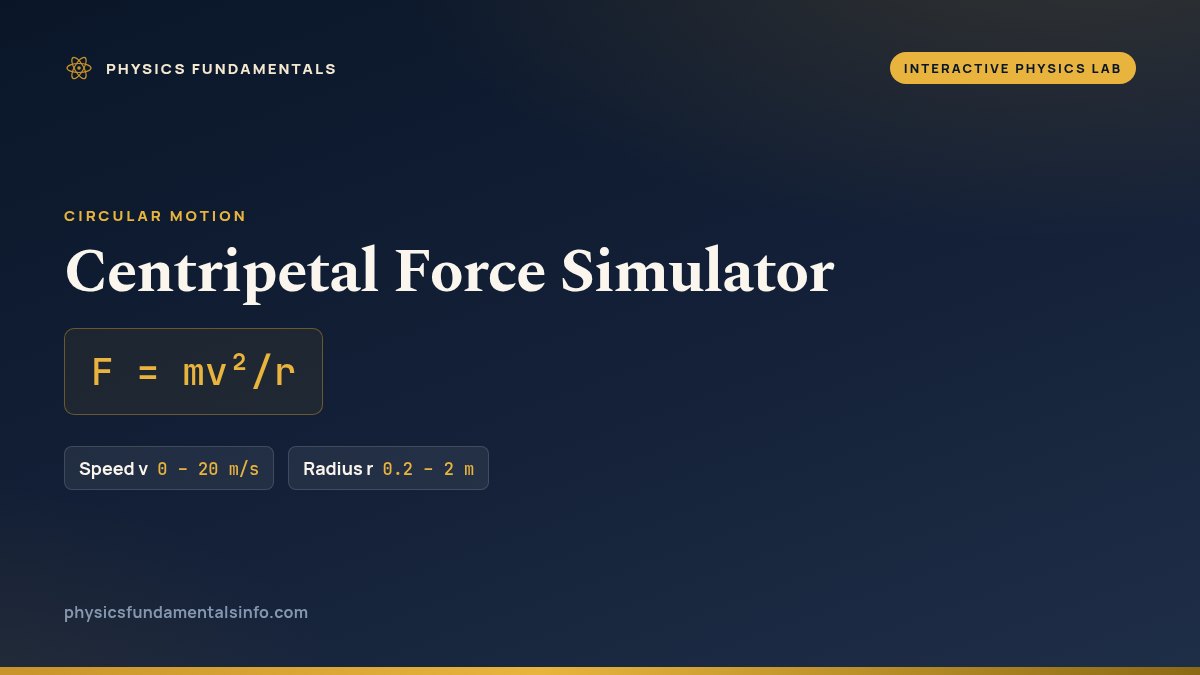
Centripetal force is the net inward force that holds an object on a circular path: F = mv²/r. Drag the sliders below to change the speed and the radius (the mass is fixed), and watch the centripetal force, acceleration, angular velocity and period respond in real time.
Centripetal Force Lab
What Is the Centripetal Force Simulator?
The centripetal force simulator is a free interactive physics lab that runs in your browser — nothing to install and no sign-up. Change the speed and radius and watch the centripetal force, acceleration and period respond through F = mv²/r.
| Control | Range | Step |
|---|---|---|
| Speed v | 0 – 20 m/s | 0.1 |
| Radius r | 0.2 – 2 m | 0.05 |
Constant Speed, Yet Always Turning: The Inward Force at Work
An object can travel at perfectly constant speed and still accelerate every instant, because acceleration tracks any change in velocity — and velocity is a direction as much as a number. This simulation makes that idea visible on screen. Drag Speed v and Radius r while the fixed 0.20 kg mass holds steady, and watch the centripetal force F, acceleration a, angular velocity ω, and period T update together as the object rounds its circular path.
Push Speed v higher and F climbs steeply, because F = mv²/r: double v and the inward force quadruples, since v² carries the weight. Radius r pulls the other way — with F proportional to 1/r, doubling r halves the force needed to hold the turn. Every reading obeys the same geometry: a = v²/r sizes the inward pull per kilogram, ω = v/r counts how fast the angle sweeps, and T = 2πr/v times one lap.
The arrow always aims inward, square to the motion, so it bends the velocity without ever speeding the object up. There is no outward force on the object — the "centrifugal" shove you feel is only inertia resisting the turn. Cut the string mid-circle and the object leaves along the tangent, a straight line, not radially outward, exactly as a car slides wide when friction cannot supply mv²/r. Check any turn against the centripetal force calculator, then send another object around the track in our other hands-on simulators.
Where the ideal centripetal force model breaks down
The simulation draws a flat circle with nothing pulling the mass down, and no real experiment gives you that. Whirl the 0.20 kg mass on a string and its weight, 0.20 × 9.81 = 1.96 N, must be carried by something, and the only candidate is the string — so the string cones below the horizontal until its vertical component matches that weight. The default readout, F = 6.40 N, is exactly the horizontal inward part. The string itself is pulling √(6.40² + 1.96²) = 6.69 N along its own length, 4.6% more, at about 17° below horizontal.
Nothing in F = mv²/r knows what supplies the force, so the sim prints whatever you ask of it. Push v to 20.0 m/s and r down to 0.20 m and it reads 400.0 N at 2000 m/s². No hand holds 400 N on a light line, and kite string parts well before it. When the supplier runs out — the string snaps, the tyre saturates — the object does not spiral gently outward; it leaves along the tangent, which is what the Release button shows. The equation says what is required, never that anything can deliver it.
Uniform circular motion also assumes the speed never changes, and left alone it always does. Air drag acts backwards along the path, and because F depends on v² the requirement collapses faster than the speed: lose a tenth of the speed and the force needed falls to 81%. The sim shows that steepness directly — drop v from 8.0 to 4.0 m/s at r = 0.50 m and F falls from 25.60 N to 6.40 N, a factor of four for a factor of two.
This circle is uniform in another sense too: one speed everywhere. Tip it into a vertical plane, like a bucket of water or a loop-the-loop, and gravity gains a component along the motion, so the object speeds up coming down and slows going up. F = mv²/r still holds instant by instant, but v differs at every instant, and the string is slackest at the top, where tension supplies only mv²/r − mg. Below v = √(gr) — 2.2 m/s at this lab's default 0.50 m radius — the string goes limp there and the circle breaks.
Where this is actually used
A washing machine's spin cycle works by deliberately withholding the force. A 0.25 m drum at 1,400 rpm turns at ω = 147 rad/s, pressing the clothes inward at ω²r ≈ 5,400 m/s², about 550 times g. The fabric gets that push from a solid wall; the water in it, the moment it reaches a perforation, gets nothing — no wall, no force — so it does what the Release button does and carries straight on out. Spin-drying is centripetal force applied to the cloth and denied to the water.
A benchtop centrifuge pushes the same trick harder. At 4,000 rpm on a 0.10 m rotor the angular velocity reaches 419 rad/s and the acceleration about 17,500 m/s², roughly 1,800 times g — enough to settle blood cells out of plasma in minutes. For scale, this lab's fastest setting (v = 20.0 m/s, r = 0.20 m) reads ω = 100.0 rad/s, about 955 rpm, at 2000 m/s². The centrifuge turns only four times faster yet pulls nearly nine times the acceleration, because a = ω²r squares the rotation rate.
Road design uses the same equation with the mass stripped out: a = v²/r never mentions mass, so one number describes a 0.20 kg ball and a 1,500 kg car alike. Set the sim to r = 2.00 m and v = 2.4 m/s and it reads 2.88 m/s². A car on a 300 m curve at 30 m/s needs 3.00 m/s² — the same demand at 150 times the radius, because the speed is 12.5 times higher and the square outruns it. Safe cornering speed therefore grows only as √r: halving a bend's radius costs about 30% of its safe speed, not half.
Frequently asked questions
What is centripetal force?
Centripetal force is the net inward force that keeps an object moving on a circular path, given by F = m·v²/r. It is not a new kind of force — it is supplied by a real agent such as tension, gravity or friction, always pointing toward the centre.
Why does an object in a circle accelerate at constant speed?
Because acceleration means any change in velocity, and velocity includes direction. In uniform circular motion the speed stays constant while the direction turns continuously, so the object is always accelerating — inward, toward the centre.
What happens to the force if you double the speed?
It quadruples. Since F = m·v²/r, the force depends on the square of the speed, so doubling v multiplies the required inward force by four. Doubling the radius instead halves the force, because F is inversely proportional to r.
Is centrifugal force real?
In an ordinary (inertial) frame there is no outward force on the object — the outward push you feel is your own inertia resisting the turn. The only real force is the inward centripetal force. Remove it and the object flies off along the tangent, in a straight line, not outward.
Why does the period get longer when I widen the circle?
Because T = 2πr/v: at a fixed speed a bigger circle is simply a longer lap. In the simulator, v = 4.0 m/s with r = 0.50 m gives a period of 0.79 s; leave the speed alone and raise the radius to 2.00 m and the period becomes 3.14 s — four times longer for four times the radius, even though the force has fallen from 6.40 N to 1.60 N.
References & formula source
- Halliday, Resnick & Walker — Fundamentals of Physics, Chapter 6 (Uniform Circular Motion).
- Young & Freedman — University Physics with Modern Physics, §5.4 (Dynamics of Circular Motion).
- R. Nave — HyperPhysics, Georgia State University, "Centripetal Force" section.
- Further reading: Centripetal force — Wikipedia