Mechanical advantage is how much a simple machine multiplies your force, in return for a longer path. Pick a lever, pulley or ramp and drag the sliders below to change the geometry, load and efficiency, and watch the ideal and actual advantage respond in real time.
Mechanical Advantage
A simple machine never gives something for nothing: it trades force for distance. Pick a lever, pulley or ramp and watch the load rise 1 metre while the effort travels the distance the geometry demands. The readouts expose the deal — a bigger mechanical advantage means less effort, but over a longer path, and friction (efficiency) always takes its cut.
What Is the Mechanical Advantage Simulator?
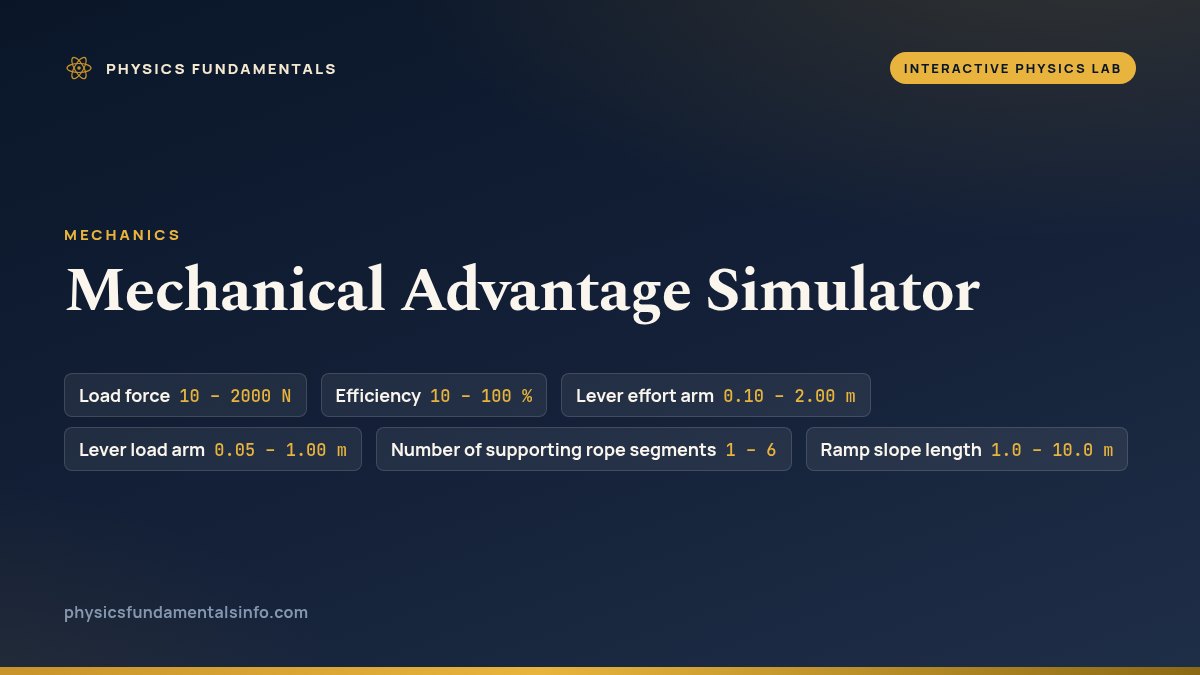
The mechanical advantage simulator is a free interactive physics lab that runs in your browser — nothing to install and no sign-up. Try a lever, pulley or ramp and watch how each trades force for distance. It reports mechanical advantage IMA, effort force Fe, effort distance de and Work in & out Wout ÷ Win as you drag the sliders.
| Control | Range | Step |
|---|---|---|
| Load force | 10 – 2000 N | 10 |
| Efficiency | 10 – 100 % | 1 |
| Lever effort arm | 0.10 – 2.00 m | 0.01 |
| Lever load arm | 0.05 – 1.00 m | 0.01 |
| Number of supporting rope segments | 1 – 6 | 1 |
| Ramp slope length | 1.0 – 10.0 m | 0.1 |
| Ramp height | 0.1 – 3.0 m | 0.1 |
Lever, Pulley, Ramp: Three Faces of One Bargain
A crowbar, a block-and-tackle, and a slope look like different tools, yet the LEVER, PULLEY, and RAMP buttons in this simulation switch between three versions of the same deal: a trade of force for distance. Tuned to give an advantage, each lets a smaller effort move a bigger load, and each charges the same price in return — a longer path to travel. The ideal mechanical advantage comes purely from geometry: for the lever it is IMA = effort arm / load arm; for the pulley it is simply the Number of supporting rope segments; for the ramp it is IMA = slope length / height. Adjust those sliders and the IMA readout tracks the shape of the machine, nothing else.
Friction then takes its cut. The Efficiency slider scales the ideal down to the actual mechanical advantage, AMA = efficiency · IMA, and the effort you actually apply follows F_effort = F_load / AMA. Drop efficiency and the effort force climbs, because you now fight the load and the friction together.
Watch the work panel to see why there is no free lunch. The effort distance stretches as d_effort = IMA · d_load, so a bigger advantage buys weaker pushes only by demanding a longer haul. Work in always meets or exceeds work out; a machine trades force for distance, never energy. Run the exact numbers in the mechanical advantage calculator, or flip through more hands-on physics simulators in the full lab collection.
Frequently asked questions
What is mechanical advantage?
It is how much a simple machine multiplies your force. The ideal mechanical advantage comes from geometry — for a lever, effort arm ÷ load arm; for a pulley, the number of supporting rope segments; for a ramp, slope length ÷ height.
Does a machine reduce the work you have to do?
No. A machine trades force for distance, not energy. A bigger mechanical advantage means a smaller effort force, but you must move it through a proportionally longer distance; the work you put in is at least the work you get out.
What is the difference between ideal and actual mechanical advantage?
Ideal mechanical advantage (IMA) is set by geometry alone. Actual mechanical advantage (AMA) accounts for friction: AMA = efficiency × IMA. Since efficiency is below 100%, the actual advantage is less than the ideal, so you need a little more effort.
How does efficiency affect the effort needed?
Lower efficiency lowers the actual mechanical advantage, so the effort force (load ÷ AMA) rises. Some of the work you do goes into overcoming friction instead of moving the load.
References & formula source
- Halliday, Resnick & Walker — Fundamentals of Physics, Chapter 7–8 (Work and Energy), simple machines.
- Young & Freedman — University Physics with Modern Physics, §6.1 (Work) and machine efficiency.
- R. Nave — HyperPhysics, Georgia State University, "Simple Machines" / mechanical advantage section.
- Further reading: Mechanical advantage — Wikipedia