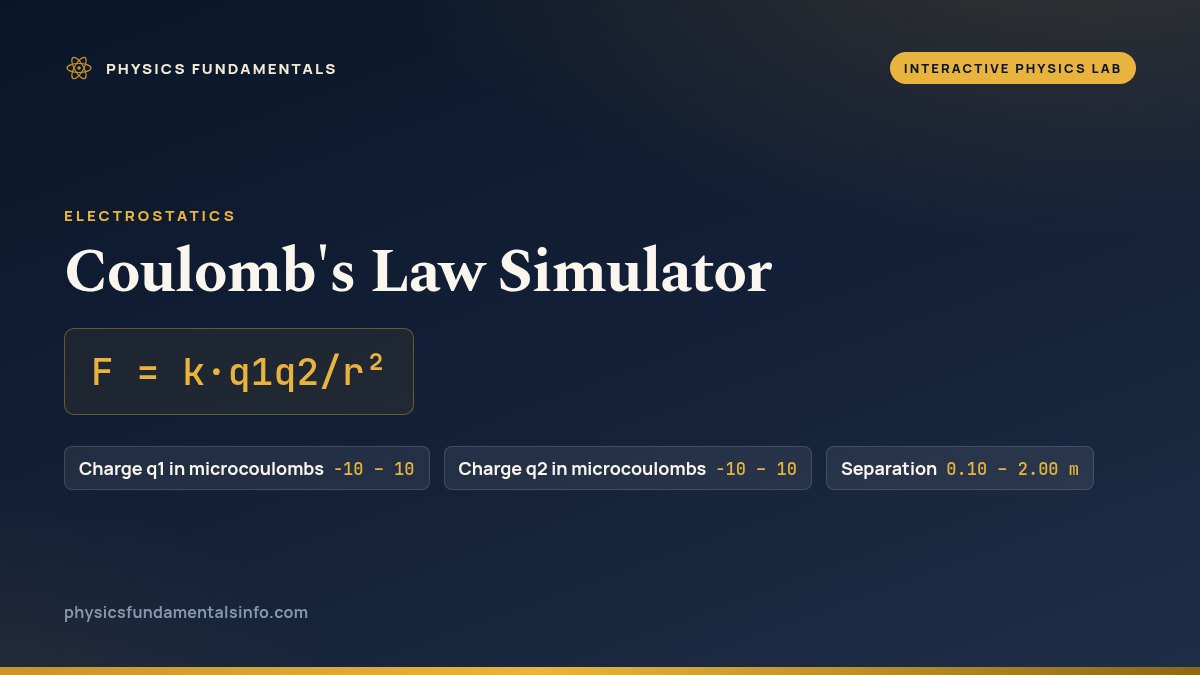
Coulomb's law gives the electric force between two point charges: F = k·q1q2/r². Drag the sliders below to change the two charges and their separation, and watch the force and the attract/repel readout respond in real time.
Interactive Lab
Coulomb’s Law
F = k·|q1·q2| / r²
What Is the Coulomb's Law Simulator?
The Coulomb's law simulator is a free interactive physics lab that runs in your browser — nothing to install and no sign-up. Change the two charges and their separation and watch the electric force respond through the inverse-square law.
| Control | Range | Step |
|---|---|---|
| Charge q1 in microcoulombs | -10 – 10 | 0.1 |
| Charge q2 in microcoulombs | -10 – 10 | 0.1 |
| Separation | 0.10 – 2.00 m | 0.01 |
Adjust Two Charges and Watch the Force Flip Sign
Gravity only ever pulls, yet electric charge follows the same inverse-square geometry while doing something gravity never can — it can attract or shove apart. This simulation lets you feel that split. Nudge the Charge q1 and Charge q2 sliders through positive and negative values and the Interaction readout swaps between attract and repel: like signs repel, opposite signs pull together, exactly as F = k·|q1·q2| / r² predicts. The Coulomb constant k ≈ 8.99×10⁹ N·m²/C² sits fixed on the panel; you are steering the charges and their gap, not the vacuum around them.
The Separation r slider is where intuition usually breaks. Because force scales as 1/r² and not as 1/r, halving the gap does not double the force — it quadruples it, and doubling the gap drops the force to a quarter. Slide r and read the number: the response is far steeper than a straight-line guess. Push q1 far above q2, too, and notice the force magnitude stays identical on both partners. The bigger charge does not win; Newton's third law hands each one an equal, opposite tug regardless of which you called q1.
The model is honest for two small spheres held well apart, and it strains when charged conductors sit almost touching, where induction reshuffles the charge. Pin down exact numbers with the Coulomb's law calculator, or tinker with neighbouring forces over at the full rack of physics playgrounds.
Frequently asked questions
What is Coulomb's law?
Coulomb's law gives the electric force between two point charges: F = k·|q1·q2|/r², where k is the Coulomb constant, q1 and q2 are the charges and r is the separation. The force grows with the product of the charges and falls with the square of the distance.
Do like charges attract or repel?
Like charges — both positive or both negative — repel each other. Opposite charges, one positive and one negative, attract. The magnitude of the force is the same either way; only its direction changes.
What happens to the force if you halve the distance?
It quadruples. Coulomb's law is an inverse-square law: force depends on 1/r², not 1/r. Halving the separation multiplies the force by four, and doubling the separation cuts it to a quarter.
Is the force the same on both charges?
Yes. By Newton's third law the two charges feel forces equal in magnitude and opposite in direction, even if one charge is far larger than the other. A big charge does not push a small one harder than it is pushed back.
References & formula source
- Halliday, Resnick & Walker — Fundamentals of Physics, Chapter 21 (Coulomb's Law).
- Young & Freedman — University Physics with Modern Physics, §21.3 (Coulomb's Law).
- R. Nave — HyperPhysics, Georgia State University, "Coulomb's Law" section.
- Further reading: Coulomb's law — Wikipedia