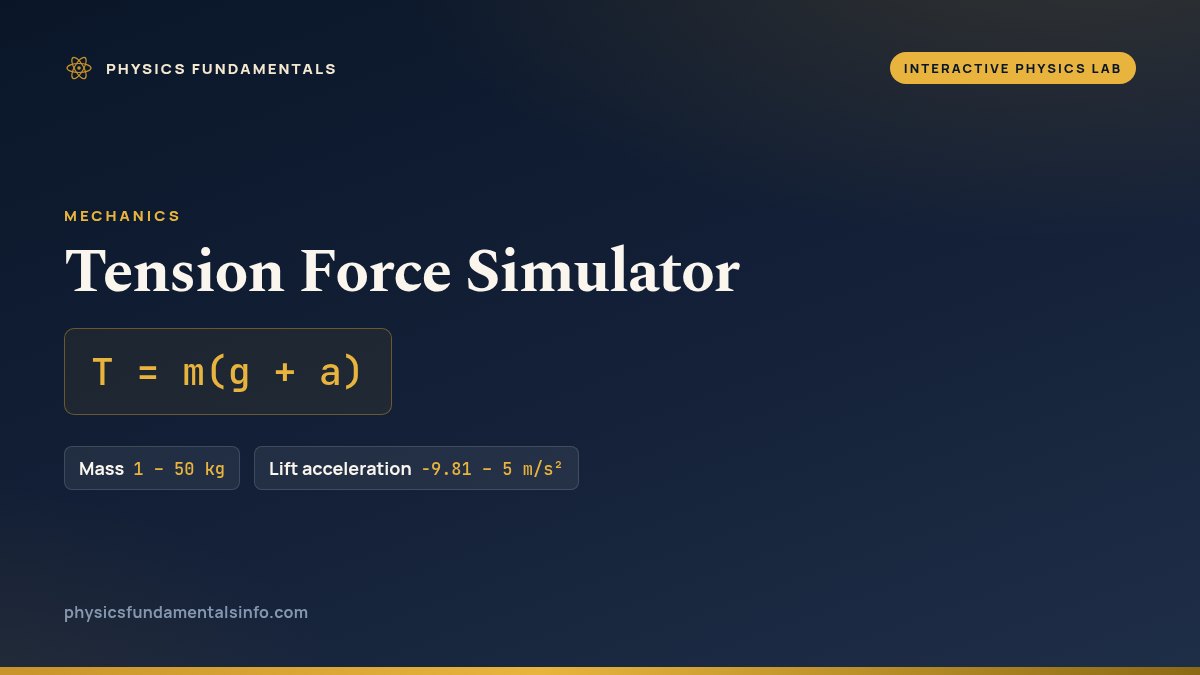
Tension in a lift cable is not just the weight — it tracks the lift's acceleration through T = m(g + a). Drag the sliders below to change the mass and the lift acceleration, and watch the cable tension rise above or fall below the weight in real time.
Tension in a lift cable
Set the load and the lift's acceleration, then read the tension. Up is positive; at free fall the rope goes slack.
What Is the Tension Force Simulator?
The tension force simulator is a free interactive physics lab that runs in your browser — nothing to install and no sign-up. Change the mass and a lift's acceleration and watch the cable tension respond through T = m(g + a).
| Control | Range | Step |
|---|---|---|
| Mass | 1 – 50 kg | 0.5 |
| Lift acceleration | -9.81 – 5 m/s² | 0.01 |
Why Cable Tension Tracks the Lift's Acceleration
You step into a lift, and for a moment the floor seems to push harder against your feet, then eases as the ride settles. The cable overhead feels the same story. The mass hangs from it, and the tension it must carry is not simply the weight. Drag the Mass slider and the load grows as you would expect, but the Lift acceleration slider is what really shifts the reading. That is the surprise this panel is built around: the pull in the cable follows how the lift accelerates, not how fast it happens to be travelling.
Apply Newton's second law to the hanging mass with up as positive. The net force is the tension minus the weight, so T - mg = m·a, which rearranges to T = m(g + a) with g = 9.8 m/s². Standing still or cruising at constant speed means a = 0, so T = mg exactly. Accelerate upward and T = m(g + a) climbs above mg, so you feel heavier. Accelerate downward and T = m(g - a) drops below mg, so you feel lighter.
Push the downward acceleration to free fall, a = g, and the tension falls to zero: apparent weightlessness, even though the mass and true weight never changed. Confirm each case with the Newton's second law calculator, then step into more mechanics across our simulation gallery.
Frequently asked questions
What is the tension in a lift cable?
For a mass m in a lift accelerating with acceleration a (taking up as positive), the cable tension is T = m(g + a). At rest or at constant speed it is just the weight, T = mg.
Does the tension depend on how fast the lift moves?
No — only on its acceleration. At any constant speed the tension equals the weight; it only changes while the lift is speeding up or slowing down.
Why do you feel heavier or lighter in a lift?
Because your apparent weight is the support force, which equals the tension m(g + a). Accelerating upward makes it larger (you feel heavier); accelerating downward makes it smaller (you feel lighter).
What is the tension during free fall?
Zero. If the downward acceleration equals g, then T = m(g − g) = 0 — apparent weightlessness — even though the mass and the true weight are unchanged.
References & formula source
- Halliday, Resnick & Walker — Fundamentals of Physics, Chapter 5 (Force and Motion I), tension and Newton's laws.
- Young & Freedman — University Physics with Modern Physics, §5.1 (Using Newton's First and Second Laws).
- R. Nave — HyperPhysics, Georgia State University, "Tension" / elevator problem section.
- Further reading: Tension (physics) — Wikipedia