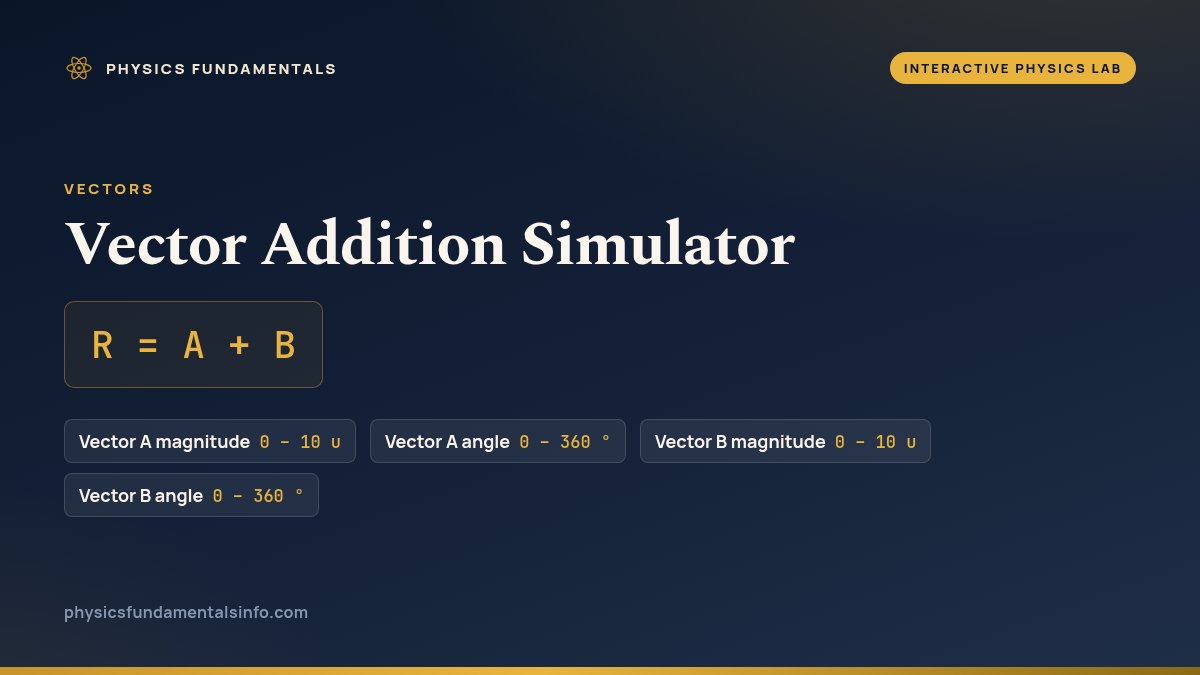
Vectors add by direction as well as size, so two vectors of the same lengths can give very different resultants. Drag the sliders below to set the magnitude and angle of vectors A and B, and watch the resultant R = A + B respond head-to-tail.
Vector Addition
Add two vectors A and B tip-to-tail to get their resultant R = A + B. Drag the sliders and watch why 3 east + 4 north = 5, not 7. Toggle to the parallelogram view to see the same sum a second way.
What Is the Vector Addition Simulator?
The vector addition simulator is a free interactive physics lab that runs in your browser — nothing to install and no sign-up. Change two vectors' magnitudes and angles and watch the resultant respond head-to-tail. It reports ax, ay, bx, by and rx as you drag the sliders.
| Control | Range | Step |
|---|---|---|
| Vector A magnitude | 0 – 10 u | 0.1 |
| Vector A angle | 0 – 360 ° | 1 |
| Vector B magnitude | 0 – 10 u | 0.1 |
| Vector B angle | 0 – 360 ° | 1 |
Two Vectors, One Resultant
A vector of length 3 and a vector of length 4 do not always total 7. Line them up and you get 7; set them at right angles and you get 5; point them opposite and you get just 1. That gap is the whole story of vector addition, and it appears the moment you nudge the Vector A angle or Vector B angle sliders while the two magnitude sliders stay fixed. The arrows swing, and the resultant R stretches or shrinks even though A and B never change size.
Here is why. A scalar like mass, time, or speed carries magnitude only, so it adds arithmetically. A vector like force, velocity, or displacement carries magnitude and direction, so it adds geometrically. The sim splits each arrow into pieces: Ax = A·cos(θ) and Ay = A·sin(θ). Add matching pieces, Rx = Ax + Bx and Ry = Ay + By, then recombine: |R| = sqrt(Rx² + Ry²), aimed along atan2(Ry, Rx). Geometrically it is the same head-to-tail chain you see drawn on screen.
The angle between A and B decides everything. Aligned, the resultant reaches its maximum A + B; opposite, it collapses to |A - B|; perpendicular, it settles at sqrt(A² + B²). Sweep the angle sliders and watch R trace that entire range. To check numbers against your own inputs, open the vector addition calculator, or try the neighbouring simulations gathered on the physics simulations hub.
Frequently asked questions
How do you add two vectors?
By components: Rx = Ax + Bx and Ry = Ay + By, where Ax = A·cos θ and Ay = A·sin θ. The resultant magnitude is sqrt(Rx² + Ry²) and its direction is atan2(Ry, Rx). Geometrically, you join them head to tail.
Why can't you just add the magnitudes?
Because vectors have direction. Two vectors of size 3 and 4 add to 7 only if they point the same way; at right angles they give 5, and pointing opposite they give just 1.
What is the difference between a scalar and a vector?
A scalar — such as mass, time or speed — has magnitude only and adds arithmetically. A vector — such as force, velocity or displacement — has magnitude and direction and adds geometrically.
What are the largest and smallest a resultant can be?
For two vectors A and B, the resultant ranges from |A − B| (pointing opposite) up to A + B (pointing the same way); at right angles it is sqrt(A² + B²).
References & formula source
- Halliday, Resnick & Walker — Fundamentals of Physics, Chapter 3 (Vectors).
- Young & Freedman — University Physics with Modern Physics, §1.7–1.8 (Vectors and Vector Addition).
- R. Nave — HyperPhysics, Georgia State University, "Vector Addition" section.
- Further reading: Euclidean vector — Wikipedia