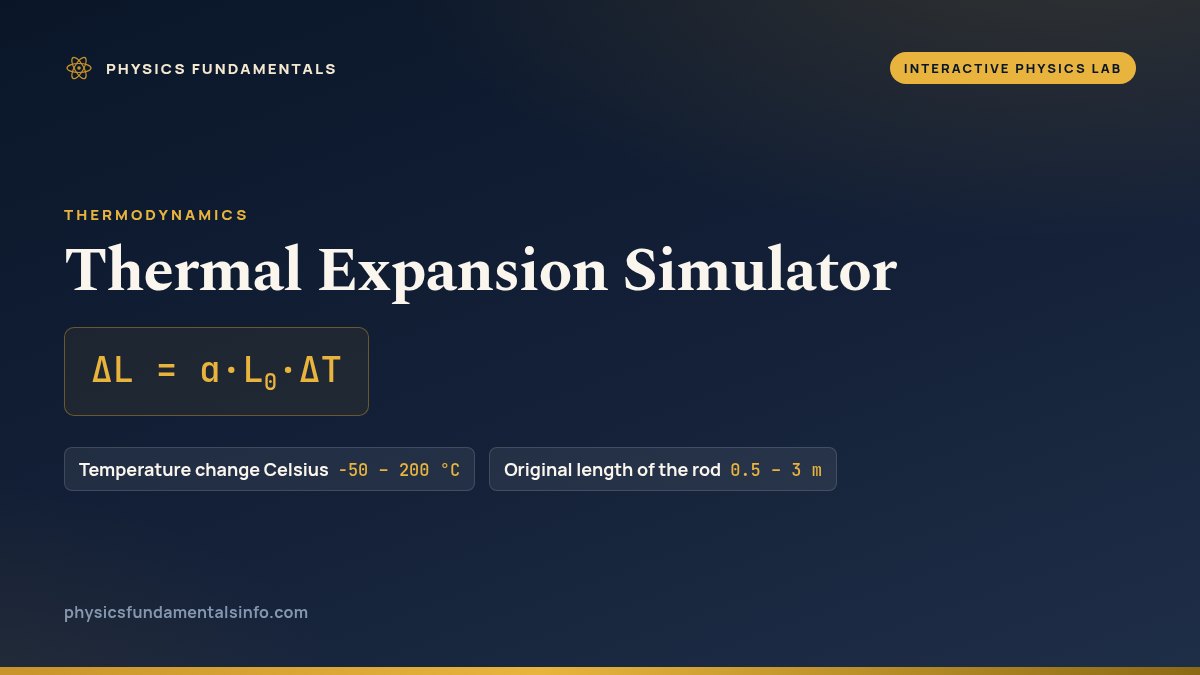
Thermal expansion stretches a heated rod by ΔL = α·L0·ΔT. Pick a material and drag the sliders below to change the temperature change and original length, then watch the change in length respond — the drawing is exaggerated, but the readouts are true.
Thermal Expansion of a Metal Rod
Clamp a rod at one end, pick a material, then heat or cool it. It stretches by ΔL = α·L0·ΔT. The dashed ghost marks the original length; the gold band is the change ΔL — drawn exaggerated so you can see it, while the readouts stay true.
What Is the Thermal Expansion Simulator?
The thermal expansion simulator is a free interactive physics lab that runs in your browser — nothing to install and no sign-up. Pick a metal, change the temperature and original length, and watch a rod stretch through ΔL = α·L0·ΔT. It reports change in length δl as you drag the sliders.
| Control | Range | Step |
|---|---|---|
| Temperature change Celsius | -50 – 200 °C | 1 |
| Original length of the rod | 0.5 – 3 m | 0.05 |
How One Number, α, Sets Each Rod's Stretch in the Thermal Expansion Sim
Heat a rod of aluminium and a rod of Invar by the same amount, and one lengthens while the other hardly stirs. That difference lives in a single material constant, α, the coefficient of linear expansion. This simulation lets you pick that constant from six buttons and watch it steer everything else. Choose Aluminium (α = 23), Brass (19), Copper (17), Steel (12), Glass (9), or Invar (1.2, in units of 10-6 per °C) and the rod's response resets instantly — aluminium expanding roughly 19 times as much as Invar for identical settings.
Two sliders supply the rest of the recipe. Temperature change ΔT can run positive for heating or negative for cooling, and Original length L0 sets the starting metre-scale. The readouts return the change in length ΔL, the original L0, and the final length L = L0 + ΔL. Everything traces to ΔL = α·L0·ΔT, a product of three factors: double either ΔT or L0 and ΔL doubles, while a negative ΔT contracts the rod.
Because α itself is only about 10-5 per °C, a real ΔL is tiny — a fraction of a millimetre up to a few millimetres per metre — so the drawing magnifies the motion ×200 while the numbers stay honest. Since ΔL grows with L0, long rails and bridge spans, not short offcuts, are what earn expansion gaps. Run the numbers in the thermal expansion calculator, then open the next experiment in our physics lab collection.
Where the ideal thermal expansion law breaks down
The first assumption to fail is that α is a constant. The sim holds it fixed from ΔT = -50 °C to +200 °C, but a tabulated α is an average taken near room temperature. Cool a solid towards absolute zero and α falls away towards zero; push it towards its melting point and α creeps upward. Over the range these sliders cover the error is a few per cent, which is why the linear law is taught first; a cryogenic pipe run cannot use one number.
Invar shows the same lesson more sharply. Its α = 1.2 is not stiffness but a magnetic accident: heating makes the alloy's magnetic ordering contract it by almost as much as ordinary thermal motion expands it, and the two nearly cancel. Heat it far enough, the magnetism goes, the cancellation stops and α climbs towards that of an unremarkable nickel steel — so the flat 1.2 the sim returns at every setting holds only inside a limited temperature window.
The larger idealisation is that the rod is free. Every readout here answers "how much longer would it get" — the real answer only if nothing is in the way. Clamp both ends and the length change is forbidden, so the same physics gives stress instead of motion: roughly σ = E·α·ΔT. Steel at L0 = 2.00 m and ΔT = +100 °C reads ΔL = 2.40 mm; block that 2.40 mm and, with a Young's modulus near 200 GPa, you get of order 240 MPa of compression, comparable to the yield strength of structural steel. Notice what vanished: length. A 2 m bar and a 200 m rail build the same stress, which is how track buckles into a sun kink.
The rod is also assumed uniformly hot, but real heat arrives from outside: while it does, the surface is hotter than the core and expands more, so the object strains against itself. Metals conduct fast enough that this passes in seconds; glass does not, which is why the glass setting — α = 9, below steel's 12 — is the one that cracks when boiling water hits a cold tumbler.
Where this is actually used
Expansion gaps in railway track. Select Steel, set L0 = 3.00 m and ΔT = +50 °C, and the sim reports ΔL = 1.80 mm. A 50 °C swing between a dark rail on a summer afternoon and the same rail on a winter night is ordinary, and since ΔL is strictly proportional to L0, a 25 m jointed rail moves 25/3 as far — about 15 mm. That is the gap you see at every joint of older track, and why continuously welded rail is laid under tension instead.
The bimetallic strip in a thermostat. The useful quantity here is the difference between two ΔL values. Set L0 = 2.00 m and ΔT = +100 °C and press Brass: the readout gives 3.80 mm. Press Steel without touching either slider: 2.40 mm. Bond those two strips face to face and the 1.40 mm mismatch cannot appear as a length difference, so the pair curls towards the steel side instead. Wound into a spiral, that curl becomes a usable rotation — enough to move a switch contact in a room thermostat or trip a thermal circuit breaker.
Invar in precision measurement. Set L0 = 1.00 m and ΔT = +100 °C. Steel gives ΔL = 1.20 mm; Invar, with everything else identical, gives 0.120 mm — ten times less drift for the same swing. When the metre bar is the measurement, that factor decides the instrument: surveying tapes, length standards and pendulum rods all moved to Invar for exactly this reason.
Frequently asked questions
What is linear thermal expansion?
When a solid is heated it lengthens by ΔL = α·L0·ΔT, where α is the coefficient of linear expansion, L0 the original length and ΔT the temperature change. Cooling reverses it.
Why do different materials expand by different amounts?
Each material has its own coefficient α. Invar (about 1.2 ×10^-6 per °C) barely moves, while aluminium (about 23) expands roughly nineteen times as much for the same length and temperature change.
Does a longer rod expand more?
Yes. The change in length is proportional to the original length L0, so a 2 m rod expands twice as much as a 1 m rod of the same material and temperature change — which is why long rails and bridges are built with expansion gaps.
What temperature is ΔT measured from?
ΔT is a change, not a reading: +100 °C means the rod ends up 100 degrees hotter than wherever it started, so one setting covers 20 °C to 120 °C and 200 °C to 300 °C alike. Because only the difference enters the formula, 100 °C of change equals 100 K of change, and either gives the same ΔL.
What happens if the rod is cooled instead of heated?
A negative ΔT gives a negative ΔL, so the rod contracts, shrinking by the same rule ΔL = α·L0·ΔT. Heating and cooling are two directions of the same relation.
References & formula source
- Halliday, Resnick & Walker — Fundamentals of Physics, Chapter 18 (Temperature, Heat), thermal expansion.
- Young & Freedman — University Physics with Modern Physics, §17.4 (Thermal Expansion).
- R. Nave — HyperPhysics, Georgia State University, "Thermal Expansion" section.
- Further reading: Thermal expansion — Wikipedia