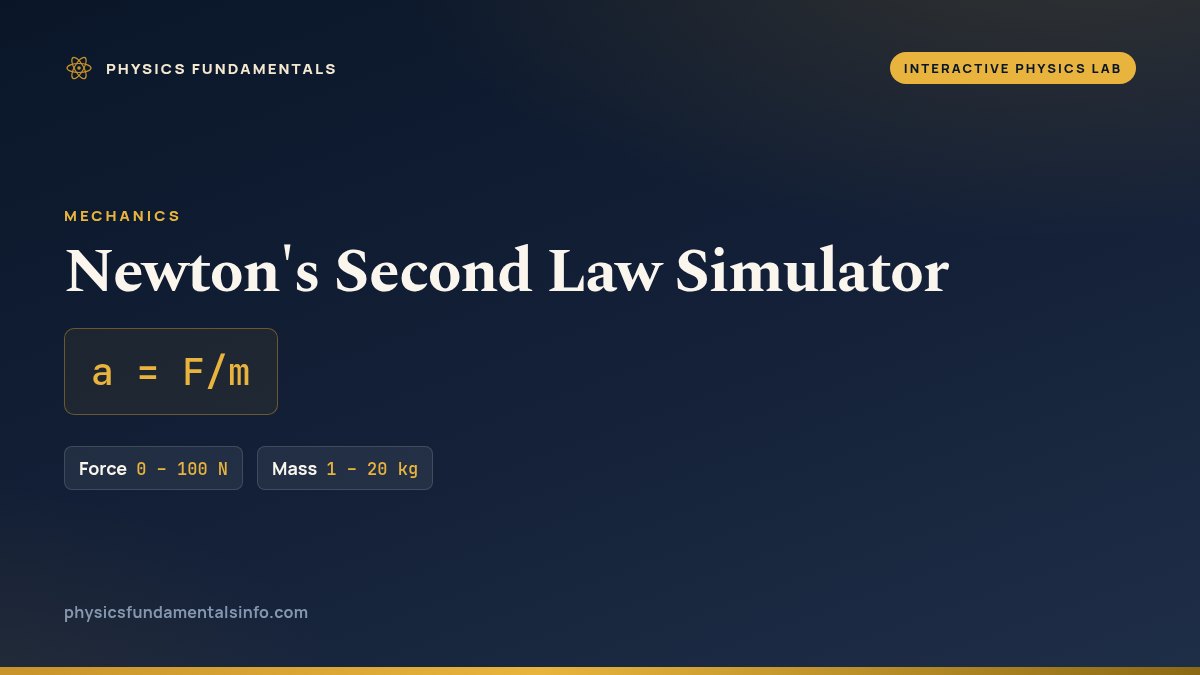
Newton's second law says the acceleration of an object is its net force divided by its mass: a = F/m. Drag the sliders below to change the applied force and the mass, and watch the acceleration and its arrow respond in real time.
Newton's Second Law
What Is the Newton's Second Law Simulator?
The Newton's second law simulator is a free interactive physics lab that runs in your browser — nothing to install and no sign-up. Change the applied force and the mass and watch the acceleration respond through a = F/m.
| Control | Range | Step |
|---|---|---|
| Force | 0 – 100 N | 1 |
| Mass | 1 – 20 kg | 1 |
What Newton's Second Law Actually Says
Push a shopping trolley and it speeds up; load it with bricks and the same push barely moves it. That stubbornness is the whole of F_net = m·a, rearranged to a = F_net/m. Acceleration answers to two masters at once: the harder the net shove, the faster the change in motion, but the greater the mass, the more that change is diluted. Hold the force fixed, double the mass, and acceleration is exactly halved.
The subtle word is net. Force here means the vector sum of every push and pull acting at once. Slide a crate across a rough floor: your hand drives it forward while friction drags it back, and only the leftover — the net force — sets the acceleration. When those forces cancel, F_net = 0, so a = 0 and the crate coasts at constant velocity. No net force is needed to maintain steady motion. Beware the opposite trap too: a ball at the top of its arc has zero velocity yet full acceleration, g pointing down — v = 0 never guarantees a = 0.
Now take the controls. Nudge the Applied force slider up and watch acceleration climb in lockstep. Then leave it alone and drag the Mass slider heavier — the same force yields a limper response, the arrow shrinking as inertia bites. Feel both handles fight over one number. For sharper numbers, open the Newton's second law calculator, or roam the full interactive labs library.
Frequently asked questions
What does Newton's second law say?
It states that the net force on an object equals its mass times its acceleration, F net = m·a, which rearranges to a = F net / m. Acceleration depends on both the net force and the mass — a bigger force accelerates an object more, a bigger mass accelerates less.
Why does the same force accelerate a heavier object less?
Because acceleration is the net force divided by mass. Hold the force fixed and double the mass, and a = F/m is exactly halved. The heavier object has more inertia, so the same push produces a smaller change in its motion.
Is the F in F = ma the applied force?
No — it is the net force, the vector sum of every push and pull acting at once. Slide a crate and your hand drives it forward while friction drags it back; only the leftover net force sets the acceleration. In this simulator there is no friction slider, so the applied force you set is the net force.
Does zero velocity mean zero acceleration?
No. A ball at the top of its arc has zero velocity yet full downward acceleration from gravity. Equally, zero net force means zero acceleration but not zero velocity — an object with balanced forces keeps moving at constant velocity, needing no force to maintain it.
References & formula source
- Halliday, Resnick & Walker — Fundamentals of Physics, Chapter 5 (Force and Motion I).
- Young & Freedman — University Physics with Modern Physics, §4.3 (Newton's Second Law).
- R. Nave — HyperPhysics, Georgia State University, "Newton's Laws" section.
- Further reading: Newton's laws of motion — Wikipedia