Mechanics formulas are the equations that link force, mass, motion, energy and momentum, letting you predict how an object moves. The core set is small: Newton’s second law (force equals mass times acceleration), the four constant-acceleration equations, kinetic and potential energy, and momentum as mass times velocity. Everything else in mechanics is built from these.
Open any mechanics textbook to the back cover and you will find the same thing: a wall of equations, printed small, with no clue about which one to reach for. Most students copy it out, memorise it, and still stall on the first line of a problem.
That stall is almost never a memory failure. It is a matching failure — you know the equations, you just cannot tell which one fits the numbers in front of you. This sheet is arranged to fix that: every formula is grouped by the quantity it produces, every symbol carries its SI unit, and every row that has a calculator on this site links straight to it.
What Are Mechanics Formulas?
Mechanics formulas are the equations describing how forces make objects move, deform, spin and collide. They cover everything from a dropped key to a satellite holding orbit, and they all rest on a handful of conserved quantities and one law relating force to acceleration.
Think of them less as a list to store and more as a set of translation rules. Each formula converts a group of measurable things — a mass, a distance, a time — into something you cannot measure directly, like the force in a cable or the speed at the bottom of a slope.
Mechanics splits neatly into six families, and that split is the whole trick to using the sheet below:
- Kinematics — motion described, with no mention of what caused it.
- Forces and Newton’s laws — what makes motion change.
- Work, energy and power — the bookkeeping of what a force costs.
- Momentum and collisions — what survives an impact.
- Circular motion and rotation — the same laws, rewritten for spin.
- Gravitation and oscillations — orbits, pendulums and springs.
Every Symbol Is a Quantity, and Every Quantity Has a Unit
A formula is only half the information. The other half is what each letter stands for and what unit it must be in — and that second half is where marks are actually lost.
Mechanics runs on three SI base units and a small set of derived ones built from them. The NIST guide to the SI sets out how those derived units are constructed; here are the four reference values that appear again and again below.
| Reference value | Symbol | Value | Where it turns up |
|---|---|---|---|
| Acceleration of free fall (Earth) | g | 9.81 m/s2 (standard value 9.80665 m/s2) | Weight, free fall, projectiles, pendulums |
| Gravitational constant | G | 6.674 × 10⁻¹¹ N·m2/kg2 | Universal gravitation, orbits, escape speed |
| The newton | N | 1 N = 1 kg·m/s2 | Every force equation |
| The joule | J | 1 J = 1 N·m = 1 kg·m2/s2 | Work, kinetic energy, potential energy |
Notice that the newton and the joule are not new ideas — they are shorthand for combinations of kilograms, metres and seconds. That fact is what makes the unit check in the section below work at all. If you want the full picture of base and derived units, we cover it in the guide to SI units in physics.
The Mechanics Formulas Cheat Sheet: 40 Equations in 6 Families
Below are the 40 mechanics formulas that cover essentially every problem set at school and first-year university level. Each table gives the quantity you are solving for, the equation, every symbol with its SI unit, and a link to the calculator that does the arithmetic.
Scan the left-hand column first. Find the quantity you want, and the row hands you the formula.
1. Kinematics: Motion Without Forces
Kinematics describes motion using only position, velocity, acceleration and time — it never asks what caused the motion. The four constant-acceleration equations are the workhorses here.
| You want | Formula | Symbols and SI units | Calculator |
|---|---|---|---|
| Average velocity | v = Δs / Δt | v = velocity (m/s); Δs = displacement (m); Δt = time (s) | Velocity |
| Average acceleration | a = (v − u) / t | a = acceleration (m/s2); u = initial velocity (m/s); v = final velocity (m/s); t = time (s) | Acceleration |
| Final velocity (no distance given) | v = u + at | as above | — |
| Displacement (no final velocity) | s = ut + ½at2 | s = displacement (m) | — |
| Final velocity (no time given) | v2 = u2 + 2as | all five symbols in m, s and m/s | SUVAT |
| Displacement (no acceleration given) | s = ½(u + v)t | as above | — |
| Free-fall drop and speed | h = ½gt2, v = gt | h = drop height (m); g = 9.81 m/s2; t = time (s) | Free Fall |
| Projectile range on level ground | R = v02·sin(2θ) / g | R = range (m); v0 = launch speed (m/s); θ = launch angle (degrees or radians) | Projectile Motion |
| Resultant of perpendicular components | R = sqrt(Rx2 + Ry2) | R = resultant magnitude (same unit as components); direction φ = atan2(Ry, Rx) | Vector Addition |
Each of the four constant-acceleration equations leaves out exactly one of the five quantities. That is not decoration — it is the selection rule. Pick the equation missing the thing you neither know nor want, and we unpack why in the guide to the SUVAT equations.
2. Forces and Newton’s Laws
Force equations tell you how motion changes. Newton’s second law is the hinge that every other force formula swings on, and the rest of this family is really just different ways of working out what goes into F.
| You want | Formula | Symbols and SI units | Calculator |
|---|---|---|---|
| Net force | F = m·a | F = net force (N); m = mass (kg); a = acceleration (m/s2) | Newton’s Second Law |
| Weight | W = m·g | W = weight (N); m = mass (kg); g = local gravitational field strength (N/kg, numerically equal to m/s2) | Weight on Other Planets |
| Friction force | Ff = μ·N | Ff = friction force (N); μ = coefficient of friction (no unit); N = normal force (N) | Friction |
| Acceleration down a rough slope | a = g(sinθ − μ·cosθ) | θ = slope angle; μ = coefficient of friction; a in m/s2 | Inclined Plane |
| Spring force | F = −k·x | k = spring constant (N/m); x = extension from natural length (m); the minus sign means the force opposes the stretch | Hooke’s Law |
| Spring constant from a test load | k = F / x | k in N/m; F in N; x in m | Spring Constant |
| Gravitational attraction between two masses | F = G·m1·m2 / r2 | G = 6.674 × 10⁻¹¹ N·m2/kg2; m1, m2 in kg; r = centre-to-centre separation (m) | Gravitational Force |
One detail worth pinning down: the F in F = ma is always the net force — the vector sum of everything acting. Draw the free-body diagram before you write the equation, a habit set out in full in Newton’s laws of motion.
3. Work, Energy and Power
Energy formulas let you skip the details of the journey. If a question gives you heights, speeds and distances but never mentions time, this family is almost always the shortcut.
| You want | Formula | Symbols and SI units | Calculator |
|---|---|---|---|
| Work done by a force | W = F·d·cosθ | W = work (J); F = force (N); d = displacement (m); θ = angle between force and displacement | Work & Power |
| Kinetic energy | KE = ½·m·v2 | KE in J; m in kg; v in m/s | Kinetic Energy |
| Gravitational potential energy near Earth | PE = m·g·h | PE in J; h = height above your chosen zero (m) | Gravitational Potential Energy |
| Elastic potential energy in a spring | Ee = ½·k·x2 | Ee in J; k in N/m; x in m | — |
| Power | P = W / t = F·v | P = power (W); W = work (J); t = time (s); v = speed (m/s) | Power |
| Mechanical advantage of a machine | MA = Fload / Feffort | both forces in N; MA has no unit | Mechanical Advantage |
The joule doing the work here is the same joule that heats a kettle. That single currency running across mechanics, heat and electricity is the point of the whole idea, explored further in what energy is in physics.
4. Momentum and Collisions
Momentum formulas govern what happens when things hit each other. Their power is that total momentum is conserved in every collision — even the messy ones where energy is clearly lost to noise, heat and crumpled metal.
| You want | Formula | Symbols and SI units | Calculator |
|---|---|---|---|
| Momentum | p = m·v | p = momentum (kg·m/s); m in kg; v in m/s. Momentum is a vector — direction matters | Momentum |
| Impulse | J = F·Δt = Δp | J = impulse (N·s, identical to kg·m/s); F = average force (N); Δt = contact time (s) | Impulse |
| Velocities after a collision | m1u1 + m2u2 = m1v1 + m2v2 | masses in kg; u = before, v = after, both in m/s, signed by direction | Collision |
| Centre of mass of several bodies | xcm = Σ(mi·xi) / Σmi | xcm = position (m); mi = each mass (kg); xi = each position (m) | Center of Mass |
A quick sanity check students find useful: N·s and kg·m/s are the same unit written two ways. If your impulse and your momentum change do not come out numerically equal, one of them has an arithmetic error.
5. Circular Motion and Rotation
Rotational formulas are the linear ones in disguise. Swap distance for angle, mass for moment of inertia and force for torque, and the shapes of the equations repeat almost line for line.
| You want | Formula | Symbols and SI units | Calculator |
|---|---|---|---|
| Centripetal acceleration | ac = v2 / r | ac in m/s2; v = tangential speed (m/s); r = radius (m) | Circular Motion |
| Centripetal force | Fc = m·v2 / r = m·ω2·r | Fc in N; ω = angular velocity (rad/s) | Centripetal Force |
| Angular velocity (and speed from it) | ω = θ / t = 2π / T, and v = ω·r | ω in rad/s; θ in radians; T = period (s); v in m/s | Angular Velocity |
| Torque | τ = r·F·sinθ | τ = torque (N·m); r = distance from pivot (m); θ = angle between r and F | Torque |
| Moment of inertia | I = k·m·r2 | I in kg·m2; k = shape factor (½ for a solid disc, 1 for a hoop, 2/5 for a solid sphere) | Moment of Inertia |
| Angular acceleration from torque | τ = I·α | α = angular acceleration (rad/s2) — the rotational twin of F = ma | — |
| Rotational kinetic energy | KErot = ½·I·ω2 | KErot in J; I in kg·m2; ω in rad/s | — |
| Angular momentum | L = I·ω | L in kg·m2/s; conserved when no external torque acts | — |
| Ideal banking angle for a curve | tanθ = v2 / (r·g) | θ = banking angle; v = design speed (m/s); r = radius (m); g = 9.81 m/s2 | Banked Curve |
Angles must be in radians whenever they sit inside ω, α or a period. Feed a calculator degrees where it expects radians and the answer comes out wrong by a factor of about 57.
6. Gravitation and Oscillations
These formulas handle the two situations where motion repeats: orbits and oscillations. Both come down to a restoring influence pulling something back towards where it started.
| You want | Formula | Symbols and SI units | Calculator |
|---|---|---|---|
| Escape velocity | vesc = sqrt(2·G·M / r) | vesc in m/s; M = mass of the body (kg); r = launch radius from its centre (m) | Escape Velocity |
| Orbital period (Kepler’s third law) | T2 = 4π2·a3 / (G·M) | T = period (s); a = semi-major axis (m); M = central mass (kg) | Kepler’s Third Law |
| Period of a simple pendulum | T = 2π·sqrt(L / g) | T in s; L = string length (m); valid for small swings, roughly under 15 degrees | Pendulum Period |
| Period of a mass on a spring | T = 2π·sqrt(m / k) | T in s; m in kg; k in N/m. Note it does not depend on amplitude | — |
| Simple harmonic motion relations | ω = 2πf, T = 1 / f, vmax = ω·A | f = frequency (Hz); A = amplitude (m); vmax in m/s | Simple Harmonic Motion |
How Do You Choose the Right Mechanics Formula?
Choose a mechanics formula by naming the quantity you want, listing the quantities you were given, and then picking the family whose equation contains only those symbols and nothing else. Three steps, in this order:
- Name the target. Write down the symbol and unit of the one thing the question asks for — “v, in m/s”, not “the speed bit”.
- List what you have. Extract every number with its symbol and unit. Do this before you look at any formula.
- Match, don’t hunt. Pick the equation whose symbols are covered by your list plus your target. If one symbol is left over that you neither know nor want, that is the wrong equation.
Step three is where the sheet above earns its keep. Because the tables are keyed by “you want”, you are searching a short column rather than scanning forty equations.
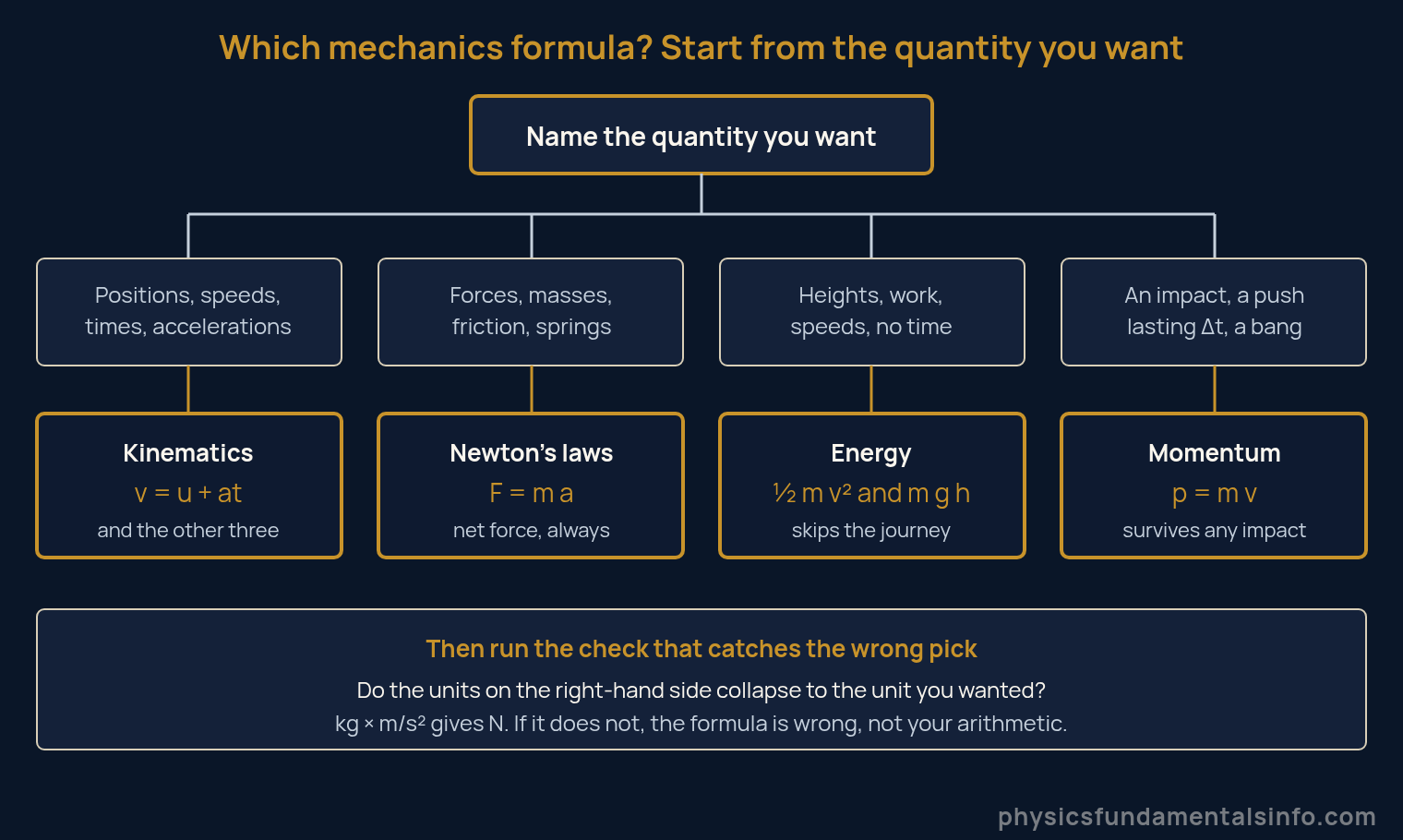
Routing from what a question gives you to the right family of mechanics formulas.
How Do You Rearrange a Mechanics Formula?
Rearrange a mechanics formula by doing the same operation to both sides until the symbol you want stands alone — always in symbols first, before any number goes in. Substituting early is the single most common source of arithmetic slips.
For the many mechanics formulas shaped like A = B × C — F = ma, p = mv, W = Fd — there is a shortcut worth internalising. Cover the symbol you want: if it was on top you multiply the two below, and if it was on the bottom you divide the top by the other.
The lab below lets you try it. Pick a relationship, choose which variable to solve for, and watch both the rearranged equation and the unit check update as you move the sliders.
One warning the lab makes obvious: the triangle only works for the A = B × C shape. An equation like v2 = u2 + 2as has four terms and a square in it, so no triangle will save you — that one has to be rearranged properly, line by line.
How Do You Check a Mechanics Formula With Units?
Check a mechanics formula by replacing every symbol with its SI unit and simplifying: if the right-hand side does not collapse to the unit of the quantity you wanted, the formula is wrong. This takes about ten seconds and catches a whole class of errors that re-reading never will.
Take kinetic energy. Substituting units into ½mv2 gives kg × (m/s)2, which is kg·m2/s2. Since 1 J = 1 N·m = 1 kg·m2/s2, the units land exactly on the joule — the formula survives.
Now try the classic slip of writing kinetic energy as ½mv. That gives kg·m/s, which is momentum, not energy. The unit check flags it instantly, without you needing to remember which version was right.
Three habits make this reliable in practice:
- Convert to SI before substituting. Grams to kilograms, centimetres to metres, minutes to seconds — every time.
- Strip the pure numbers. Factors like ½, 2π and cosθ carry no units, so ignore them during the check.
- Expand the named units. Rewrite N as kg·m/s2 and J as kg·m2/s2, then cancel.
A unit check confirms a formula is dimensionally possible; it cannot catch a wrong numerical factor. Both ½mv2 and 2mv2 pass the check, so it is a filter, not a proof. For the wider method that surrounds this step, see our six-step framework for solving physics problems.
Where These Mechanics Formulas Show Up in Real Life
Every equation on this sheet was written to describe something someone needed to build or predict. Four examples where they are still doing exactly that:
- Crumple zones. Impulse says J = FΔt. A car body that deforms stretches Δt across a longer collision, so the same change in momentum arrives as a smaller average force on the occupants.
- Motorway curve design. The banking angle formula tanθ = v2/(rg) sets the camber engineers build into a bend so vehicles at the design speed need no help from friction to turn.
- Figure skating spins. Angular momentum L = Iω is conserved when a skater pulls their arms in. Moment of inertia drops, so angular velocity climbs — no push required.
- Satellite launches. Kepler’s third law fixes the altitude that gives a 24-hour period, which is why geostationary satellites all sit on the same ring above the equator.
Common Mistakes With Mechanics Formulas
The same four errors account for most lost marks in mechanics. Each one is a misunderstanding, not a slip — which is why they survive re-reading the sheet.
Mistake 1: Treating mass and weight as the same thing
Mass is measured in kilograms and never changes; weight is a force in newtons and changes with location. Writing 60 kg into a formula that wants a force in newtons is one of the most frequent errors on marked scripts.
The fix is mechanical: whenever you see a mass in a force equation, ask whether the equation wants m or mg.
Mistake 2: Using F = ma with only one of the forces
The F in Newton’s second law is the net force, not the force you happen to have been given. A 100 N push on a crate with 30 N of friction gives a net force of 70 N, and using 100 N inflates the acceleration by more than 40 per cent.
Mistake 3: Assuming kinetic energy is conserved in every collision
Momentum is conserved in all collisions; kinetic energy is conserved only in elastic ones. In a real crash a large fraction of the kinetic energy goes into deformation, heat and sound — so applying the elastic-collision equations to a car pile-up gives a confidently wrong answer.
Mistake 4: Mixing degrees and radians
Angles inside ω, α, or a period must be in radians; angles inside sinθ and cosθ in force resolution are usually in degrees. A pendulum or rotation answer that comes out about 57 times too large or too small almost always traces back to this.
How Mechanics Formulas Connect to the Rest of Physics
Mechanics formulas are not a closed set — they are the layer everything else is built on top of. The joule you calculate with ½mv2 is the same joule that appears in specific heat capacity; the newton from F = ma is the same newton in electrostatic and magnetic force laws.
Within mechanics itself, the families are alternative routes rather than separate subjects. The diagram below shows the same block reaching the same answer two different ways.

Force and energy routes through the same mechanics problem, giving identical answers.
Add friction to that slope and the energy route needs an extra term, but it still works. Add a collision, and momentum becomes the only route that survives. Choosing well is what separates a two-line solution from a twenty-line one.
If you need equations from outside mechanics — thermodynamics, waves, electromagnetism or modern physics — they are all collected in the physics formulas hub. MIT’s introductory mechanics course makes the same argument this page does, and makes it forcefully: its own 8.01 Classical Mechanics materials open by contrasting learning a set of formulas to memorise with learning principles you can apply to unfamiliar situations.
Worked Problems
Show Solution
Solution:
Step 1: Acceleration from the definition, a = (v − u) / t.
Step 2: a = (27 m/s − 0 m/s) / 9.0 s = 3.0 m/s2
Step 3: Net force from Newton’s second law, F = m·a = 1,200 kg × 3.0 m/s2 = 3,600 N
Answer: a = 3.0 m/s2, F = 3.6 kN
Show Solution
Solution:
Step 1: Kinetic energy, KE = ½·m·v2.
Step 2: KE = ½ × 0.145 kg × (38 m/s)2 = ½ × 0.145 × 1,444 kg·m2/s2
Step 3: KE = 104.69 J
Answer: KE = 105 J (3 s.f.)
Show Solution
Solution:
Step 1: Initial momentum, p = m·v = 65 kg × 8.0 m/s = 520 kg·m/s. Final momentum is zero.
Step 2: Impulse equals change in momentum, so J = Δp = −520 N·s (the minus sign means it opposes the motion).
Step 3: From J = F·Δt, F = 520 N·s / 4.0 s = 130 N
Answer: Δp = 520 kg·m/s in magnitude, average braking force = 130 N
Show Solution
Solution:
Step 1 (force route): The acceleration along the slope is a = g·sinθ = 9.81 m/s2 × sin30° = 4.905 m/s2
Step 2: Apply v2 = u2 + 2as with u = 0: v2 = 0 + 2 × 4.905 m/s2 × 4.0 m = 39.24 m2/s2, so v = 6.264 m/s
Step 3 (energy route): The vertical drop is h = 4.0 m × sin30° = 2.0 m. Setting m·g·h = ½·m·v2 and cancelling m gives v = sqrt(2·g·h) = sqrt(2 × 9.81 × 2.0) = 6.264 m/s
Answer: v = 6.3 m/s by both routes (2 s.f.)
Show Solution
Solution:
Step 1: Normal force. The vertical component of the pull lifts part of the weight: N = m·g − F·sinθ = (40 × 9.81) − (150 × sin25°) = 392.4 − 63.39 = 329.01 N
Step 2: Friction force, F_f = μ·N = 0.30 × 329.01 N = 98.70 N
Step 3: Work by the pull, W = F·d·cosθ = 150 N × 6.0 m × cos25° = 815.68 J. Work by friction = −98.70 N × 6.0 m = −592.21 J
Step 4: Net work = 815.68 − 592.21 = 223.46 J. Setting this equal to ½·m·v2 gives v = sqrt(2 × 223.46 / 40) = 3.343 m/s
Answer: 816 J by the pull, −592 J by friction, final speed 3.3 m/s
Show Solution
Solution:
Step 1: Angular velocity, ω = 2π·f = 2π × 3.0 s−1 = 18.85 rad/s
Step 2: Tangential speed, v = ω·r = 18.85 rad/s × 0.75 m = 14.14 m/s
Step 3: Centripetal force, F_c = m·v2 / r = 0.20 kg × (14.14 m/s)2 / 0.75 m = 53.30 N. Checking with F_c = m·ω2·r gives 0.20 × 18.852 × 0.75 = 53.30 N, the same value.
Answer: ω = 18.8 rad/s, v = 14.1 m/s, F_c = 53.3 N
Show Solution
Solution:
Step 1: Momentum is conserved through the impact. Before: p = 0.012 kg × 350 m/s = 4.2 kg·m/s
Step 2: After the bullet embeds, the combined mass is 2.012 kg, so v = 4.2 / 2.012 = 2.088 m/s
Step 3: Kinetic energy of the combined mass, KE = ½ × 2.012 kg × (2.088 m/s)2 = 4.384 J
Step 4: This energy is stored in the spring, so ½·k·x2 = 4.384 J, giving x = sqrt(2 × 4.384 / 800) = 0.1047 m
Answer: v = 2.09 m/s, maximum compression = 10.5 cm
Note the size of the energy loss: the bullet arrived with 735 J and only 4.4 J survived. Over 99 per cent went into heat and deformation — which is exactly why you cannot use energy conservation across an embedding collision.
Show Solution
Solution:
Step 1: For a solid disc, I = ½·m·r2 = ½ × 8.0 kg × (0.30 m)2 = 0.36 kg·m2
Step 2: Convert the final speed: ω = 240 × 2π / 60 = 25.13 rad/s
Step 3: Angular acceleration, α = ω / t = 25.13 / 5.0 = 5.027 rad/s2
Step 4: Torque, τ = I·α = 0.36 kg·m2 × 5.027 rad/s2 = 1.81 N·m. Rotational kinetic energy, KE = ½·I·ω2 = ½ × 0.36 × 25.132 = 113.7 J
Answer: I = 0.36 kg·m2, α = 5.03 rad/s2, τ = 1.81 N·m, KE = 114 J