Moment of inertia: the moment of inertia (I) measures how hard it is to change an object’s rotation about an axis. For a simple body it is I = k·m·r², where k is a shape factor. This free calculator finds the moment of inertia for spheres, cylinders, rods, hoops and disks — and shows every step.
What Is the Moment of Inertia Calculator?
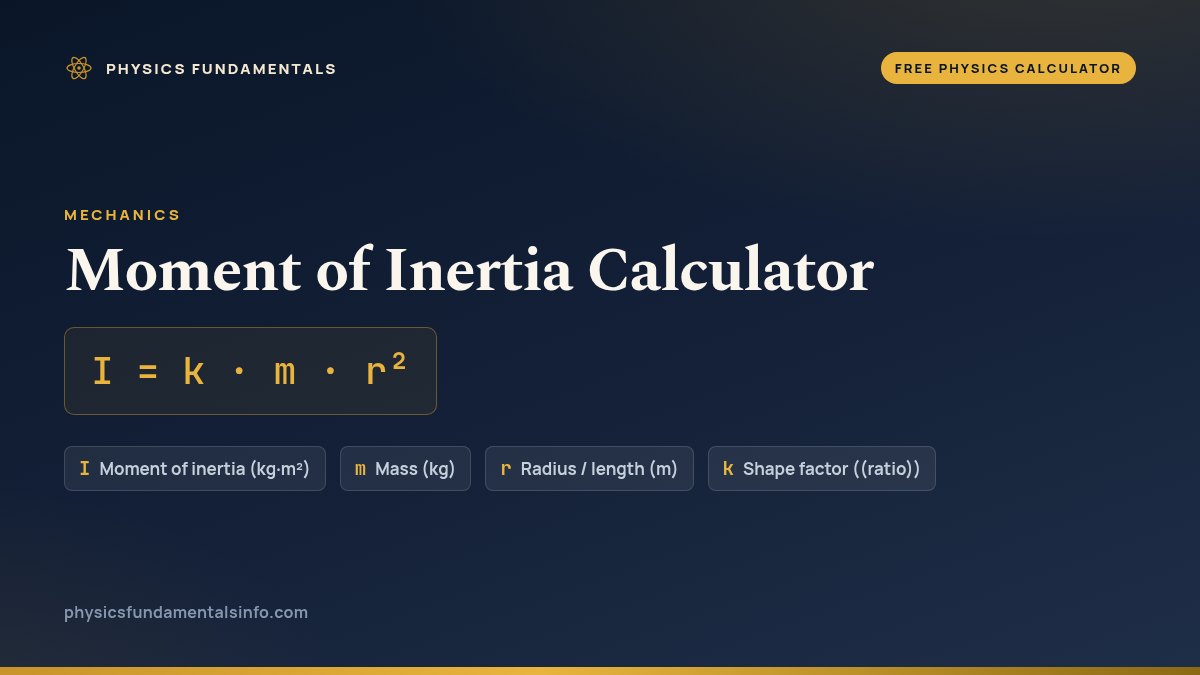
The moment of inertia calculator is a free online tool built on the formula I = k · m · r². Enter the values you already know, in whichever units suit you, and it solves for moment of inertia for common shapes and shows every step of the substitution. Moment of Inertia is rotational inertia for spheres, cylinders, rods and hoops.
| Symbol | Quantity | Default unit | Also accepts | Example value |
|---|---|---|---|---|
| I | Moment of inertia | kg·m² | — | — |
| m | Mass | kg | g | 2 |
| r | Radius / length | m | cm | 0.5 |
| k | Shape factor | (ratio) | — | 0.5 |
How to calculate moment of inertia
The moment of inertia is the rotational equivalent of mass: it tells you how much an object resists being spun up or slowed down about a given axis. For a single rigid body it is I = k · m · r², where m is the mass, r is the radius (or characteristic length), and k is a dimensionless shape factor fixed by the geometry and the choice of axis. The answer comes out in kilograms metre squared (kg·m²).
There are three steps. First, identify the shape and axis, then read off its factor — a solid sphere is k = 2/5, a hollow sphere 2/3, a solid cylinder or disk 1/2, a thin hoop or ring 1, a uniform rod about its centre 1/12, and the same rod about one end 1/3. Second, enter the mass and the radius or length and choose their units; the calculator converts to SI base units (kilograms and metres) for you. Third, read the result alongside the worked steps, which show the formula, your numbers substituted in, and the final value with units.
The equation rearranges to find the mass instead: m = I / (k · r²). The most important thing to get right is what r represents and where the axis lies. For a hoop or cylinder, r is the radius from the central axis; for a rod, r is its full length. Because the radius is squared, moving mass even slightly farther from the axis has a large effect — doubling r quadruples the moment of inertia.
Once you have I, the rest of rotational dynamics follows. Combine it with angular acceleration through Newton’s second law for rotation, τ = I · α, using the torque calculator, or use it to find rotational kinetic energy, ½ · I · ω². For the term itself, see the physics glossary.
Worked example
A solid disk (a flywheel) has a mass of 2 kg and a radius of 0.5 m. Its shape factor is k = 1/2, so the moment of inertia is I = k · m · r² = 0.5 · 2 · 0.5² = 0.25 kg·m². If the same 2 kg were instead a thin hoop of the same radius (k = 1), it would be I = 1 · 2 · 0.5² = 0.5 kg·m² — twice as hard to spin up, because all of the hoop’s mass sits at the rim instead of being spread inward toward the axis.
Why moment of inertia matters
Moment of inertia governs how flywheels store energy, how quickly motors and wheels spin up, why long rods and bridges resist twisting, and why spinning skaters and divers speed up as they tuck in. It is the single quantity that links a force or torque to the angular acceleration it produces.
Frequently asked questions
What is the formula for moment of inertia?
For a simple rigid body the moment of inertia is I = k·m·r², where m is the mass, r is the radius or characteristic length, and k is a dimensionless shape factor that depends on geometry and the axis of rotation. For example k = 2/5 for a solid sphere and k = 1/2 for a solid cylinder. The SI unit is the kilogram metre squared (kg·m²).
What does the shape factor k mean?
The shape factor captures how an object’s mass is distributed relative to the axis of rotation. Mass spread far from the axis gives a larger k. A thin hoop has all its mass at radius r, so k = 1; a solid disk of the same mass and radius has k = 1/2 because much of its mass sits closer to the centre. A solid sphere is k = 2/5 and a hollow sphere is 2/3.
Why does a rod have two different values?
Moment of inertia depends on where the axis is. A uniform rod rotated about its centre has k = 1/12 (using its length as r), but the same rod rotated about one end has k = 1/3, because more of its mass is now far from the axis. This is the parallel-axis idea: moving the axis away from the centre of mass always increases the moment of inertia.
How is moment of inertia different from mass?
Mass measures resistance to straight-line (linear) acceleration; moment of inertia measures resistance to angular acceleration about an axis. The two are linked by I = k·m·r², so spreading the same mass farther from the axis raises the moment of inertia without changing the mass at all — which is why a figure skater spins faster by pulling their arms in.
What are the units of moment of inertia?
The SI unit is the kilogram metre squared (kg·m²). It comes straight from the formula: mass in kilograms multiplied by a length in metres squared. This calculator accepts mass in kilograms or grams and length in metres or centimetres, converting to SI before computing, so the result is always in kg·m².
References & formula source
- Halliday, Resnick & Walker — Fundamentals of Physics, Chapter 10 (Rotation).
- Young & Freedman — University Physics with Modern Physics, §9.4 (Moment of Inertia) and §9.5 (Parallel-Axis Theorem).
- NIST — International System of Units (SI): the kilogram and the metre.
- Further reading: Moment of inertia — Wikipedia