Energy in physics is the capacity to do work or cause change, measured in joules (J). It exists in many forms — kinetic, potential, thermal, chemical and more — and can transform between them but is never created or destroyed. The total energy of an isolated system stays constant, a rule called the conservation of energy.
Every time you charge your phone, sprint for a bus, or feel the sun on your skin, energy is being moved from one place or form to another. It is the single quantity that connects a falling apple, a lightning strike and a star — which is why energy is often called the “currency” of the universe.
What makes energy so powerful as an idea is that it is conserved. You can track it like money in a bank account: it shifts between forms and locations, but the books always balance. Master that one principle and huge chunks of physics suddenly make sense.
What Is Energy in Physics?
Intuitively, energy is the “ability to make things happen” — to move an object, heat it, light it up, or change it in some way. If something can cause a change, it has energy.
Precisely, energy is the capacity to do work, where work means transferring energy by applying a force over a distance. Because energy and work are two sides of the same coin, they share the same SI unit: the joule (J). One joule is the energy transferred when a force of one newton acts over one metre, so 1 J = 1 N·m = 1 kg·m2/s2. The joule is defined within the International System of Units (SI) maintained by NIST.
Energy is a scalar — it has a size but no direction. This is one reason it is so useful: you can add up the energy in a system without worrying about angles or vectors, then use the total to predict what happens next.
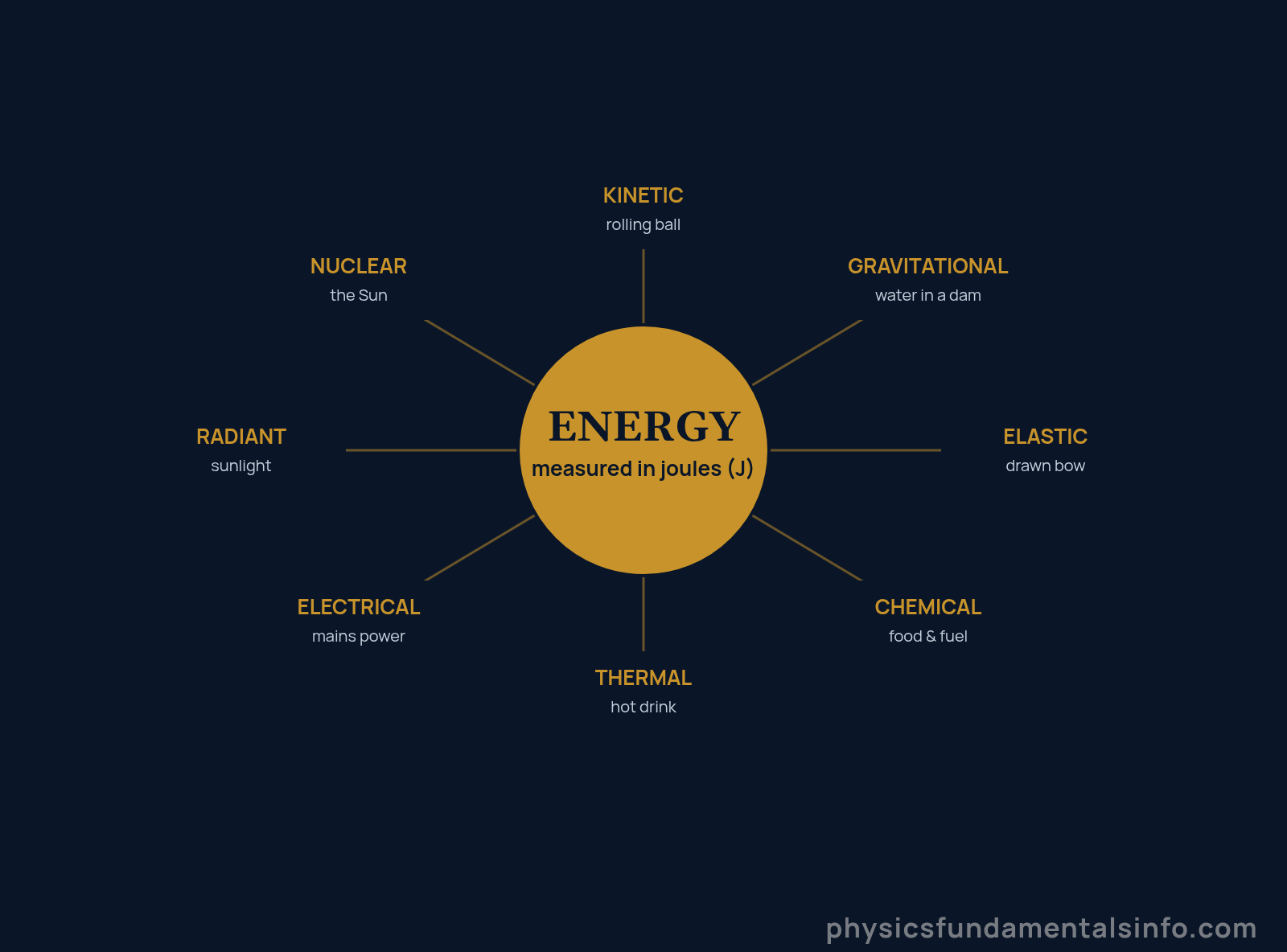
Energy is the capacity to do work and comes in many interchangeable forms.
The Energy Formula
There is no single “energy equation” — instead, each form has its own formula. The two you meet first, and the two that matter most in mechanics, are kinetic energy and gravitational potential energy.
Kinetic energy is the energy of motion:
- KE — kinetic energy, in joules (J)
- m — mass of the object, in kilograms (kg)
- v — speed of the object, in metres per second (m/s)
Gravitational potential energy is stored energy due to an object’s height in a gravitational field:
- PE — gravitational potential energy, in joules (J)
- m — mass, in kilograms (kg)
- g — gravitational field strength, ≈ 9.81 m/s2 near Earth’s surface
- h — height above a chosen reference level, in metres (m)
For a simple mechanical system, the total mechanical energy is just the sum of the two:
A third everyday formula is the elastic potential energy stored in a stretched or compressed spring, where k is the spring constant (N/m) and x is the extension (m):
Because KE depends on v2, doubling an object’s speed quadruples its kinetic energy. That is why stopping distances grow so sharply with speed — a fact every driving instructor relies on.
How Energy Works: Transfer and Transformation
Energy never just sits still and useless. Two things happen to it:
- Transfer — energy moves from one object to another (a hot cup heats your hands; a kicked ball gains the energy your foot loses).
- Transformation — energy changes form (chemical energy in food → kinetic energy in your muscles → thermal energy as you warm up).
The classic demonstration is an object falling under gravity. At the top of a drop, it is momentarily still: all its mechanical energy is potential. As it falls, height decreases and speed increases, so PE converts smoothly into KE. Just before impact, almost all the energy is kinetic. The total (KE + PE) stays the same the whole way down — provided we ignore air resistance.
The bridge between work and energy is the work-energy theorem: the net work done on an object equals its change in kinetic energy.
Push a trolley and you do positive work, speeding it up; friction does negative work, slowing it down. Energy bookkeeping never breaks.
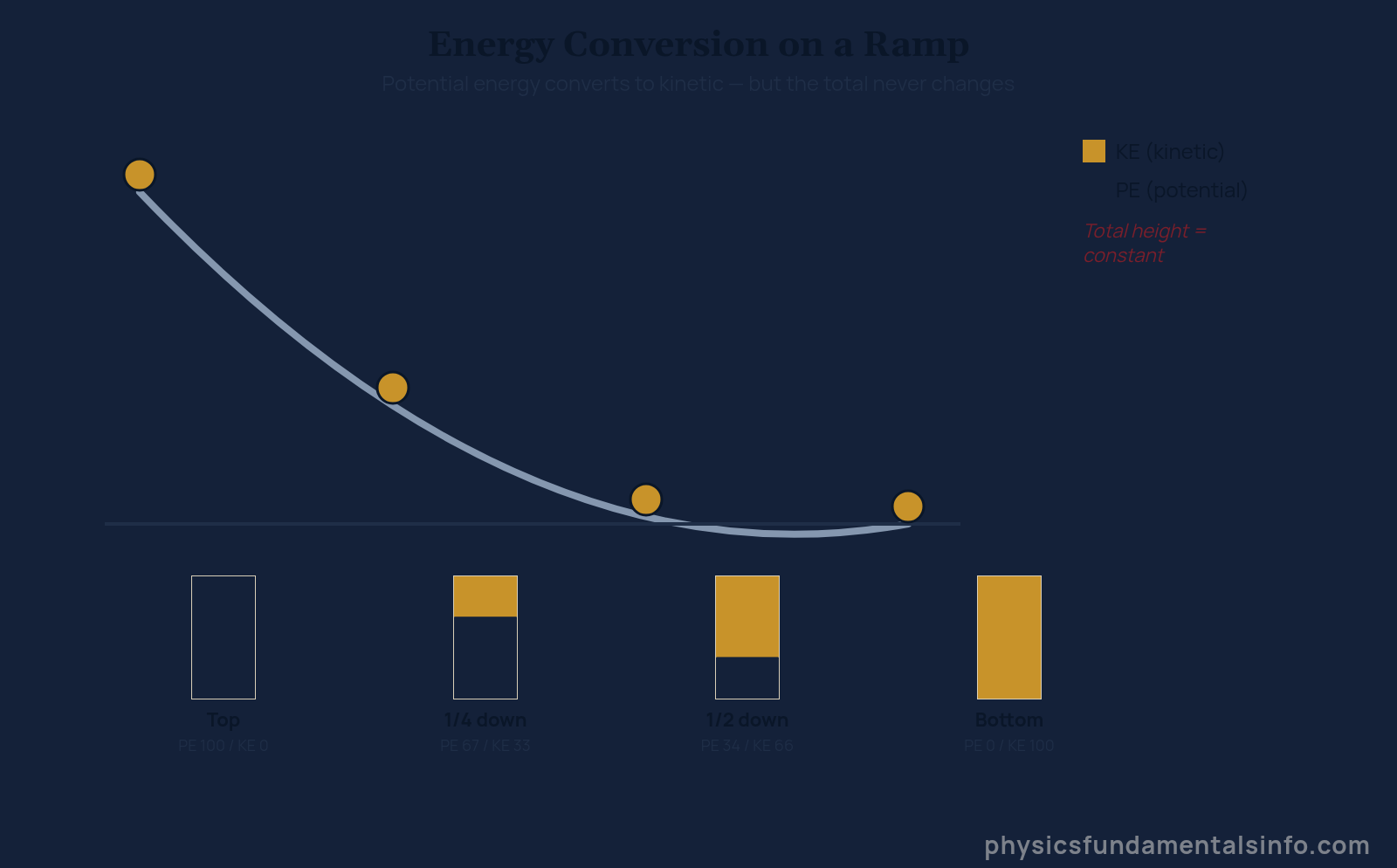
As a ball rolls down a ramp, potential energy converts to kinetic energy — but the total stays constant.
The Main Types of Energy
Energy comes in many named forms, but they all reduce to two big families: kinetic (energy of motion) and potential (stored energy). Here is how the common forms map out.
| Type of energy | Family | What it is | Everyday example |
|---|---|---|---|
| Kinetic | Motion | Energy of any moving mass | A rolling ball, flowing water |
| Gravitational potential | Stored | Energy due to height in gravity | Water behind a dam |
| Elastic potential | Stored | Energy in a stretched/compressed object | A drawn bow, a wound spring |
| Chemical | Stored | Energy in molecular bonds | Food, fuel, batteries |
| Thermal (internal) | Motion (microscopic) | Kinetic energy of jiggling particles | A hot drink |
| Electrical | Either | Energy carried by moving charge | Mains power, lightning |
| Radiant (light) | Motion | Energy carried by electromagnetic waves | Sunlight |
| Nuclear | Stored | Energy locked in atomic nuclei | The Sun, nuclear plants |
How Energy Relates to Power, Work and Force
These four words get muddled constantly, yet they mean very different things. Getting them straight is one of the fastest ways to raise an exam grade.
| Quantity | What it measures | SI unit | Type |
|---|---|---|---|
| Force | A push or pull on an object | newton (N) | Vector |
| Work | Energy transferred by a force over a distance | joule (J) | Scalar |
| Energy | Capacity to do work | joule (J) | Scalar |
| Power | Rate of transferring energy (energy ÷ time) | watt (W) = J/s | Scalar |
The key relationship: power = energy ÷ time. Two motors can deliver the same total energy, but the more powerful one delivers it faster. A 100 W bulb and a 2,000 W kettle both run on electrical energy — the kettle simply converts it twenty times faster.
The Law of Conservation of Energy
The most important rule about energy is short: energy cannot be created or destroyed, only transformed from one form to another. In any isolated system, the total energy is constant.
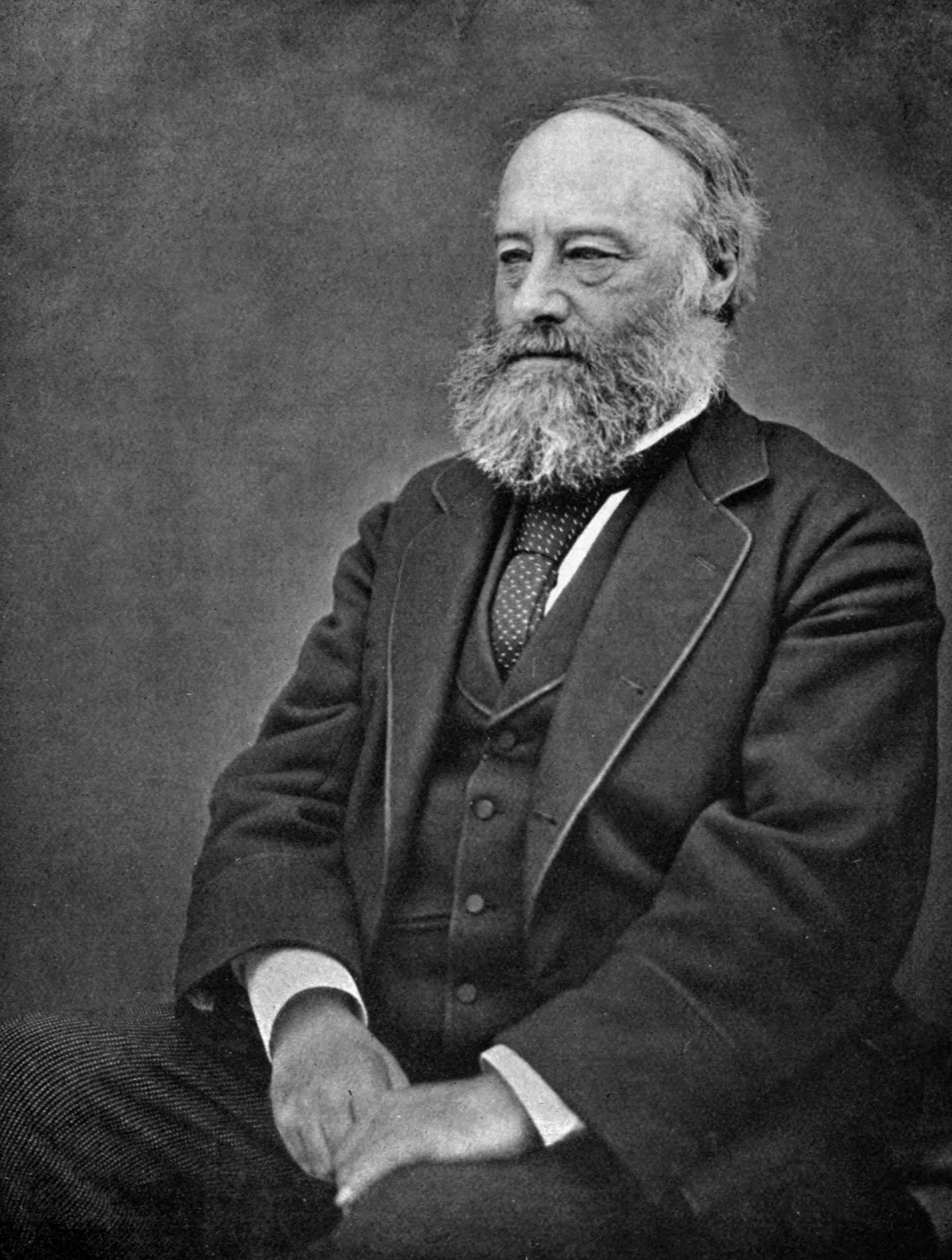
This principle, formalised through the 19th-century work of scientists including James Prescott Joule (after whom the unit is named), is one of the deepest laws in all of science. It holds from subatomic particles to galaxies, and no verified exception has ever been found. For a deeper technical treatment, see the HyperPhysics mechanics reference.
What “Losing” Energy Really Means
In everyday speech we “use up” energy — but physically, energy is never destroyed. When a car brakes, its kinetic energy doesn’t vanish; it becomes thermal energy in the brakes, tyres and air. When a bouncing ball ends up still, its energy has spread out as heat and sound.
So “lost” energy is really dispersed and degraded energy — spread thinly into the surroundings as low-grade heat, where it’s no longer useful to us. The total amount is unchanged; only its usefulness has dropped. This one-way spreading-out is the seed of the second law of thermodynamics.
What E = mc2 Tells Us
Einstein’s famous equation reveals that mass itself is a form of stored energy:
- E — rest energy, in joules (J)
- m — mass, in kilograms (kg)
- c — the speed of light, ≈ 3.00 × 10⁸ m/s (exactly 299,792,458 m/s)
Because c2 is enormous, even a tiny mass holds a colossal amount of energy. This is why nuclear reactions — in the Sun and in power stations — release so much energy from so little fuel: a small fraction of mass is converted directly into energy.
Common Misconceptions About Energy
Misconception 1: “Energy is a physical substance or fluid.”
Energy is not a material you can hold or bottle. It is a property of objects and systems — a number we calculate to track changes. Nothing literally “flows out” of a battery; rather, chemical energy is converted into electrical energy.
Misconception 2: “Energy gets used up and disappears.”
Energy is always conserved. “Using” energy means converting useful, concentrated forms into dispersed thermal energy. The total never changes — only its usefulness.
Misconception 3: “Energy and power are the same thing.”
Energy (joules) is the total amount transferred; power (watts) is how fast it’s transferred. A marathon runner and a sprinter may transfer similar energy overall, but the sprinter has far higher power.
Misconception 4: “An object at rest has no energy.”
A stationary object can hold gravitational potential energy (if raised), elastic potential energy (if a spring is loaded), thermal energy (it’s warm), chemical energy, and — via E = mc2 — rest energy. Zero motion does not mean zero energy.
Worked Problems
Show Solution
Solution:
Step 1: Use the kinetic energy formula. KE = ½mv2
Step 2: Substitute the values with units. KE = ½ × (2 kg) × (5 m/s)2
Step 3: Solve. KE = ½ × 2 × 25 = 25 kg·m2/s2
Answer: KE = 25 J
Show Solution
Solution:
Step 1: Use the potential energy formula. PE = mgh
Step 2: Substitute. PE = (2 kg) × (9.81 m/s2) × (10 m)
Step 3: Solve. PE = 196.2 kg·m2/s2
Answer: PE ≈ 196 J (3 s.f.)
Show Solution
Solution:
Step 1: Apply conservation of energy — all PE at the top becomes KE at the bottom. mgh = ½mv2
Step 2: Mass cancels, so v = √(2gh). Substitute: v = √(2 × 9.81 m/s2 × 20 m)
Step 3: Solve. v = √(392.4 m2/s2) = 19.81 m/s
Answer: v ≈ 19.8 m/s
Show Solution
Solution:
Step 1: KE gained equals PE lost over that 5 m. ΔPE = mgh = (0.5 kg)(9.81 m/s2)(5 m)
Step 2: Solve for KE. ΔPE = 24.525 J, so KE = 24.5 J
Step 3: Find speed from KE = ½mv2 → v = √(2KE/m) = √(2 × 24.525 / 0.5) = √98.1
Answer: KE ≈ 24.5 J and v ≈ 9.90 m/s
Show Solution
Solution:
Step 1: Use the elastic potential energy formula. Ee = ½kx2
Step 2: Substitute. Ee = ½ × (200 N/m) × (0.15 m)2
Step 3: Solve. Ee = ½ × 200 × 0.0225 = 2.25 J
Answer: Ee = 2.25 J
Show Solution
Solution:
Step 1: Net work equals the change in kinetic energy. W = ΔKE = ½m(v_f2 − v_i2)
Step 2: Substitute. W = ½ × 1500 × (302 − 102) = ½ × 1500 × (900 − 100)
Step 3: Solve. W = ½ × 1500 × 800 = 600 000 J
Answer: W = 600 kJ (6.00 × 10⁵ J)
Show Solution
Solution:
Step 1: PE at the top = KE at the bottom. mgh = ½mv2
Step 2: PE = (60 kg)(9.81 m/s2)(4 m) = 2354.4 J. So KE at the bottom = 2354.4 J too.
Step 3: v = √(2gh) = √(2 × 9.81 × 4) = √78.48 = 8.86 m/s
Answer: v ≈ 8.86 m/s; total energy ≈ 2 350 J at both top and bottom (conserved).
Show Solution
Solution:
Step 1: Convert mass to SI units. m = 1 g = 0.001 kg
Step 2: Substitute into E = mc2. E = (0.001 kg) × (3.00 × 10⁸ m/s)2
Step 3: Solve. E = 0.001 × 9.00 × 1016 = 9.0 × 10¹³ J
Answer: E ≈ 9.0 × 10¹³ J — about the energy of a large bomb, locked inside a paperclip’s worth of mass.