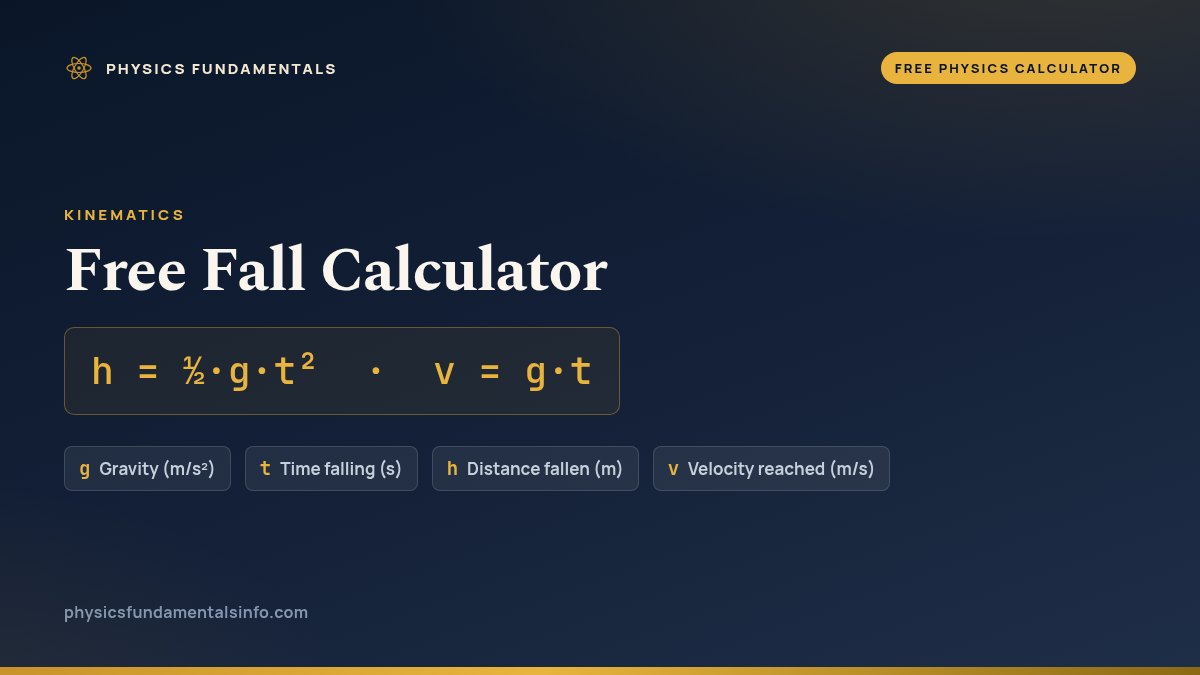
Free fall: an object dropped under gravity alone, with air resistance ignored, falls a distance set by the acceleration g and the time — h = ½·g·t², reaching a speed v = g·t. This free calculator takes any one of the time, distance or velocity, plus a gravity preset for Earth, the Moon, Mars or Jupiter, and returns the rest with every step of the working.
What Is the Free Fall Calculator?
The free fall calculator is a free online tool built on the formula h = ½·g·t² · v = g·t. Enter the values you already know, in whichever units suit you, and it solves for distance, velocity, time, gravity and shows every step of the substitution. Free Fall is distance, speed and time for an object dropped under gravity.
| Symbol | Quantity | Default unit | Also accepts | Example value |
|---|---|---|---|---|
| g | Gravity | m/s² | — | — |
| t | Time falling | s | — | — |
| h | Distance fallen | m | cm, km, ft | — |
| v | Velocity reached | m/s | km/h, mph | — |
How to calculate free fall
Free fall is the special case of constant-acceleration motion with zero initial velocity and gravity as the only force, with air resistance ignored. While it falls, the object speeds up by g every second — about 9.81 m/s² on Earth — so the distance grows with the square of the time, h = ½·g·t², and the speed grows in proportion to the time, v = g·t. Like projectile motion, the outcome is independent of mass: drop a feather and a hammer in a vacuum and they land together.
There are three steps. First, pick the gravity that applies — Earth, the Moon (1.62 m/s²), Mars (3.72 m/s²) or Jupiter (24.79 m/s²) from the preset menu, or type your own value of g. Second, enter the single quantity you know: the time falling t in seconds, the distance fallen h in metres, centimetres, kilometres or feet, or the velocity reached v in m/s, km/h or mph. Third, read the answer with the worked steps, which show the formula, your numbers substituted in, and the other two quantities with units.
Two relationships are worth feeling directly. Distance depends on the square of time, so in the first second an object drops about 4.9 m, but in two seconds it falls four times as far, roughly 19.6 m. Speed, by contrast, climbs linearly with time. Both scale with g, which is why switching the gravity preset shows how the same drop plays out on the Moon versus Jupiter: lower gravity means a slower, gentler fall, higher gravity a faster, harder one.
Free fall is the gateway to several neighbouring ideas. Add a horizontal launch and you have projectile motion, where the vertical part is exactly this free fall. For the full toolkit of constant-acceleration equations with any initial speed, see the SUVAT calculator, and to track the energy a falling object trades from height into motion, compare the gravitational potential energy and kinetic energy calculators, or look up a term in the physics glossary.
Worked example
Drop an object from rest through h = 45 m on Earth, where g = 9.81 m/s². The time to fall is t = sqrt(2h/g) = sqrt(2 × 45 / 9.81) = 3.03 s, and the speed at the bottom is v = g·t = 9.81 × 3.03 = 29.7 m/s (about 107 km/h). Move the same drop to the Moon, where g = 1.62 m/s², and it now takes about 7.5 s and arrives at only 12 m/s — a direct illustration of how every free-fall result scales with gravity.
Why it matters
Free fall underlies drop-tower rides and bungee jumps, measuring g with a falling object, reaction-time rulers, the timing of dropped-object safety calculations, and the weightless arcs flown by "vomit comet" research aircraft. It is also the starting point for understanding terminal velocity, the constant speed a real falling object reaches once air resistance balances gravity. Anywhere something is dropped, thrown or allowed to fall, these two formulas are where the analysis begins.
Frequently asked questions
What is free fall in physics?
Free fall is motion under gravity alone, with no air resistance and zero initial velocity. It is the special case of constant-acceleration motion in which the only force is weight, so the object accelerates downward at g. On Earth g ≈ 9.81 m/s², meaning the speed increases by about 9.81 m/s for every second of fall.
Does mass affect how fast something falls?
No. In free fall the result is independent of mass: a feather and a hammer dropped together hit the ground at the same instant, as Apollo 15 demonstrated on the airless Moon. Mass cancels out because gravity pulls harder on a heavier object but that object also needs more force to accelerate. Only when air resistance enters — heading toward terminal velocity — does mass and shape change the outcome.
What formulas does the free fall calculator use?
It uses the constant-acceleration equations with zero initial speed: distance h = ½·g·t², velocity v = g·t, and the combined relation v² = 2·g·h. Rearranged, the time to fall a distance h is t = sqrt(2h/g). Give the calculator any one of t, h or v and it returns the other two from these formulas.
How does gravity change the fall on the Moon, Mars or Jupiter?
Gravity g scales every result. A 45 m drop that takes about 3.0 s and reaches 30 m/s on Earth (g = 9.81 m/s²) takes roughly 7.5 s and only about 12 m/s on the Moon (g = 1.62 m/s²), because both time and speed depend on g. On Jupiter (g = 24.79 m/s²) the same drop is over in under 2 s. Switching the gravity preset shows this directly.
Does the free fall calculator account for air resistance?
No. Like the textbook equations, it assumes a vacuum — gravity is the only force. For a real object the drag force grows with speed until it balances weight and the object stops accelerating at its terminal velocity. Free fall is the gateway concept to that limit; the equations here are exact for dense, compact objects over short drops, and a good approximation otherwise.
References & formula source
- Young & Freedman — University Physics with Modern Physics, §2.5 (Freely Falling Bodies).
- Halliday, Resnick & Walker — Fundamentals of Physics, Chapter 2 (Motion Along a Straight Line: Free-Fall Acceleration).
- Serway & Jewett — Physics for Scientists and Engineers, §2.7 (Freely Falling Objects).
- Further reading: Free fall — Wikipedia