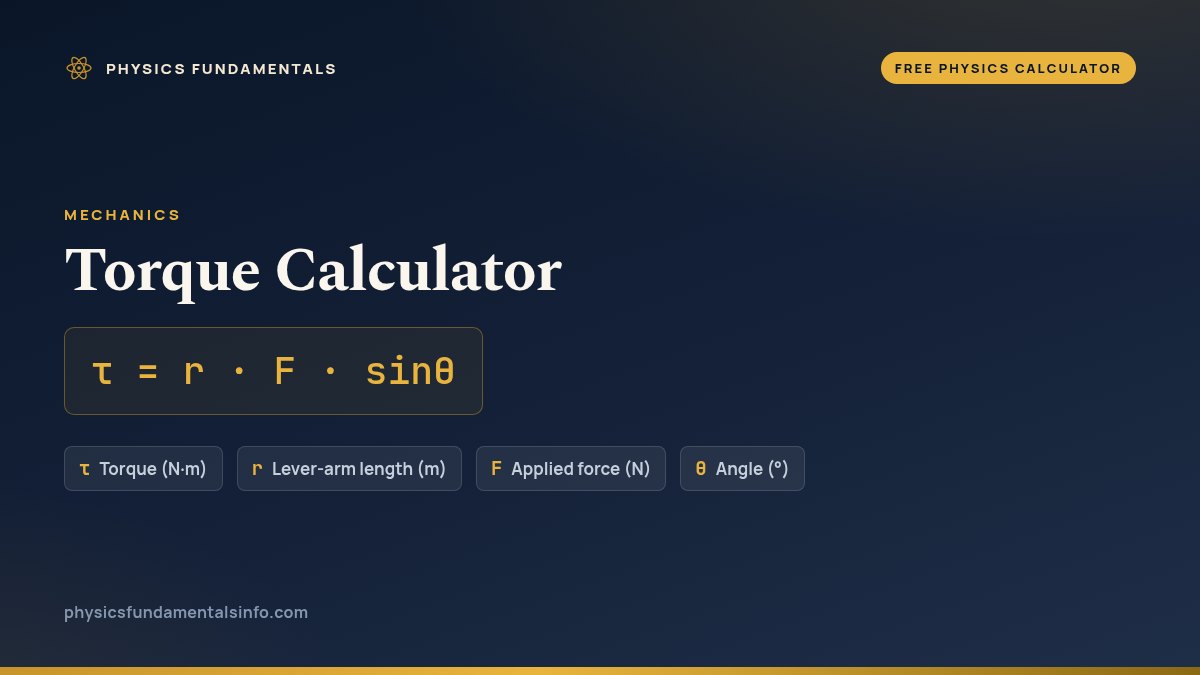
Torque is the turning effect of a force about a pivot — the rotational equivalent of force. It is the lever-arm length times the force times the sine of the angle between them, τ = r·F·sinθ. This free calculator solves for the torque, the force, the lever-arm length or the angle, in any unit, and shows every step of the working.
What Is the Torque Calculator?
The torque calculator is a free online tool built on the formula τ = r · F · sinθ. Enter the values you already know, in whichever units suit you, and it solves for torque, force, lever arm, angle and shows every step of the substitution. Torque is turning effect of a force about a pivot.
| Symbol | Quantity | Default unit | Also accepts | Example value |
|---|---|---|---|---|
| τ | Torque | N·m | lb·ft | 15 |
| r | Lever-arm length | m | cm, mm | 0.3 |
| F | Applied force | N | kN | 50 |
| θ | Angle | ° | — | 90 |
How to calculate torque
Torque is the rotational equivalent of force — it measures a force's tendency to cause rotation about a pivot. It depends on three things: the force F, the lever-arm length r from the pivot to where the force acts, and the angle θ between them. Multiply all three with a sine on the angle — τ = r·F·sinθ — and the answer is a turning effect measured in newton-metres.
There are three steps. First, decide what you want — the torque, or one of F, r or θ — and pick it in the calculator's Solve for menu. Second, enter the values you know: the lever-arm length in metres, centimetres or millimetres, the force in newtons or kilonewtons, and the angle in degrees. Third, read the answer with the worked steps, which show the formula, your numbers substituted in, and the result in newton-metres and pound-feet.
The angle matters because only the part of the force at right angles to the lever arm does any turning. A force applied perpendicular to the arm (θ = 90°, so sinθ = 1) produces the maximum turning effect, τ = r·F; a force pointing straight along the arm (θ = 0°) produces none at all. This is why a longer wrench loosens a stubborn bolt more easily — torque is proportional to r — and why you push a door at its outer edge, perpendicular to its face, rather than near the hinge.
Torque is the gateway to rotational dynamics. Just as Newton's second law says a net force produces linear acceleration in proportion to mass, a net torque produces angular acceleration in proportion to the body's moment of inertia, the rotational analogue of mass. Sustained over time that acceleration builds up the rotation rate, or angular velocity, of the spinning object. For the inward force that keeps that object on its circular path, see the centripetal force calculator, or look up a term in the physics glossary.
Worked example
A force F = 50 N is applied at the end of a spanner of length r = 0.30 m, perpendicular to the handle so θ = 90°. The torque is τ = r·F·sinθ = 0.30 × 50 × sin90° = 15 N·m. Double the spanner length to 0.60 m and the torque doubles to 30 N·m; apply the same force at θ = 30° instead of 90° and it falls to 0.30 × 50 × sin30° = 7.5 N·m — a direct illustration of the lever-arm and angle dependence in τ = r·F·sinθ.
Why it matters
Torque governs tightening bolts to specification with a torque wrench, see-saws and levers, the output ratings of engines and electric motors, the gearing of bicycles and gearboxes, robotic joints, door handles, and the stability of cranes and structures. Anywhere a force has to turn, twist or balance something about a pivot, τ = r·F·sinθ is the starting point.
Frequently asked questions
What is torque in physics?
Torque is the rotational equivalent of force — it measures a force’s tendency to turn an object about a pivot or axis. It is the product of the lever-arm length r, the applied force F and the sine of the angle θ between them: τ = r·F·sinθ. Torque is measured in newton-metres (N·m), and it is what produces angular acceleration just as a net force produces linear acceleration.
Why is there a sinθ in the torque formula?
Only the component of the force perpendicular to the lever arm twists the object; the component pointing along the arm just pulls or pushes on the pivot and produces no turning. The factor sinθ extracts that perpendicular component, so torque is greatest when the force is applied at 90° (sin90° = 1) and zero when the force is in line with the arm (sin0° = 0). Equivalently, r·sinθ is the perpendicular distance from the pivot to the force’s line of action — the “moment arm”.
What units does the torque calculator use?
Lever-arm length r is entered in metres, centimetres or millimetres; force F in newtons or kilonewtons; and the angle θ in degrees. Torque is returned in newton-metres (N·m), with a pound-feet (lb·ft) value alongside, where 1 lb·ft ≈ 1.35582 N·m. Note that the newton-metre of torque is kept distinct from the joule of energy even though both are N·m.
Why does a longer wrench loosen a stubborn bolt?
Torque is proportional to the lever-arm length r, so doubling the length of the wrench doubles the torque you apply for the same effort at the end. A longer spanner, breaker bar or door handle multiplies your turning effect, which is exactly why mechanics reach for a longer tool — or slip a pipe over the handle — when a bolt will not budge.
What is the difference between torque and moment?
In everyday physics “torque” and “moment of a force” mean the same thing: r·F·sinθ, the turning effect of a force about a point. Engineers often say “moment” for the bending or turning effect on a static structure and “torque” for the twisting effect on a rotating shaft, but the formula and units (N·m) are identical. Both are vectors whose direction follows the right-hand rule.
References & formula source
- Young & Freedman — University Physics with Modern Physics, Chapter 10 (Dynamics of Rotational Motion).
- Halliday, Resnick & Walker — Fundamentals of Physics, Chapter 10 (Rotation) and Chapter 11 (Rolling, Torque & Angular Momentum).
- Hibbeler — Engineering Mechanics: Statics, Chapter 4 (Force System Resultants: Moment of a Force).
- Further reading: Torque — Wikipedia