How to solve physics problems reliably comes down to one repeatable routine: translate the words into data, draw the situation and fix a sign convention, name the governing principle, rearrange the equation in symbols, substitute values in SI units, then check units, magnitude and limiting cases before writing the answer.
You read the question twice. You understand every word in it, you know exactly which chapter it came from, and the page in front of you is still blank.
That blank-page moment is almost never a knowledge problem. It is a process problem — and process is the one part of physics nobody teaches you directly.
What Does It Mean to Solve a Physics Problem?
Solving a physics problem means converting a described situation into a mathematical model, extracting the unknown from that model, and confirming the result is physically sensible. Three jobs, in that order.
Notice what is missing from that description: recall. Most exam boards hand you a formula sheet, and every serious textbook prints one in the back. The equations were never the scarce resource.
The scarce resource is the mapping — the step where a paragraph about a braking cyclist becomes a diagram, a sign convention and one chosen equation. Students who solve quickly are not remembering more than you. They are running a fixed routine that removes decisions.
And routines can be learned in an afternoon. That is the good news buried inside every “I’m just not a physics person” story.
The 6-Step Framework at a Glance
Here is the whole method in one place. Read it once now, then use the detailed walk-through below to watch each step do real work.
- Translate the words into listed data and one named unknown.
- Draw the situation and choose which direction is positive.
- Choose the principle that governs the situation, then take your equation from it.
- Rearrange to isolate the unknown, in symbols, before any number appears.
- Substitute in SI units, carrying units through the arithmetic.
- Check the units, the magnitude and a limiting case, then round sensibly.
Each step earns its place by blocking one specific, predictable mistake:
| Step | What you actually do | The error it prevents |
|---|---|---|
| 1. Translate | List every given quantity with its symbol and unit; name the unknown. | Missing a value hidden inside a phrase such as “from rest” or “smooth surface”. |
| 2. Draw | Sketch it, mark the forces or rays or currents, and fix a positive direction. | Sign errors — the single biggest source of lost marks in mechanics. |
| 3. Choose the principle | Ask what is conserved or which law applies, then take the equation from that law. | Formula-hunting: picking an equation because it happens to contain the right letters. |
| 4. Rearrange | Isolate the unknown algebraically while everything is still a symbol. | Arithmetic slips that hide inside a half-finished calculation. |
| 5. Substitute | Convert to SI units first, then substitute, carrying the units with the numbers. | Prefix and conversion slips: km/h against m/s, grams against kilograms, milliamps against amps. |
| 6. Check | Test the units, the order of magnitude and one limiting case; then round. | Submitting an answer that is physically impossible without noticing. |

The six steps run in order, and a failed check sends you back to the diagram — not to a different formula.
How to Solve Physics Problems: The Six Steps in Detail
Each step below is short on purpose. The skill is not in understanding them — it is in refusing to skip one when you are in a hurry.
Step 1 — Translate the Words into Data
Write out every quantity the question gives you, each with its symbol and its unit, then write the unknown on its own line. Do this even when the problem looks trivial.
Physics questions hide data inside ordinary English. Four phrases account for most of it:
- “Starts from rest” — the initial velocity is zero, u = 0.
- “Smooth surface” — friction is zero.
- “Dropped” — the initial vertical velocity is zero.
- “Comes to a stop” — the final velocity is zero, v = 0.
Miss one of those and the problem genuinely does become unsolvable — not because you lack an equation, but because you are one value short and do not know it. The step takes about twenty seconds and rescues a surprising share of the questions students call impossible.
Step 2 — Draw It and Fix Your Signs
Draw the situation and mark a positive direction on the page before you write a single equation. A sketch is not decoration; it is where the physics gets decided.
What you draw depends on the branch. Mechanics wants a free-body diagram showing every force acting on the object — if you are shaky on which forces belong there, our guide to the types of forces in physics works through contact and field forces one at a time. Optics wants a ray diagram with the normal drawn in. Circuits want the circuit redrawn cleanly, loops and junctions labelled.
Then commit to a sign convention. Because velocity, acceleration and force are all vector quantities, their signs mean nothing except relative to the direction you chose — and a marker cannot read your mind unless you write it down.
A common student slip: flipping the sign of gravity halfway through a thrown-ball problem because the ball “is coming down now”. It is not. If up is positive, the acceleration stays negative for the entire flight, including the instant at the top when the velocity is zero.
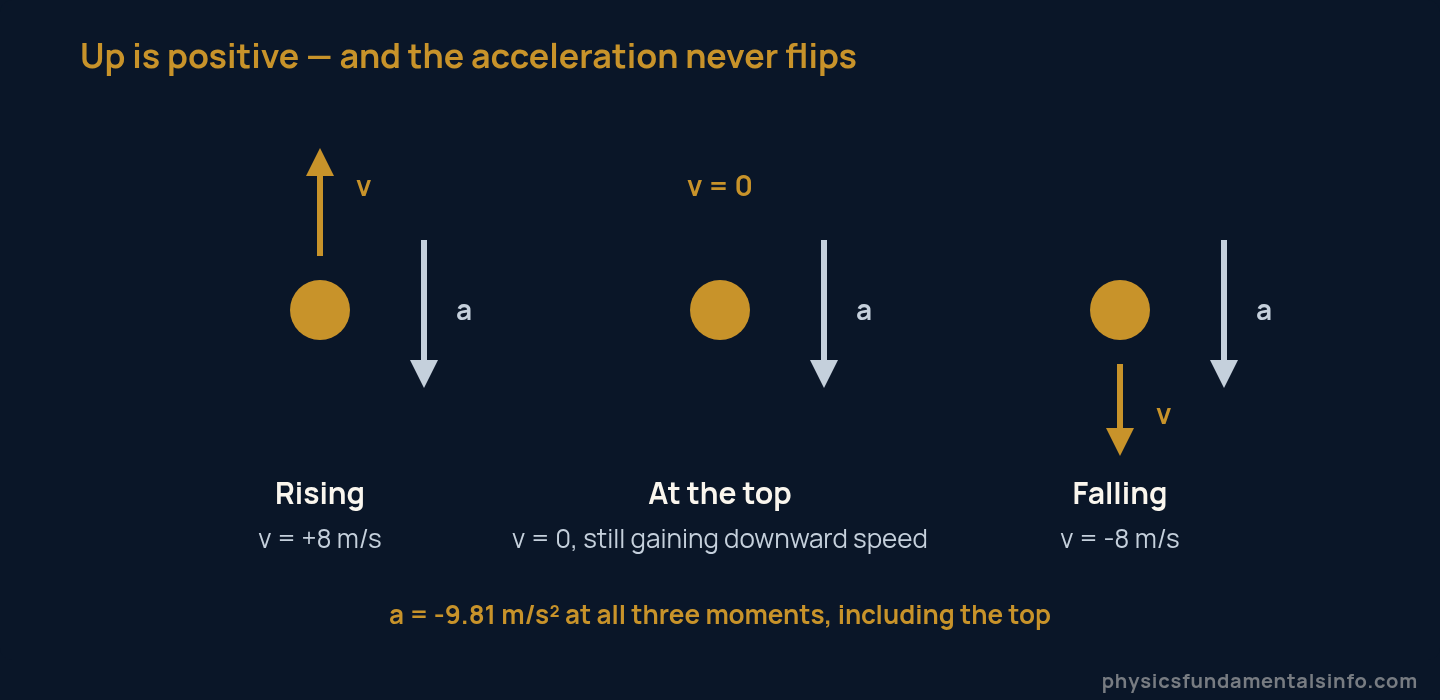
Velocity changes sign during the flight. Acceleration does not — which is exactly why the sign convention has to be written down first.
Step 3 — Name the Principle, Not the Formula
Before choosing an equation, say which physical principle governs the situation. Equations are consequences of principles, and naming the principle first is what stops you scanning a formula sheet for matching letters.
The question is short: what is conserved here, or what law connects these quantities? A handful of triggers cover most of an introductory course:
- A force acts and something accelerates — Newton’s second law.
- Two objects interact briefly — momentum is conserved.
- Nothing dissipates energy — mechanical energy is conserved.
- Charge flows around a loop — charge and energy conservation give you Kirchhoff’s rules.
This is also why equations are worth learning in families rather than as a flat list — our breakdown of physics formulas by group organises them by the principle each one descends from, which is the order your memory actually wants them in.
One test tells you whether Step 3 was done honestly. Can you say why that equation applies here without pointing at the letters in it? If not, you are formula-hunting.
Step 4 — Rearrange in Symbols Before You Touch a Number
Isolate the unknown algebraically while every quantity is still a letter. Numbers go in once, at the end, and only into a finished expression.
Take the kinematic relation that links speeds to distance without involving time — one of the SUVAT equations:
If the unknown is the distance, rearrange before substituting anything:
- s — displacement, in metres (m)
- u — initial velocity, in metres per second (m/s)
- v — final velocity, in metres per second (m/s)
- a — constant acceleration, in metres per second squared (m/s2)
Three things improve at once. Mistakes become visible, because a wrong symbolic answer looks wrong in a way that a wrong decimal never does. The structure can be sanity-checked before you commit — double the acceleration here and the distance must halve. And when the question changes the numbers, you reuse the expression instead of redoing the problem.
With the rearranged expression in hand, you can confirm the arithmetic using our SUVAT calculator, which solves for any of s, u, v, a or t and prints the working line by line — a way to check Step 4, never a way to skip it.
Rearranging is the step most students name as their weak point, so drill it on its own. The lab below lets you pick a relationship, choose what to solve for, and watch the rearrangement and the unit check happen side by side.
Step 5 — Substitute in SI Units, Carrying the Units
Convert every quantity to SI units before it enters the equation, then write the units alongside the numbers as you substitute. Two habits, one line of working.
The conversions that catch people are always the same handful: km/h into m/s, grams into kilograms, centimetres into metres, minutes into seconds, degrees Celsius into kelvin, and the electrical prefixes — milliamps, kilohms, microfarads. Our guide to SI units in physics covers the conversion rules in full; the underlying system of seven base units is maintained by NIST, which is why every equation you meet assumes them.
Carrying units also converts your calculator into an error detector. Substitute into F = ma with mass in kilograms and acceleration in metres per second squared and the units multiply out to kg·m/s2, which is the newton — so if your working produces anything else, the mistake happened before the arithmetic did.
One temperature warning worth internalising: a temperature difference of 80 °C equals a difference of 80 K exactly, so ΔT needs no conversion. An absolute temperature does. Confusing the two is a classic thermodynamics trap.
Step 6 — Check the Answer Three Ways
Run three fast checks before you write the final line: do the units come out right, is the magnitude believable, and does a limiting case behave sensibly? Each takes seconds and each catches a different class of error.
- Units. The units on both sides must match. In v2 = u2 + 2as, the right-hand side gives m2/s2 plus (m/s2)(m) = m2/s2 — consistent, so the equation survives the test.
- Magnitude. Compare against something you know. A person cannot run at 90 m/s. A household appliance does not draw 400 A. If your answer is thousands of times off, the error is usually a unit, not the algebra.
- Limiting case. Push a variable to zero or infinity and see whether the formula still makes sense. Set the acceleration to zero in s = (v2 – u2) / (2a) and the expression blows up — correctly, because with no acceleration the speed can never change.
Then round. Your answer cannot be more precise than the least precise measurement you were given, so a question quoting 5.0 m and 9.81 m/s2 supports two significant figures, not the nine your calculator offers.
How the Framework Changes Between Mechanics, Circuits and Optics
The six steps never change, but Steps 2, 3 and 5 look different in each branch of physics. Knowing what they turn into is most of what “being good at” a topic means.
| Branch | Step 2: what you draw | Step 3: principle you reach for first | Step 5: the usual unit trap |
|---|---|---|---|
| Kinematics and dynamics | Free-body diagram with labelled axes | Newton’s second law, or conservation of energy or momentum | km/h left unconverted; grams used instead of kilograms |
| Circuits | Redrawn circuit with loops and junctions marked | Conservation of charge and energy (Kirchhoff), then Ohm’s law | Prefixes: milliamps, kilohms, microfarads |
| Optics | Ray diagram with the normal drawn and angles measured from it | Snell’s law, or the lens and mirror equation | Angles taken from the surface instead of the normal; calculator left in radians |
| Thermodynamics | System boundary with before and after states labelled | First law — energy conservation across the boundary | Celsius used where absolute temperature is required |
| Waves | Snapshot of the wave with wavelength and amplitude marked | The wave relation v = fλ, then superposition | Nanometres left unconverted; kilohertz treated as hertz |
Read the table by column rather than by row. The pattern that emerges — draw the situation, invoke a conservation law, watch the prefixes — is the framework itself, wearing five different costumes.
Where This Framework Shows Up Outside the Classroom
The same six steps are what professional practice looks like when calculations carry consequences. Four examples, each leaning on a different step.
Collision investigation. An investigator measuring skid marks works backwards to impact speed using the same relation you rearranged above, with the deceleration coming from the road surface. The reconstruction stands up in court because every assumption was written down at Step 1.
Spacecraft navigation. NASA lost the Mars Climate Orbiter in 1999 because one team’s software produced results in pound-force seconds while the spacecraft’s navigation expected newton-seconds. The physics was right and the mission still failed. That is Step 5, at a cost of hundreds of millions of dollars.
Engineering sign-off. Before trusting a simulation, engineers run the order-of-magnitude check from Step 6 by hand. Software will happily return a beam deflection of forty metres and not care; a human comparing that against the length of the beam will.
Clinical imaging. A radiographer setting exposure works from a physical relationship and a unit-consistent calculation, then applies a magnitude check against expected dose. The check exists precisely because a decimal slip has a patient on the other end of it.
Common Misconceptions About Solving Physics Problems
Four beliefs do more damage than any missing equation.
“It’s about memorising formulas”
Memorised formulas are the cheapest part of the skill, and most exams supply them anyway. What is never supplied is the judgement in Step 3 — deciding which principle governs a situation you have not seen before. Spend your revision time there.
“If I can follow the solution, I can solve it”
Following a worked solution is recognition; solving from a blank page is retrieval, and they are different mental operations. Recognition feels like understanding, which is exactly what makes it dangerous. The only honest test is a blank page and a closed book.
“Put the numbers in early to see what happens”
Substituting early buries your reasoning under arithmetic. Once a line reads 0.2553 rather than V/R, you have lost the ability to spot that the structure is wrong — and you have thrown away the reusable result.
“A negative answer means I made a mistake”
Usually it means the opposite. A negative sign generally reports a direction opposite to the one you chose as positive in Step 2 — a deceleration, a force pointing the other way, a charge flowing back. Read the sign as information, then decide whether it is impossible. Negative mass or negative absolute temperature is an error; negative velocity rarely is.
How to Practise So the Framework Becomes Automatic
Practise the framework deliberately for two or three weeks and it stops being a checklist and becomes the way you read a question. A few habits do most of the work.
- Keep an error log tagged by step number. Every mistake belongs to one of the six steps. After twenty problems the pattern is unmistakable, and most students find they are losing marks in one step, not six.
- Sit with a hard problem for ten minutes before opening the solution. The struggle is what builds retrieval; reading the answer early feels productive and teaches almost nothing.
- When you do open it, read one line at a time. Cover the rest, take the hint, close the book, and continue on your own.
- Redo a solved problem two days later from a blank page. If you cannot, you had recognised it rather than learned it.
- Mix topics in a session. Doing twenty momentum problems in a row trains Step 4 and skips Step 3 entirely, because you already know which principle applies.
- Estimate before calculating. Committing to a guess sharpens the magnitude check and costs nothing.
If you want to see the same discipline set out at university level, the MIT 8.01 online textbook devotes its entire second chapter to units, dimensional analysis, problem solving and estimation — before it teaches any mechanics at all. That ordering is not an accident.
Worked Problems
Six problems, rising in difficulty, each solved with the same six steps. Every one ends with a link to the matching calculator so you can vary the numbers and confirm your own working.