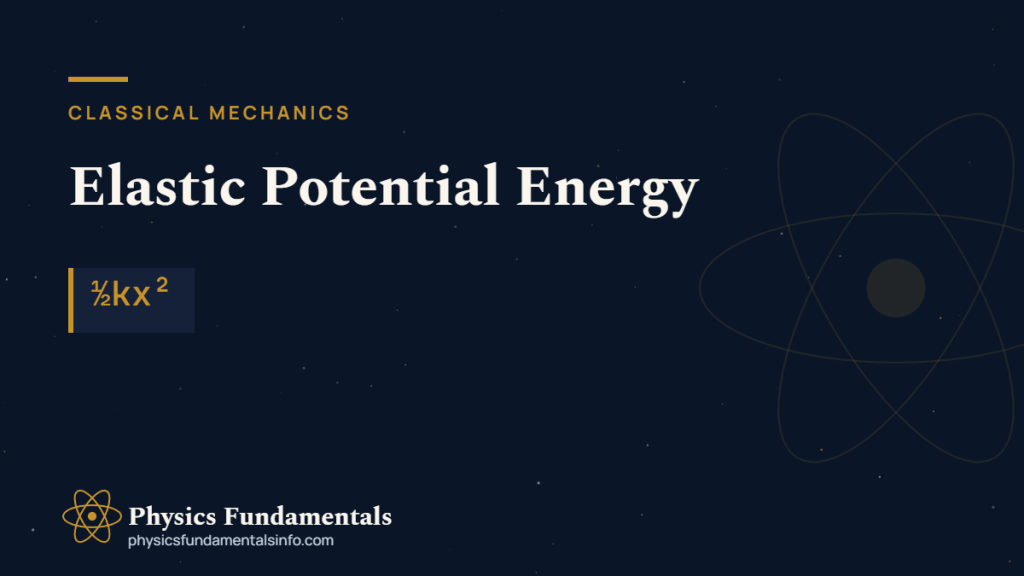
Elastic potential energy is the energy stored in an elastic object — such as a spring, a rubber band, or a trampoline — when it is stretched or compressed from its natural length. For an ideal spring that obeys Hooke’s law, it equals one-half of the spring constant times the displacement squared (EPE = ½kx2), measured in joules (J).
Pull back a bowstring and hold it. Nothing is moving, yet you can feel that the bow is loaded — straining to snap forward the instant you let go. That stored, ready-to-release energy is elastic potential energy, and it is hiding in far more of your day than you might think.
It is in the trampoline that throws a child skyward, the squashed suspension spring soaking up a pothole, and the wound mainspring driving a mechanical watch. In every case, something elastic has been deformed, energy has been tucked away inside it, and that energy is waiting to come back out as motion.
What Is Elastic Potential Energy?
Elastic potential energy is the energy an object stores when it is deformed — stretched, compressed, bent, or twisted — and which it gives back when it returns to its original shape. The key word is elastic: the object must spring back. Squash a lump of clay and it stays squashed, so it stores almost nothing; squash a spring and it pushes right back.
Think of it as energy you can put in and get out again. The work you do stretching a spring does not vanish. It is held in the spring as potential energy, ready to be released as kinetic energy the moment you release your grip.
More precisely, elastic potential energy is the energy stored in any object that obeys Hooke’s law when it is displaced by a distance x from its equilibrium position. It is one member of a wider family of stored energy — the broader idea of energy in physics as the capacity to do work.
The Elastic Potential Energy Formula
For an ideal spring, the stored energy is given by one compact expression:
Each symbol has a precise meaning and a fixed SI unit:
- EPE — the elastic potential energy stored, measured in joules (J).
- k — the spring constant (also called the force constant), a measure of stiffness, measured in newtons per metre (N/m). A larger k means a stiffer spring.
- x — the displacement (the extension or compression) from the spring’s natural length, measured in metres (m).
A quick unit check confirms the formula gives energy: (N/m) × (m2) = N·m = J. Everything lands in joules, exactly as it should.
You can plug numbers straight in, or compute it instantly with our Hooke’s Law calculator, which solves for the spring force, the constant, the extension, or the stored energy. The same quantity is derived step by step in OpenStax University Physics if you want the full textbook treatment.
How a Spring Stores Energy
Where does the ½ come from? It is not a fudge factor — it falls straight out of how the spring pushes back.
Hooke’s law says the force needed to stretch a spring grows with the stretch: F = kx. At the very start, when x is tiny, the force is almost nothing. By the time you have pulled it to its full extension, the force is at its maximum value, kx. The force is not constant — it climbs in a straight line from zero up to kx.
Because work is force times distance, and the force here is changing, you cannot just multiply the final force by the distance. You must use the average force. Since the force rises evenly from 0 to kx, its average is exactly halfway: ½kx. Multiply that average force by the distance moved, x, and you get the stored energy:
There is a neat geometric way to see the same result. Plot force against extension and you get a straight line. The work done — and therefore the energy stored — is the area under that line. That area is a triangle, and a triangle’s area is ½ × base × height = ½ × x × kx = ½kx2. The ½ is simply the ½ in the area of a triangle.
This stored energy equals the work done against the spring while deforming it. No energy is lost in an ideal spring, so every joule you put in is recoverable.
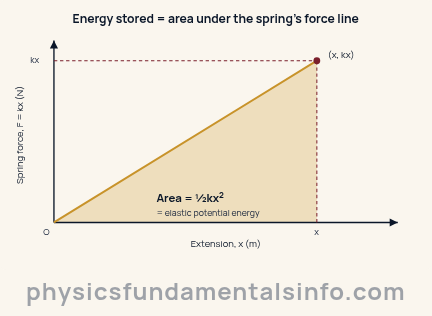
The shaded triangle under the force–extension line is the work done on the spring, which equals the stored elastic potential energy, ½kx2.
Want to feel the relationship between stiffness, stretch, and stored energy directly? The interactive lab below lets you drag the spring and watch the force, the energy, and the shaded area update live.
Why Doubling the Stretch Quadruples the Energy
Here is the single most misunderstood thing about elastic potential energy. The force in a spring grows in step with the stretch — pull twice as far, feel twice the force. But the energy does not. Energy depends on x squared, so pull twice as far and you store four times the energy.
That little exponent changes everything. Triple the stretch and the stored energy goes up ninefold. Stretch a spring to ten times its original displacement and it holds a hundred times the energy. The numbers climb fast.
The table below fixes the spring (k = 200 N/m) and only changes how far it is stretched. Watch the energy column race ahead of the extension column.
| Extension x (m) | x2 (m2) | EPE = ½ × 200 × x2 (J) | Energy vs the 0.10 m row |
|---|---|---|---|
| 0.05 | 0.0025 | 0.25 | ¼ × |
| 0.10 | 0.0100 | 1.0 | 1 × (baseline) |
| 0.20 | 0.0400 | 4.0 | 4 × |
| 0.30 | 0.0900 | 9.0 | 9 × |
| 0.40 | 0.1600 | 16.0 | 16 × |
The same x2 has a second consequence. Squaring a negative number gives a positive result, so compressing a spring by a certain distance stores exactly the same energy as stretching it by that distance. The spring does not care which way you push it — only how far.
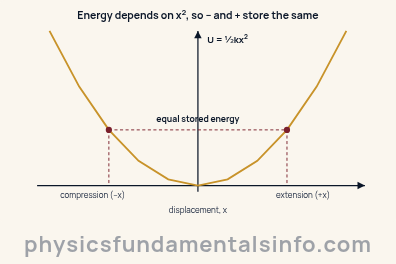
The energy curve is a symmetric parabola: a push and a pull of the same size sit at the same height, storing equal energy.
Real-World Examples of Elastic Potential Energy
Once you know what to look for, stored elastic energy turns up everywhere — usually a moment before something springs, launches, or bounces.
A drawn bow
Pulling the string bends the limbs of the bow and loads them with elastic potential energy. Release the string and that energy converts almost entirely into the kinetic energy of the arrow. A heavier draw and a longer pull both mean more stored energy — and a faster arrow.
A trampoline or diving board
When you land, your weight stretches the mat (or bends the board) and stores energy in the deformation. The surface then snaps back, returning that energy and throwing you upward. Land harder, deform it more, and it launches you higher.
A car’s suspension springs
Hit a bump and the coil springs in a car’s suspension compress, absorbing the jolt as elastic potential energy instead of passing it straight to the cabin. The spring then releases that energy in a controlled way, smoothing the ride. These springs are stiff — typical values run to tens of thousands of N/m.
A bungee cord
A bungee jump is a clean swap between two kinds of stored energy. At the top, the jumper has gravitational potential energy. As they fall and the cord stretches taut, that energy is transferred into elastic potential energy in the cord — which then yanks them back up.
A wound mainspring
Winding a mechanical watch or a clockwork toy twists a coiled spring, packing it with elastic potential energy. The spring unwinds slowly, releasing that energy bit by bit to turn the gears — a tiny, portable energy store.

Common Misconceptions About Elastic Potential Energy
A handful of specific errors trip up almost every student. Clear these and the topic becomes much easier.
“The energy grows in step with the stretch”
This is the big one. It is the force that grows in step with the stretch (F = kx); the energy grows with the stretch squared (½kx2). Pull twice as far and you do not double the energy — you quadruple it. Mixing these up is the most common slip in spring problems.
“You can just multiply force by distance”
Because the spring force changes as you stretch it, multiplying the final force kx by the distance x gives kx2 — double the right answer. You must use the average force, ½kx, which is where the ½ comes from. In practice, forgetting the ½ is the fastest way to be exactly twice off.
“Compressing a spring stores negative energy”
The minus sign in Hooke’s law (F = −kx) describes the direction of the restoring force, not a negative energy. Energy is always positive, because x2 is always positive. A compressed spring stores just as much usable energy as a stretched one.
“½kx2 works for any material at any stretch”
The formula only holds while the object obeys Hooke’s law — its linear, elastic region. Stretch a spring past its elastic limit and it deforms permanently; real rubber bands are non-linear and lose energy to heat each cycle. Beyond those limits, ½kx2 is an approximation at best.
How Elastic Potential Energy Relates to Other Concepts
Elastic potential energy does not sit on its own — it is one node in a tightly connected web of mechanics ideas.
Hooke’s law is its foundation. Hooke’s law gives the force (F = kx); elastic potential energy is the energy that force stores, equal to the area under the Hooke’s-law line. Understanding Hooke’s law first makes the ½kx2 formula feel inevitable rather than arbitrary.
Kinetic energy is its partner in motion. When a spring releases, its stored ½kx2 becomes ½mv2 of movement. A spring-loaded launcher is just elastic potential energy turning into kinetic energy — and notice both formulas carry a square, which is no coincidence.
Simple harmonic motion is what you get when you let a mass on a spring run free. Energy sloshes endlessly between elastic potential energy at the turning points and kinetic energy at the centre — a cycle explored in depth in OpenStax University Physics §15.2. That continuous trade is the engine of simple harmonic motion.
It also sits beside gravitational potential energy as the other everyday form of stored energy. A bungee cord converts one into the other; the difference is that gravitational PE grows linearly with height (mgh), while elastic PE grows with the square of displacement.
| Energy type | Formula | Grows with | Stored when… | Everyday example |
|---|---|---|---|---|
| Elastic potential | ½kx2 | displacement2 (x2) | a spring or elastic object is deformed | drawn bow, compressed car spring |
| Kinetic | ½mv2 | speed2 (v2) | an object is moving | a rolling ball, a moving car |
| Gravitational potential | mgh | height h (linear) | a mass is raised | water behind a dam, a lifted weight |
Worked Problems
Show Solution
Solution:
Step 1: Use the elastic potential energy formula. EPE = ½kx2.
Step 2: Substitute with units. EPE = ½ × (200 N/m) × (0.10 m)2.
Step 3: Solve. (0.10 m)2 = 0.010 m2, so EPE = ½ × 200 × 0.010 = 1.0 J.
Answer: 1.0 J
Show Solution
Solution:
Step 1: Apply EPE = ½kx2 again.
Step 2: Substitute. EPE = ½ × (200 N/m) × (0.20 m)2 = ½ × 200 × 0.040.
Step 3: Solve. EPE = 4.0 J.
Step 4: Compare. Doubling the stretch (0.10 m → 0.20 m) raised the energy from 1.0 J to 4.0 J — a factor of four, because energy depends on x2.
Answer: 4.0 J — four times the energy of Problem 1
Show Solution
Solution:
Step 1: Start from EPE = ½kx2 and rearrange for x: x = √(2 × EPE ÷ k).
Step 2: Substitute. x = √(2 × 5.0 J ÷ 250 N/m) = √(10 ÷ 250).
Step 3: Solve. x = √0.040 = 0.20 m.
Answer: 0.20 m
Show Solution
Solution:
Step 1: Rearrange EPE = ½kx2 for k: k = 2 × EPE ÷ x2.
Step 2: Substitute. k = (2 × 12 J) ÷ (0.40 m)2 = 24 ÷ 0.16.
Step 3: Solve. k = 150 N/m.
Answer: 150 N/m
Show Solution
Solution:
Step 1: Find the stored elastic potential energy. EPE = ½kx2 = ½ × 400 × (0.05)2 = ½ × 400 × 0.0025 = 0.50 J.
Step 2: Set it equal to kinetic energy (energy is conserved). ½mv2 = 0.50 J.
Step 3: Rearrange for v. v = √(2 × 0.50 ÷ 0.020) = √(1.0 ÷ 0.020) = √50.
Step 4: Solve. v ≈ 7.1 m/s.
Answer: ≈ 7.1 m/s
Show Solution
Solution:
Step 1: At rest, the spring force balances the weight: kx = mg.
Step 2: Solve for k. k = mg ÷ x = (2.0 × 9.81) ÷ 0.10 = 19.62 ÷ 0.10 = 196 N/m (to 3 s.f.).
Step 3: Find the stored energy. EPE = ½kx2 = ½ × 196.2 × (0.10)2 = ½ × 196.2 × 0.010 ≈ 0.98 J.
Step 4: Sanity check. The weight dropped through 0.10 m, releasing mgh = 2.0 × 9.81 × 0.10 ≈ 1.96 J of gravitational PE — yet only ≈ 0.98 J (exactly half) is stored in the spring. The other half went into kinetic energy as the mass sped up on its way down, which is why a real mass overshoots and oscillates rather than stopping gently.
Answer: (a) ≈ 196 N/m; (b) ≈ 0.98 J
Show Solution
Solution:
Step 1: Find the stored elastic potential energy. EPE = ½kx2 = ½ × 800 × (0.15)2 = ½ × 800 × 0.0225 = 9.0 J.
Step 2: At the highest point, all of it has become gravitational PE: mgh = 9.0 J.
Step 3: Rearrange for h. h = 9.0 ÷ (m × g) = 9.0 ÷ (0.10 × 9.81) = 9.0 ÷ 0.981.
Step 4: Solve. h ≈ 9.2 m.
Answer: ≈ 9.2 m