Kepler's third law links an orbit's period to the cube of its size, T² = 4π²a³/GM. This free calculator solves for the orbital period, the semi-major axis (orbital radius), or the mass of the central body, and shows every step.
What Is the Kepler's Third Law Calculator?
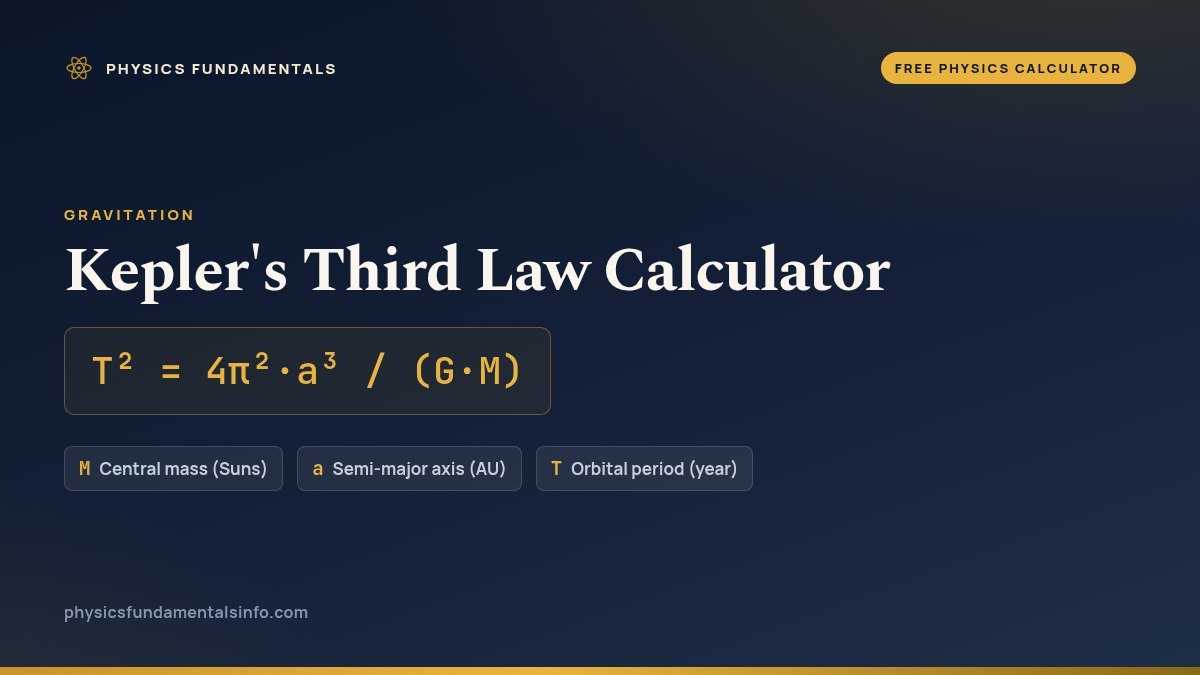
The Kepler's third law calculator is a free online tool built on the formula T² = 4π²·a³ / (G·M). Enter the values you already know, in whichever units suit you, and it solves for orbital period, semi-major axis or central mass and shows every step of the substitution. Kepler's Third Law is links an orbit period to its size — weigh stars and design orbits.
| Symbol | Quantity | Default unit | Also accepts | Example value |
|---|---|---|---|---|
| M | Central mass | Suns | kg, Earths | 1 |
| a | Semi-major axis | AU | km, m | 1 |
| T | Orbital period | year | day, s | — |
How to calculate with Kepler's third law
Kepler's third law says the square of the period is proportional to the cube of the semi-major axis, T² = 4π²a³/(G·M), where G is the gravitational constant (6.674×10⁻¹¹ N·m²/kg²) and M is the mass of the central body. Every two-body orbit obeys it, so the same equation describes planets round the Sun, moons round a planet and satellites round the Earth.
Using the calculator takes three steps. First, pick what to solve for — the period, the semi-major axis or the central mass — in the Solve for menu. Second, enter the other two quantities: the mass in kilograms or solar masses, the distance in metres, kilometres or AU, and the period in seconds, days or years. For a circular orbit the semi-major axis a equals the radius, so you can enter the orbital radius directly. Third, read the answer together with the worked steps.
The law is powerful because it needs only geometry and time: measure how big an orbit is and how long it takes, and you can deduce the mass holding it together, or vice-versa. To explore how fast a body must move to leave that orbit see the escape velocity calculator, and for the force that supplies the pull see the gravitational force calculator. For the underlying terms, see the physics glossary.
Worked example
Take the Earth orbiting the Sun, with M = 1.989×1030 kg and a = 1 AU = 1.496×10¹¹ m. The period follows from T = 2π·sqrt(a³/GM) = 2π·sqrt((1.496×10¹¹)³ / (6.674×10-11 × 1.989×1030)) ≈ 3.156×10⁷ s = 365.3 days, exactly the length of a year as expected. Reversing the calculation — feeding in the period and radius — returns the Sun's mass, which is how the solar mass is measured.
Why it matters
Kepler's third law lets astronomers weigh the Sun, stars and planets from the orbits of their moons and companions, and it is central to exoplanet detection, where a planet's period and distance reveal its host star's mass. Engineers use it to design satellite orbits — setting T = 24 hours gives the geostationary radius of about 42 000 km. The related orbital speed is v = sqrt(GM/a), tying the law to the circular motion calculator and the centripetal force that keeps a body on its path.
Frequently asked questions
What is Kepler's third law?
Kepler's third law states that the square of an orbital period is proportional to the cube of the semi-major axis: T^2 = 4pi^2 a^3 / (GM). Here G is the gravitational constant, M is the mass of the central body, a is the semi-major axis of the orbit and T is the orbital period. It applies to any two-body orbit, from moons and planets to satellites and binary stars.
What is the semi-major axis?
The semi-major axis is half the longest diameter of the elliptical orbit — the average of the closest and farthest distances from the central body. For a circular orbit it is simply the radius. In Kepler's third law it is the size term whose cube fixes the period, regardless of how eccentric the ellipse is.
How do I find the mass of a star or planet?
Rearrange Kepler's third law to M = 4pi^2 a^3 / (G T^2) and use the orbit of a moon, planet or satellite around it. Measure the companion's semi-major axis and orbital period, plug them in, and the equation returns the central mass. This is how astronomers weigh the Sun, distant stars and even black holes.
What is the geostationary orbit?
A geostationary orbit is the one with a period of 24 hours, so a satellite keeps pace with Earth's rotation and appears fixed in the sky. Setting T = 24 hours in Kepler's law gives a radius of about 42 164 km from Earth's centre, or roughly 35 786 km above the surface. Communications and weather satellites use this orbit.
How is it related to orbital and escape velocity?
For a circular orbit the orbital speed is v = sqrt(GM/a), which drops as the orbit gets larger — exactly the trend Kepler's law encodes. The escape speed from that same distance is sqrt(2) times larger, so a body moving faster than sqrt(2)·v will break free of the central mass entirely rather than orbit it.
References & formula source
- Halliday, Resnick & Walker — Fundamentals of Physics, Chapter 13 (Gravitation).
- Young & Freedman — University Physics with Modern Physics, §13.5 (Kepler's Laws and the Motion of Planets).
- NASA — Planetary Fact Sheet (orbital parameters).
- Further reading: Kepler's laws of planetary motion — Wikipedia