The SI units physics runs on are seven base units: the second (s), metre (m), kilogram (kg), ampere (A), kelvin (K), mole (mol) and candela (cd). Since 2019 each one is fixed by an exact constant of nature, and every other unit — newton, joule, volt, pascal — is built from these seven.
In September 1999 a NASA Mars orbiter costing about $125 million vanished into the Martian atmosphere. The hardware worked. The navigation maths worked. One team had supplied thruster impulse data in pound-force seconds while the flight software expected newton seconds.
That is the case for a single agreed system of measurement, made in one very expensive sentence. Physics is never just numbers — it is numbers welded to units, and the SI is the welding standard the scientific world agreed to share.
What Are SI Units in Physics?
SI units are the international system of measurement used in physics, built from seven base units and defined by seven exact constants of nature. SI stands for Système International d’Unités. Every measurement in a physics paper, exam paper or engineering drawing can be expressed in it.
Think of it as a language with seven letters. You cannot spell “pressure” without borrowing from mass, length and time — and once you know how those letters combine, you can read any unit you have never met before.
Two features make the SI different from a random collection of units. It is coherent: multiply and divide base units together and you get the right derived unit with no fudge factor of 60 or 5,280 hiding in the middle. And it is defined rather than stored: the units come from constants of nature, not from objects in a vault.
The 7 SI Base Units and What Each One Measures
The seven SI base units are the second, metre, kilogram, ampere, kelvin, mole and candela, measuring time, length, mass, electric current, thermodynamic temperature, amount of substance and luminous intensity respectively.
| Base quantity | Unit | Symbol | Fixed by | In plain English |
|---|---|---|---|---|
| Time | second | s | ΔνCs = 9 192 631 770 Hz | 9 192 631 770 ticks of a caesium-133 atom |
| Length | metre | m | c = 299 792 458 m/s | How far light travels in 1/299 792 458 of a second |
| Mass | kilogram | kg | h = 6.626 070 15 × 10-34 J s | Fixed by the Planck constant, measured on a Kibble balance |
| Electric current | ampere | A | e = 1.602 176 634 × 10-19 C | A set number of elementary charges flowing per second |
| Thermodynamic temperature | kelvin | K | k = 1.380 649 × 10-23 J/K | A fixed amount of energy per degree of freedom |
| Amount of substance | mole | mol | NA = 6.022 140 76 × 1023 mol-1 | Exactly 6.022 140 76 × 1023 specified entities |
| Luminous intensity | candela | cd | Kcd = 683 lm/W | Brightness weighted for the human eye at 540 THz |
Notice what is missing. There is no base unit for force, energy, pressure, voltage or speed — every one of those is assembled from the seven above. The list is deliberately minimal.
The candela is the odd one out, and students often ask why brightness gets its own base unit. It is the only one weighted by human physiology: the same radiant power looks brighter to your eye at green wavelengths than at deep red, and the candela bakes that response in.
How the 2019 Redefinition Rebuilt the SI on Constants of Nature
On 20 May 2019 the SI switched from artefacts and recipes to fixed constants, so every unit is now defined by a number that can never drift. Four base units changed definition that day: the kilogram, ampere, kelvin and mole.
Until then, the kilogram was a lump. A platinum-iridium cylinder held near Paris was the kilogram by definition, and its official copies around the world slowly disagreed with it by tens of micrograms over a century. Nobody could say which one had changed.
The fix inverts the logic. Instead of measuring the Planck constant in terms of the kilogram, the SI fixes h at exactly 6.626 070 15 × 10-34 J s and lets the kilogram fall out of it. A Kibble balance then realises that definition by comparing mechanical power against electrical power.
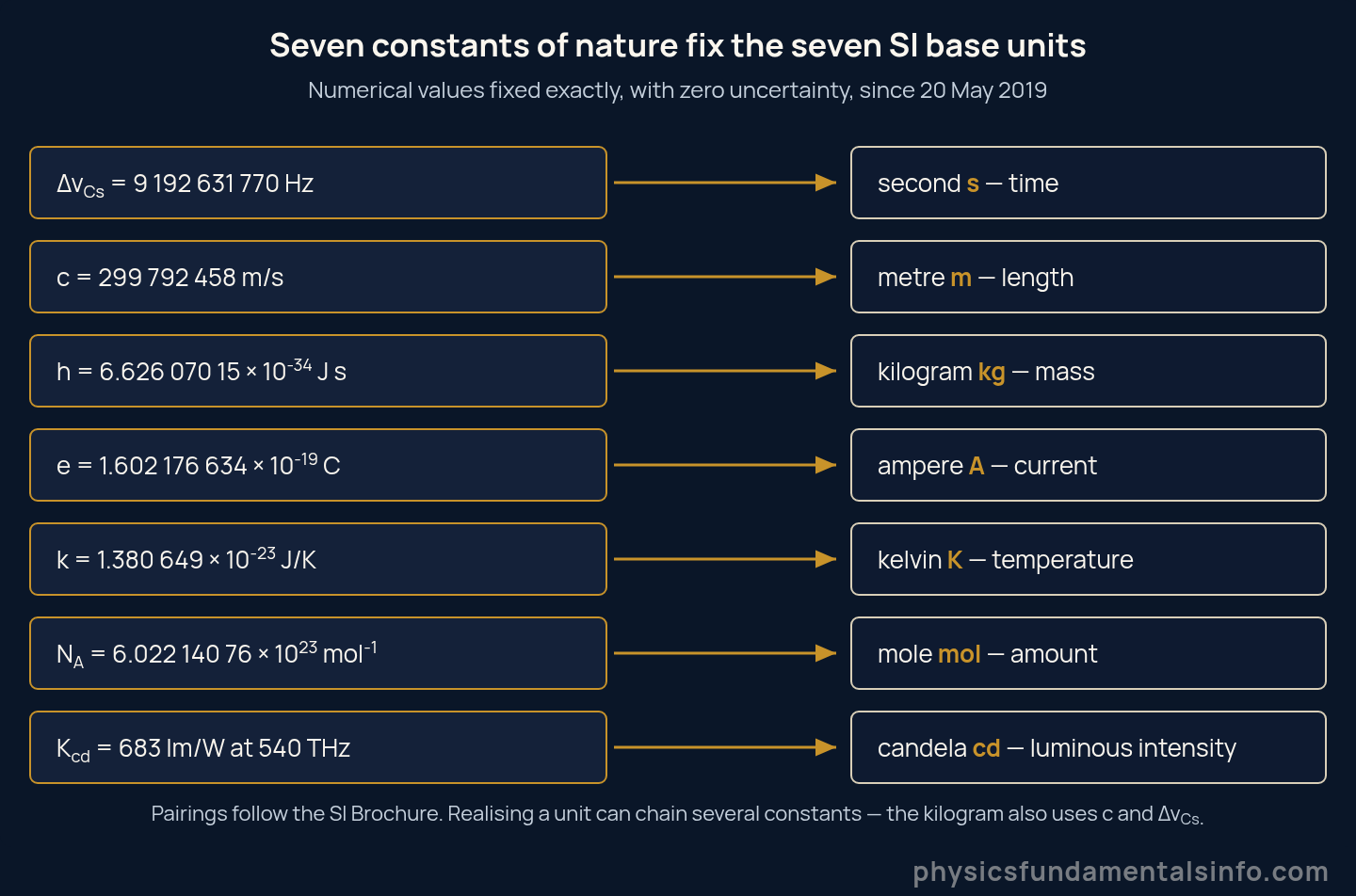
Each SI base unit is now defined by fixing the numerical value of one constant of nature.
One practical consequence is easy to miss: the speed of light is no longer something we measure. It is a defined number, so measuring “the speed of light” now really means calibrating your metre.
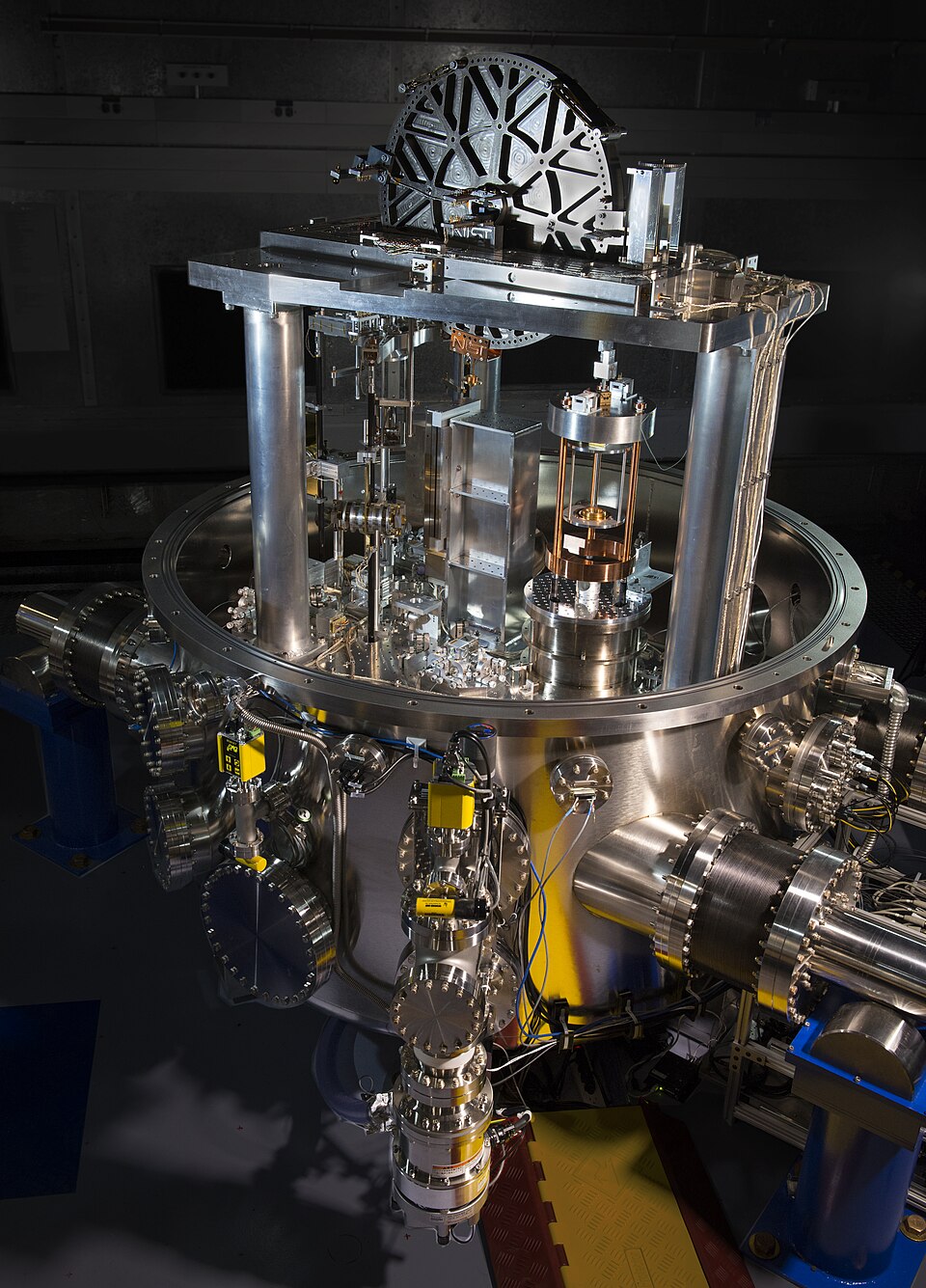
What is still changing
The second is next in line. Optical clocks now beat caesium clocks by orders of magnitude in stability, and the international timekeeping community has been working towards a new definition based on an optical transition, with roughly 2030 as the working target. Nothing you calculate today changes — the numerical value of the second is designed to carry over.
SI Derived Units: How Every Other Unit Is Built
A derived unit is any SI unit made by multiplying or dividing base units together, and 22 of them are important enough to have their own name and symbol. Force, energy and power are the three that matter most in an introductory course.
- N — newton, the SI unit of force (derived)
- kg — kilogram, mass (base unit)
- m — metre, length (base unit)
- s — second, time (base unit)
Read that as a sentence, not a formula: one newton is the force that gives one kilogram an acceleration of one metre per second squared. The unit is Newton’s second law, written in shorthand.
- J — joule, the SI unit of energy, work and heat (derived)
- N · m — one newton of force acting through one metre
- kg · m2 / s2 — the same thing reduced to base units only
- W — watt, the SI unit of power (derived)
- J — joule, energy transferred
- s — second, the time taken
Here is the table worth bookmarking. The last column is the one examiners love, because reducing a unit to base units is how you check whether an equation can possibly be right.
| Quantity | Unit | Symbol | In other SI units | In base units |
|---|---|---|---|---|
| Frequency | hertz | Hz | — | s-1 |
| Force, weight | newton | N | — | kg · m · s-2 |
| Pressure, stress | pascal | Pa | N/m2 | kg · m-1 · s-2 |
| Energy, work, heat | joule | J | N · m | kg · m2 · s-2 |
| Power | watt | W | J/s | kg · m2 · s-3 |
| Electric charge | coulomb | C | — | A · s |
| Potential difference | volt | V | W/A | kg · m2 · s-3 · A-1 |
| Resistance | ohm | Ω | V/A | kg · m2 · s-3 · A-2 |
| Capacitance | farad | F | C/V | kg-1 · m-2 · s4 · A2 |
| Magnetic flux | weber | Wb | V · s | kg · m2 · s-2 · A-1 |
| Magnetic flux density | tesla | T | Wb/m2 | kg · s-2 · A-1 |
| Celsius temperature | degree Celsius | °C | — | K (offset by 273.15) |
Some derived units have no special name at all, and that is fine. Speed is metres per second, density is kilograms per cubic metre, and neither needs a fancier label to be perfectly SI.
SI Prefixes: From Quetta to Quecto
SI prefixes are multipliers that scale any unit by a power of ten, and there are 24 of them, running from quetta (1030) down to quecto (10-30). Four were added in November 2022 — the first expansion since 1991, driven mostly by data storage.
| Prefix | Symbol | Factor | Prefix | Symbol | Factor |
|---|---|---|---|---|---|
| quetta | Q | 1030 | deci | d | 10-1 |
| ronna | R | 1027 | centi | c | 10-2 |
| yotta | Y | 1024 | milli | m | 10-3 |
| zetta | Z | 1021 | micro | μ | 10-6 |
| exa | E | 1018 | nano | n | 10-9 |
| peta | P | 1015 | pico | p | 10-12 |
| tera | T | 1012 | femto | f | 10-15 |
| giga | G | 109 | atto | a | 10-18 |
| mega | M | 106 | zepto | z | 10-21 |
| kilo | k | 103 | yocto | y | 10-24 |
| hecto | h | 102 | ronto | r | 10-27 |
| deca | da | 101 | quecto | q | 10-30 |
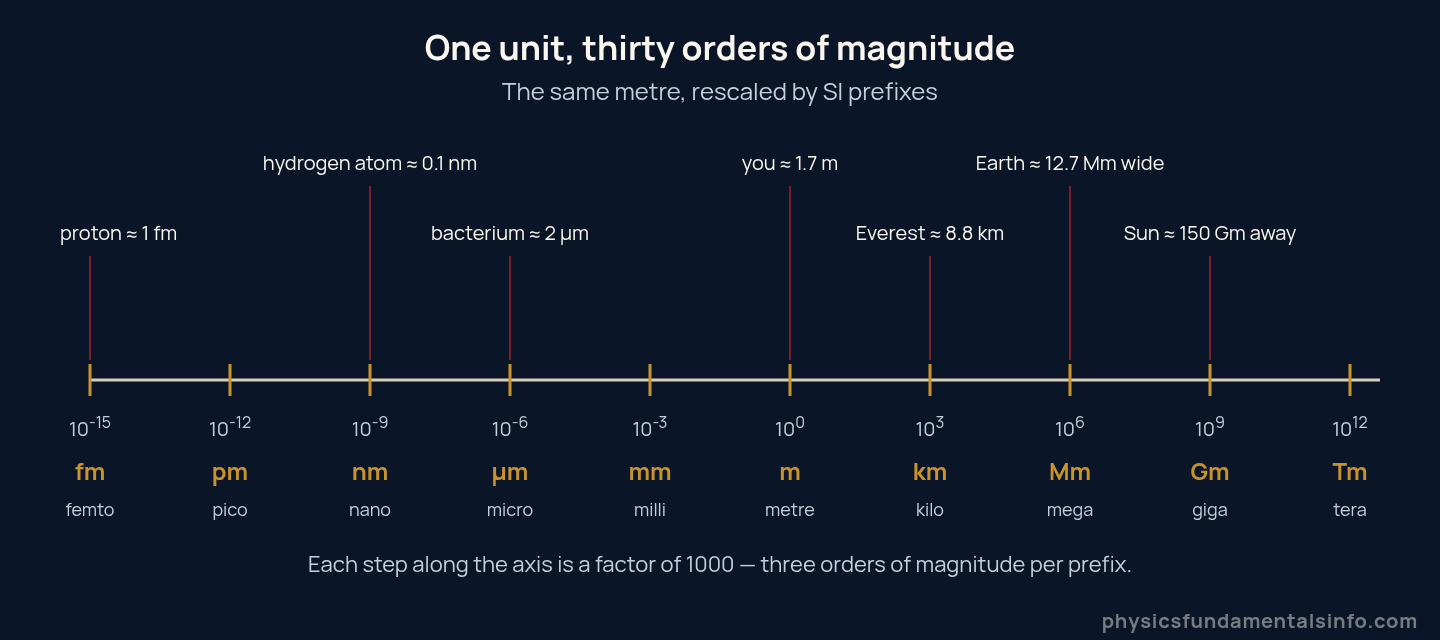
SI prefixes let one base unit cover everything from a proton to the Solar System.
The kilogram prefix trap
The kilogram is the only base unit that already contains a prefix, and that creates a rule people trip over constantly. Prefixes attach to the gram, never to the kilogram.
So a millionth of a kilogram is 1 milligram (mg), not 1 microkilogram. There is no such thing as a “μkg” — write mg and move on.
How to Convert Between Units Without Losing Marks
To convert a unit, multiply by a fraction equal to 1 whose top and bottom are the same physical quantity written in different units, then cancel. It is the only method you need, and it never lets you multiply when you should divide.
- value in old unit — the number you were given, with its unit attached
- conversion factor — a ratio equal to 1, such as (1000 m / 1 km) or (1 h / 3600 s)
- value in new unit — the same physical quantity, relabelled
Try it on 90 km/h. Write it as 90 km/h × (1000 m / 1 km) × (1 h / 3600 s); the km cancel, the h cancel, and 90 000 / 3600 leaves 25 m/s. If you had accidentally inverted a factor, the leftover units would be nonsense and you would catch it immediately.
In practice, most exam mistakes are not conversion errors at all — they are conversions that were never done. Areas and volumes are the classic ambush: 1 cm2 is 10-4 m2, not 10-2 m2, because the factor gets squared along with the unit.
SI units versus everything else
Plenty of perfectly legal units are not SI. Some are accepted for use alongside it — the litre, the hour, the tonne, the degree of angle — and others belong to older systems that refuse to die.
| Quantity | SI unit | Common non-SI unit | Relation |
|---|---|---|---|
| Length | metre (m) | inch | 1 in = 0.0254 m (exact) |
| Mass | kilogram (kg) | pound | 1 lb = 0.453 592 37 kg (exact) |
| Volume | cubic metre (m3) | litre | 1 L = 10-3 m3 (accepted with SI) |
| Time | second (s) | hour | 1 h = 3600 s (accepted with SI) |
| Energy | joule (J) | kilowatt hour | 1 kWh = 3.6 MJ (exact) |
| Energy | joule (J) | electronvolt | 1 eV = 1.602 176 634 × 10-19 J (exact) |
| Pressure | pascal (Pa) | atmosphere | 1 atm = 101 325 Pa (exact) |
| Pressure | pascal (Pa) | bar | 1 bar = 100 000 Pa (exact) |
| Torque | newton metre (N · m) | foot-pound | 1 N · m ≈ 0.737 562 ft · lb |
| Angle | radian (rad) | degree | 1° = π/180 rad (accepted with SI) |
Torque is where this bites hardest in real life, because workshop manuals switch systems without warning; our Nm to ft-lb Converter handles that swap in both directions if you would rather not trust a hurried mental factor of 1.356.
How to write SI units correctly
Marks get lost on notation, not just numbers. These are the rules that examiners and journal editors actually enforce:
- Leave a space between number and symbol: 5 kg, not 5kg.
- Never pluralise a symbol: 5 kg, not 5 kgs.
- No full stop after a symbol unless the sentence ends there.
- Symbols named after a person take a capital, but the written-out name does not: N and newton, Pa and pascal, W and watt.
- The unit of mass is kg, never Kg — a capital K means kelvin.
- Do not mix names and symbols: write metres per second or m/s, never metre/s.
- Prefix and unit are joined with no space and no hyphen: km, mA, GPa.
- Only one prefix per unit: nm, not mμm.
- Degrees Celsius take a space before the symbol (25 °C), but degrees of angle do not (25°).
SI Units Physics Students Use Every Day
SI units are not an exam formality — they are the reason satellites, medicines and semiconductors work across borders. Four examples show how far the system reaches.
GPS positioning
Your phone finds itself by timing radio signals from satellites. Since the metre is defined through the speed of light and the second through caesium, a timing error of one nanosecond becomes a position error of about 30 cm. Atomic clocks in orbit are not a luxury; they are the unit definition doing its job.
Semiconductor manufacturing
Chip features are quoted in nanometres, and lithography tolerances run to fractions of a nanometre across a 300 mm wafer. Two fabs on opposite sides of the planet can only build interchangeable parts because both trace their length measurements to the same defined metre.
Drug dosing
Clinical doses are given in milligrams per kilogram of body mass, so the mole and the kilogram are doing safety-critical work. Confusing mg with μg is a thousand-fold error, and it is one of the most common medication mistakes in hospitals.
Energy on your electricity bill
Your supplier bills in kilowatt hours while physics works in joules — and 1 kWh is exactly 3.6 MJ. A 2 kW heater running for three hours uses 6 kWh, or 21.6 MJ, which is the same energy expressed in the coherent SI unit.
Common Misconceptions About SI Units
“SI is just another name for the metric system”
Not quite. The metric system is a family of decimal systems going back to the 1790s, including the older CGS system built on centimetres and grams. The SI is one specific, modern, coherent member of that family, and CGS units such as the erg, dyne and gauss are not SI.
“The kilogram is a metal cylinder in Paris”
It was, until 20 May 2019. The international prototype was formally retired that day and the kilogram is now defined through the Planck constant. The cylinder still exists as a historical object, but it no longer defines anything.
“Kilograms measure weight”
Kilograms measure mass; weight is a force measured in newtons. A 70 kg astronaut still has 70 kg of mass in orbit, but a bathroom scale would read zero because it senses force, not mass. If that distinction is shaky, our guide to weight versus mass works through it properly.
“You must never use degrees Celsius in physics”
The degree Celsius is a legitimate SI derived unit with a special name. The catch is that only kelvin works for absolute temperatures inside formulas such as pV = nRT. Temperature differences are safe in either, since a change of 1 °C is exactly a change of 1 K — a point our comparison of heat versus temperature unpacks further.
How SI Units Relate to Formulas and Dimensional Analysis
Units let you audit an equation before you trust it, because both sides of a correct physical equation must reduce to identical base units. This is dimensional analysis, and it is the fastest error check in physics.
Take v2 = u2 + 2as. The left side is (m/s)2 = m2/s2. On the right, 2as is m/s2 × m = m2/s2. Both sides match, so the equation survives the check — and if a stray factor of time had crept in, it would not have.
The same trick works in reverse. If you know that force is measured in kg · m/s2, you can reconstruct half of Newton’s second law from the unit alone, which is handy when a formula sheet goes missing.
Where units really earn their keep is the sanity check on magnitude. A student who calculates a car’s kinetic energy as 3 × 10⁻⁴ J has almost certainly left mass in grams; the unit is right, the number is absurd, and only the second observation saves the answer.
Every equation on our physics formulas reference obeys this rule, and so does every derived unit above — the ampere quietly underwrites electric current, the coulomb, the volt and the ohm in turn.
Worked Problems
Show Solution
Solution:
Step 1: The coherent SI unit of speed is metres per second, so convert kilometres to metres and hours to seconds.
Step 2: 72 km/h = 72 × (1000 m) / (3600 s).
Step 3: 72 000 / 3600 = 20.
Answer: 20 m/s
Show Solution
Solution:
Step 1: The prefix micro (μ) means a factor of 10-6.
Step 2: 45 μA = 45 × 10-6 A.
Step 3: Write with one digit before the decimal point: 45 × 10-6 = 4.5 × 10⁻⁵.
Answer: 4.5 × 10⁻⁵ A
Show Solution
Solution:
Step 1: Newton’s second law gives F = ma.
Step 2: F = 1200 kg × 2.5 m/s2 = 3000 kg · m/s2.
Step 3: By definition 1 N = 1 kg · m/s2, so 3000 kg · m/s2 = 3000 N.
Answer: 3.0 × 10³ N, equivalently 3.0 × 10³ kg · m/s2
Show Solution
Solution:
Step 1: The coherent SI unit of density is kg/m3, so convert both quantities first.
Step 2: 250 g = 0.250 kg, and 200 cm3 = 200 × (10-2 m)3 = 200 × 10-6 m3 = 2.00 × 10⁻⁴ m3.
Step 3: ρ = m / V = 0.250 / (2.00 × 10⁻⁴) = 1250.
Answer: 1250 kg/m3 (1.25 × 10³ kg/m3)
Show Solution
Solution:
Step 1: Energy transferred is E = Pt, with P in watts and t in seconds.
Step 2: t = 30 min = 1800 s, so E = 60 W × 1800 s = 108 000 J.
Step 3: Since 1 kWh = 3.6 × 10⁶ J, E = 108 000 / 3 600 000 = 0.030 kWh.
Answer: 1.08 × 10⁵ J, which is 0.030 kWh
Show Solution
Solution:
Step 1: Reduce the left side. v2 has units (m/s)2 = m2 · s-2.
Step 2: Reduce each term on the right. u2 gives m2 · s-2, and 2as gives (m · s-2) × m = m2 · s-2; the 2 is a pure number with no units.
Step 3: All three terms reduce to m2 · s-2, so the equation is dimensionally consistent.
Answer: Consistent — every term has base units m2 · s-2
Show Solution
Solution:
Step 1: Rearrange for G, giving G = F · r2 / (m1 · m2).
Step 2: Substitute units: N · m2 / kg2, and replace the newton with its base units, kg · m · s-2.
Step 3: (kg · m · s-2) × m2 / kg2 = m3 · kg-1 · s-2.
Answer: m3 · kg-1 · s-2, matching the accepted value G = 6.674 × 10⁻¹¹ m3 kg-1 s-2
Frequently Asked Questions
What are the 7 SI base units?
What is the difference between base units and derived units?
Why was the kilogram redefined in 2019?
Is the litre an SI unit?
Is the newton a base unit or a derived unit?
How many SI prefixes are there?
Should I write 5 kg or 5 Kg?
Two authoritative references are worth bookmarking if you need the primary source: the BIPM page on the SI base units, which is the body that maintains the system, and the NIST guide to SI units for definitions, prefixes and writing conventions.