Physics misconceptions are intuitive but incorrect beliefs about how the physical world behaves — that heavier objects fall faster, that motion needs a constant force, that heat and temperature are the same thing. They are built from everyday experience, they survive years of teaching, and they quietly wreck exam answers. Fixing one means testing a prediction, not memorising a formula.
Drop a coin and a crumpled receipt from shoulder height. The coin wins, every single time, and your brain files away a rule that has never once let you down: heavy things fall faster.
That rule is wrong. It is also not a silly mistake — it is a working model assembled from thousands of honest observations made in a world full of air. Physics never asks you to distrust your experience. It asks you to find the variable your experience never controlled for.
What Are Physics Misconceptions?
Physics misconceptions are stable, intuitive beliefs about physical behaviour that contradict the accepted physics — and that persist even after correct instruction. Researchers also call them alternative conceptions, naive conceptions or preconceptions.
The word “misconception” undersells them. A misconception is not a gap in your knowledge; it is a rival theory sitting in the gap, one that has been quietly making successful predictions since you were about four years old.
That is exactly what makes them dangerous in an exam. A blank makes you pause and check. A confident wrong model makes you write three lines of fluent nonsense and move on.
Why Physics Misconceptions Survive Years of Teaching
Physics misconceptions survive teaching because a lesson usually adds the correct idea alongside the wrong one instead of replacing it. Students end up fluent in both, and switch between them depending on whether the question looks like schoolwork or looks like real life.
Physics education researchers measure this with the Force Concept Inventory, a multiple-choice test built by David Hestenes, Malcolm Wells and Gregg Swackhamer in 1992. Its 30 questions are unusual: the wrong options are not random, they are the specific wrong ideas students genuinely hold.
The results are sobering. A meta-analysis summarised by PhysPort, the AAPT’s physics-education resource, covering roughly 31,000 students, puts the average normalised gain at about 0.22 for traditional lecture courses and about 0.39 for interactive-engagement courses — better, but still a long way from a clean sweep.
Three things keep a misconception alive:
- It works most of the time. “Push harder to go faster” is a perfectly good rule for a supermarket trolley on a floor with friction.
- Everyday language reinforces it. We say we shut the door to keep the cold out, and that a phone battery is running out of energy.
- Symbol-pushing hides it. You can rearrange F = ma correctly for two years without ever being asked what a is.
In practice, this is why a student can score well on calculation questions and then insist that a ball thrown upward has zero acceleration at the top of its flight.
6 Physics Misconceptions About Motion and Forces
Motion and forces produce the densest cluster of physics misconceptions, because this is the area where you have the most personal experience — and where that experience is most contaminated by friction and air resistance.
1. Heavier objects fall faster
In a vacuum, every object falls with the same acceleration regardless of mass — about 9.81 m/s2 near Earth’s surface. A 7 kg ball and a 0.2 kg ball dropped together land together.
The reason is a cancellation that feels almost like a trick. Gravity pulls harder on the heavier ball (larger mg), but the heavier ball is also harder to accelerate (larger m). Divide one by the other and the mass vanishes: a = mg/m = g.
Air resistance is what breaks the pattern on Earth, and it depends on shape and speed, not on mass alone. Flatten the receipt into a pellet and it keeps up with the coin surprisingly well. The full treatment lives in our guide to free fall.
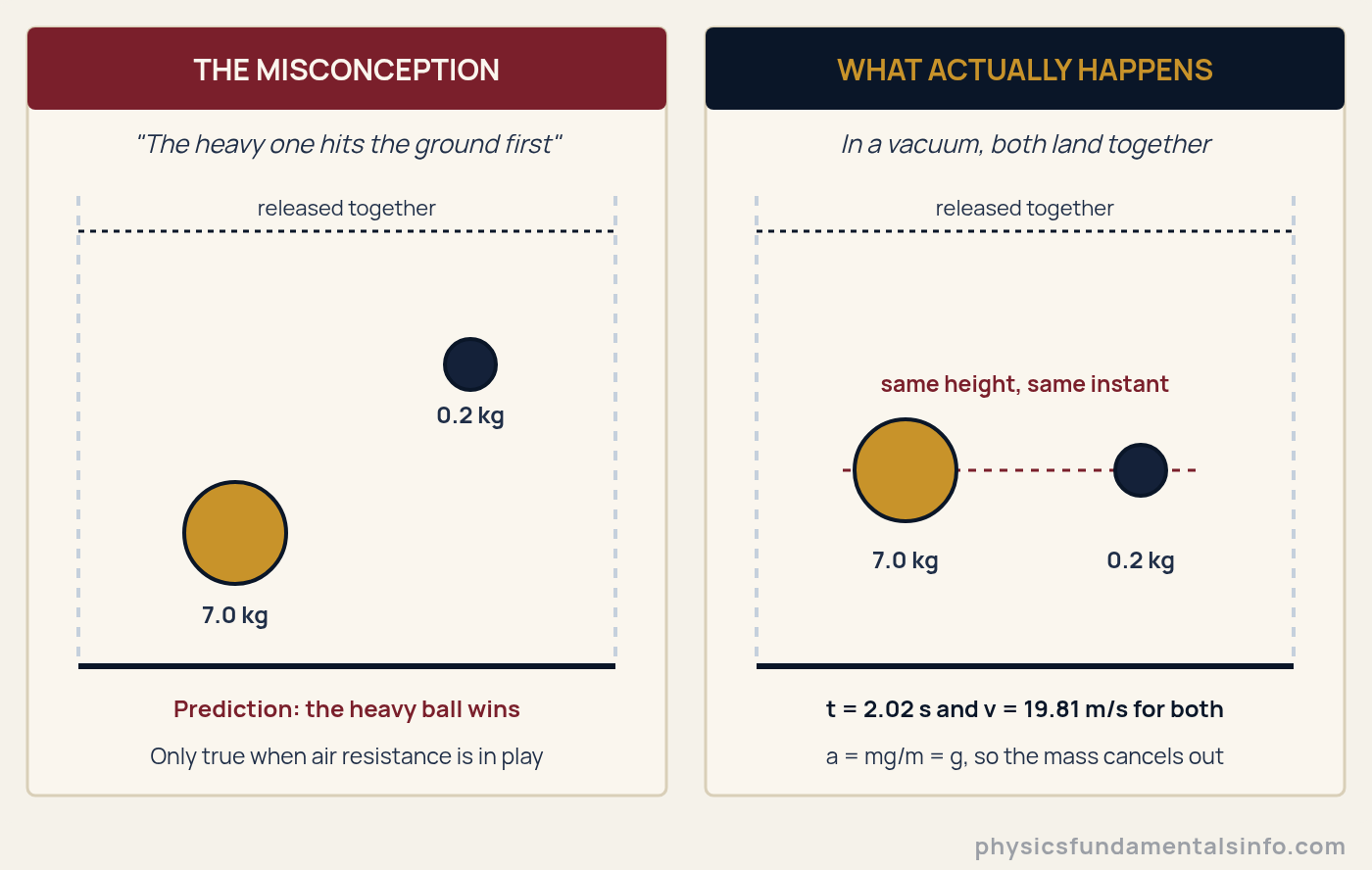
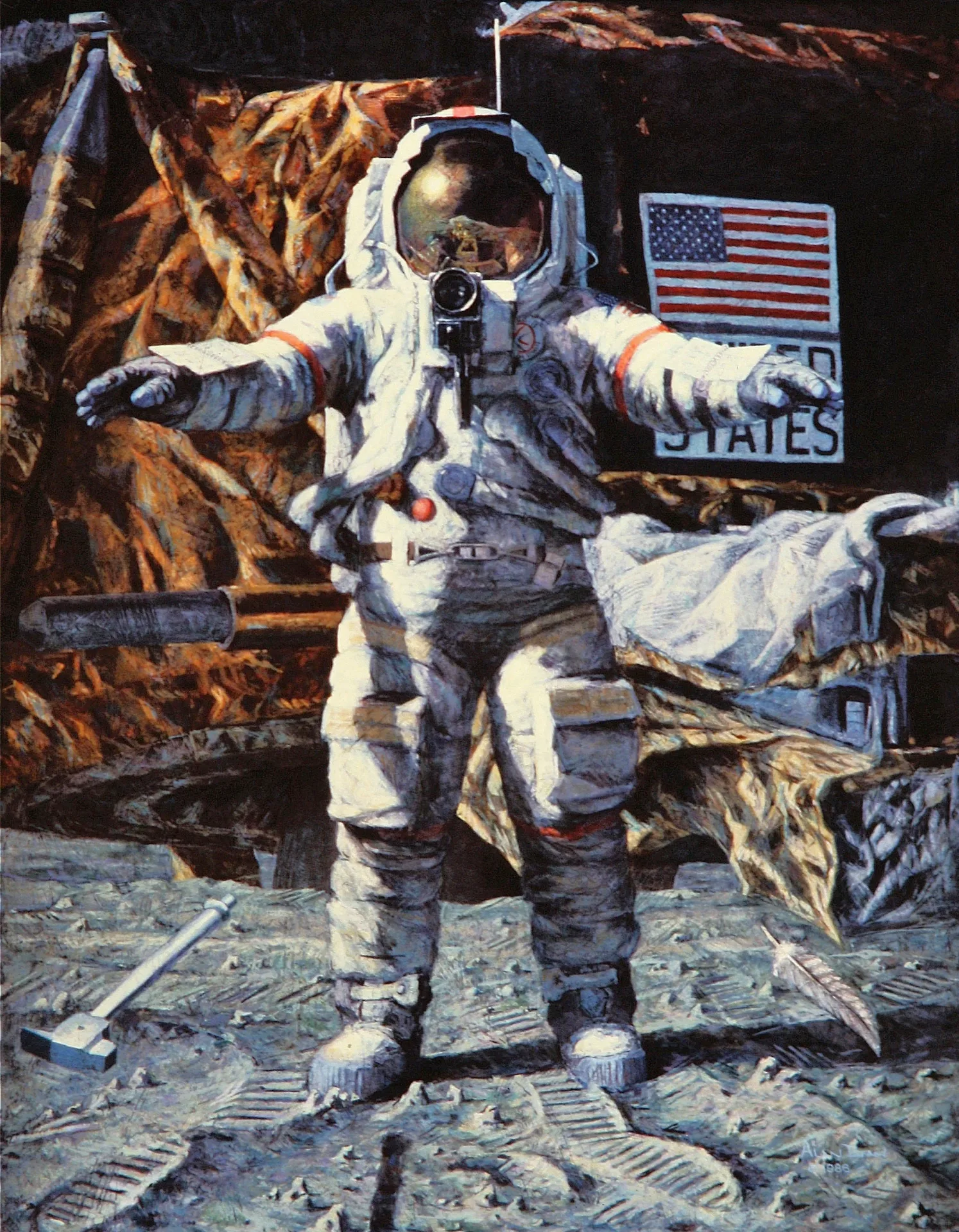
Two balls, one evacuated column: the physics misconception on the left, the measured result on the right.
2. Motion requires a continuous force
An object needs no force at all to keep moving at constant velocity — force changes motion rather than sustaining it. This is Newton’s first law, and it is the single most-missed idea in introductory mechanics.
Why does it feel so wrong? Because on Earth you have never seen an unforced object. Stop pedalling and you slow down, so “no push, no motion” looks like a law of nature rather than a law of friction.
Kick a puck across fresh ice and the illusion weakens. Watch a probe coast between planets for years on a dead engine and it collapses entirely. Our breakdown of Newton’s laws of motion works through the first law in detail.
3. Action and reaction forces cancel out
Action–reaction pairs never cancel, because the two forces act on two different objects. Cancellation only happens when forces act on the same object.
Push a crate. You exert a force on the crate; the crate exerts an equal and opposite force on you. The crate’s motion is decided only by the forces acting on the crate — your push and friction — and your push is the one that wins.
Here is the exam-room test: before you cancel anything, name the object each force acts on. If the two labels differ, they are a third-law pair and they stay put. Our guide to the types of forces shows how to sort a free-body diagram cleanly.
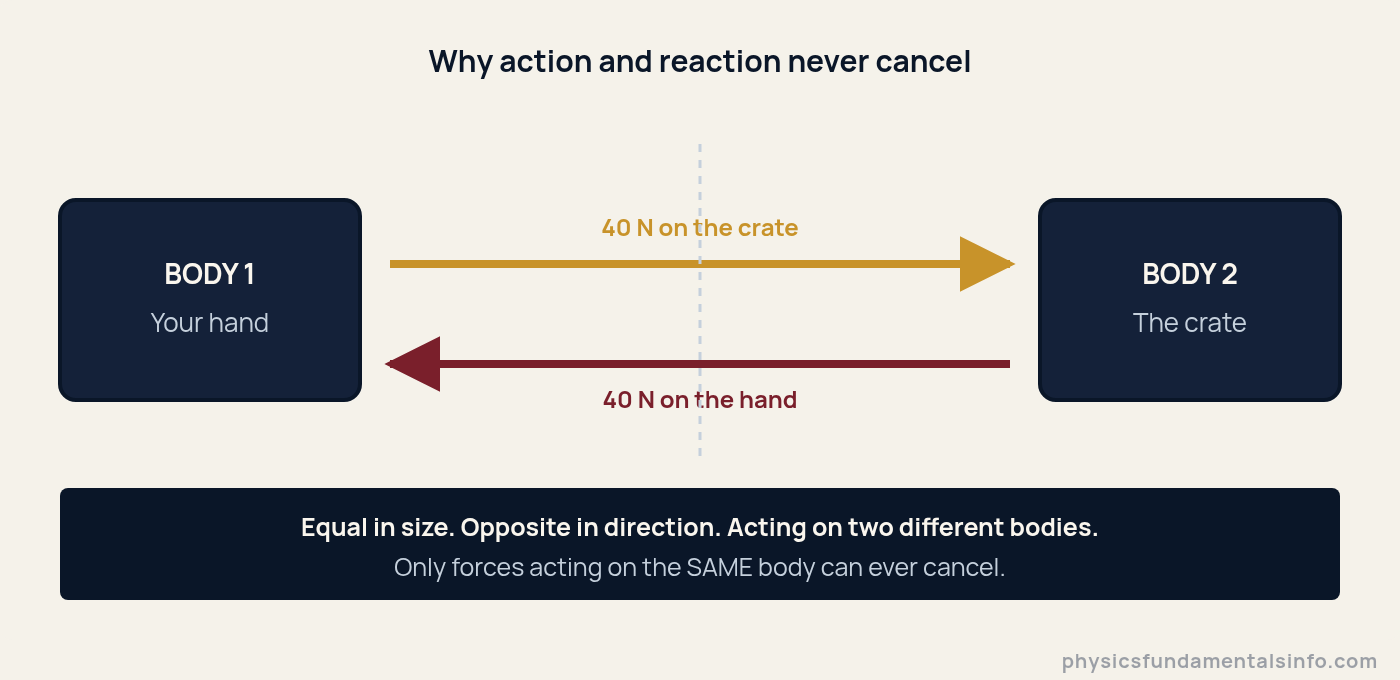
A Newton’s third-law pair: equal and opposite, but acting on two different bodies.
4. Zero velocity means zero acceleration
An object can have zero velocity and non-zero acceleration at the same instant — velocity and acceleration are independent quantities. A ball at the very top of its flight is the classic case.
At that instant the ball is momentarily still. Gravity, however, has not paused: the acceleration is still 9.81 m/s2 downward, which is precisely why the ball does not hover there.
The same slip appears with a mass at the end of a stretched spring, and with a car at the moment it changes direction. Velocity tells you where you are heading now; acceleration tells you how that is about to change.
5. A centrifugal force pushes you outward on a bend
No outward force acts on you when a car turns — you feel thrown outward because your body continues in a straight line while the car curves underneath you. The only real horizontal force is inward.
That inward force is friction between tyres and road, or tension in a string, or the normal force from a banked track. Physicists call the required inward force the centripetal force; it is a role, not a new kind of force.
Centrifugal force does exist as a bookkeeping term, but only inside a rotating frame of reference, where it is added to make Newton’s laws work again. In the ground frame, there is nothing pushing you out. Our article on centripetal force works through the algebra.
6. Mass and weight are the same thing
Mass measures how much matter an object contains and is measured in kilograms; weight is the gravitational force on that object and is measured in newtons. They are different quantities with different units.
The confusion is baked into English — bathroom scales report “weight” in kilograms, and shops sell food by weight in grams. NIST, the US national metrology institute, is blunt about it: using “weight” where you mean mass should be phased out in technical work, because the SI unit of weight is the newton.
Take a 60 kg student to the Moon and the mass stays 60 kg while the weight drops from about 589 N to about 97 N. Run the numbers yourself with the Weight on Other Planets Calculator and watch the kilograms hold still while the newtons swing. The full comparison is in weight vs mass.
6 More Physics Misconceptions About Energy, Heat, Electricity and Waves
Beyond mechanics, the pattern repeats with a twist: these misconceptions are usually caused by everyday language rather than everyday observation. We say “the cold got in” and “the battery ran out”, and the words do the damage.
7. There is no gravity in space
Gravity is very much present in orbit — astronauts float because they are in free fall, not because gravity has switched off. The International Space Station and everyone inside it are falling around the Earth together.
The numbers make it concrete. NASA notes that at the station’s altitude of roughly 200 to 250 miles, Earth’s gravity is still about 90 percent of its surface value.
Think of a lift with a cut cable: you, your bag and the floor all accelerate downward together, so nothing presses on anything. That is weightlessness — and it is why “microgravity” is the honest word, not “zero gravity”. Gravity itself never stops, it only weakens with distance, as our guide to weight on other planets shows.
8. Energy gets used up
Energy is never used up or destroyed — it is transferred and spread out, usually ending as low-grade thermal energy in the surroundings. Total energy is conserved in every process we know of.
What we actually consume is useful energy: concentrated, low-entropy energy we can still direct. Petrol becomes warm exhaust and warm brakes, and every joule is still there, just scattered too thinly to do anything with.
This distinction is the quiet backbone of thermodynamics, and it is why “energy crisis” really means “useful energy crisis”. Our overview of energy in physics takes the idea further.
9. Current is used up as it goes round a circuit
Current is the same at every point in a simple series circuit — charge is conserved, so nothing is consumed on the journey. What drops across each component is voltage, not current.
The mental picture that causes the trouble is a bag of energy carried by each electron and handed out at the first lamp. A better one: a closed loop of bicycle chain. Every link moves at once, and the pedal does the work.
Electrons themselves drift astonishingly slowly, often under a millimetre per second. The signal that starts them moving travels near the speed of light — which is why the lamp lights instantly. See electric current for the full picture.
10. Heat and temperature are the same thing
Temperature measures the average kinetic energy of particles, while heat is energy transferred between objects because of a temperature difference. One is a state; the other is a transfer.
A sparkler burns at well over 1,000 °C, yet the sparks land on your hand harmlessly. They are hot, but they carry almost no energy. A bath at 50 °C would scald you badly, because there is so much more of it.
The companion error is treating cold as a substance. Cold is not something that flows into a room; it is the name we give to thermal energy leaving. Our articles on heat vs temperature and conduction, convection and radiation cover both.
11. Waves carry matter with them
A wave transports energy, not matter — the particles of the medium oscillate about fixed positions and end up roughly where they started. Only the disturbance travels.
Watch a gull sitting on the sea. Swell after swell rolls past beneath it, yet the bird bobs up and down and stays put. The water is going nowhere; the wave is going everywhere.
This also settles a favourite film mistake. Sound is a mechanical wave and needs a medium, so an explosion in space is silent — light reaches you, sound cannot. Our guide to transverse vs longitudinal waves explains why.
12. You do work whenever you push or carry something
In physics, work is done only when a force has a component along the displacement — so carrying a heavy bag horizontally at steady speed does zero work against gravity. Your muscles get tired, but the physics ledger records nothing.
The formula is unforgiving here. With the force vertical and the displacement horizontal, the angle between them is 90°, cos 90° = 0, and the work is exactly zero.
Lift that same bag onto a shelf and you have done real work against gravity. Push a wall until you sweat and you have done none. It is worth reading work done in physics before your next energy question.
The Four Equations These Physics Misconceptions Break
Most of the twelve errors above come down to misreading one of four equations. Each is written below with every symbol defined in SI units.
- F — resultant (net) force on the object, in newtons (N)
- m — mass of the object, in kilograms (kg)
- a — acceleration, in metres per second squared (m/s2)
Read it carefully: force sets acceleration, not velocity, and only the resultant force counts. Both misconception 2 and misconception 4 come from misreading this one line.
- W — weight, the gravitational force on the object, in newtons (N)
- m — mass, in kilograms (kg)
- g — gravitational field strength, in newtons per kilogram (N/kg), equal to 9.81 N/kg near Earth’s surface
Only g changes when you travel. Move to the Moon and g falls to about 1.62 N/kg, so W falls with it while m does not move at all.
- F — centripetal (inward) force required, in newtons (N)
- m — mass of the object, in kilograms (kg)
- v — speed along the circular path, in metres per second (m/s)
- r — radius of the path, in metres (m)
Note the direction implied by the equation: inward. There is no outward term anywhere in it, which is misconception 5 dealt with in one line.
- Q — heat transferred, in joules (J)
- m — mass of the substance, in kilograms (kg)
- c — specific heat capacity, in joules per kilogram per kelvin (J/(kg·K))
- dT — temperature change ΔT, in kelvin (K) — numerically identical to a change in °C
Heat Q and temperature change ΔT sit on opposite sides of the equation, separated by mass and material. That gap is misconception 10 in algebraic form.
Physics Misconceptions vs What Physics Actually Says
Use this table as a self-check. Read the middle column first and be honest about which ones still feel true.
| Topic | The misconception | What physics actually says | Where it costs marks |
|---|---|---|---|
| Free fall | Heavier objects fall faster | In a vacuum all objects accelerate at g = 9.81 m/s2 | Projectile and drop-time questions |
| Newton’s first law | Motion needs a constant force | Constant velocity needs zero resultant force | Free-body diagrams at constant speed |
| Newton’s third law | Action and reaction cancel | The pair acts on two different bodies | Tug-of-war and collision explanations |
| Kinematics | Zero velocity means zero acceleration | a is still g at the top of a throw | Vertical motion and graph questions |
| Circular motion | A centrifugal force pushes you out | The only real force is inward (centripetal) | Banked curves, loops, satellite orbits |
| Mass and weight | Mass and weight are the same | Mass is in kg; weight is a force in N | Any question that changes planet or unit |
| Gravitation | There is no gravity in space | Orbiting objects are in continuous free fall | Orbit and weightlessness explanations |
| Energy | Energy gets used up | Energy is conserved but degrades in quality | Conservation and efficiency questions |
| Circuits | Current is used up by components | Series current is equal everywhere; voltage drops | Series and parallel circuit analysis |
| Thermal physics | Heat and temperature are the same | Q = m c ΔT links them through mass and material | Calorimetry and cooling questions |
| Waves | Waves carry matter along | Waves transfer energy; particles oscillate in place | Wave definition and sound-in-space questions |
| Work and energy | Pushing or carrying always does work | W = F d cos θ, so a 90° angle gives zero work | Work-energy theorem problems |
How to Unlearn a Physics Misconception
You unlearn a misconception by making it fail in public — predict an outcome out loud, test it, and then explain the gap. Reading the correct statement is not enough, because the wrong model was never built from reading.
This is the predict–observe–explain cycle, and physics education research keeps finding the same thing: the prediction has to come first. Being surprised is the part that does the work.
Four habits that make the correction stick:
- Say the wrong answer out loud before you check. An unspoken intuition cannot be corrected.
- Name the object for every force. Half of all third-law errors die here.
- Sanity-check magnitudes. If your answer says a person weighs 60 N on Earth, something is wrong.
- Explain it to somebody else. You will find the hole in about ninety seconds.
One warning worth taking seriously: getting the right number does not prove you have the right model. Plenty of students calculate a correct fall time while still believing the heavier ball would win a real race. Our guide on how to solve physics problems builds the checking habit into the method.
Worked Problems
Show Solution
Solution:
Step 1: In a vacuum the only force is weight, so a = g for both balls. Use s = ½ g t2.
Step 2: 20 = ½ × 9.81 × t2, so t2 = 40 / 9.81 = 4.077 s2.
Step 3: t = 2.02 s for both balls.
Step 4: v = g t = 9.81 × 2.019 = 19.81 m/s for both balls.
Answer: t = 2.02 s and v = 19.8 m/s — identical for both masses.
Show Solution
Solution:
Step 1: Mass is a property of the matter itself, so m = 60 kg in both places.
Step 2: On Earth, W = m g = 60 × 9.81 = 588.6 N.
Step 3: On the Moon, W = m g = 60 × 1.62 = 97.2 N.
Answer: mass = 60 kg in both locations; weight = 589 N on Earth and 97.2 N on the Moon.
Show Solution
Solution:
Step 1: Only gravity acts, so a = 9.81 m/s2 downward at every instant — including the top, where v = 0.
Step 2: Time to the top: v = u − g t gives 0 = 12 − 9.81 t, so t = 12 / 9.81 = 1.22 s.
Step 3: Maximum height: v2 = u2 − 2 g s gives 0 = 144 − 2 × 9.81 × s, so s = 144 / 19.62 = 7.34 m.
Answer: a = 9.81 m/s2 downward, t = 1.22 s, s = 7.34 m.
Show Solution
Solution:
Step 1: Use W = F d cos θ, where θ is the angle between the force and the displacement.
Step 2: Carrying — the supporting force is vertical, the displacement is horizontal, so θ = 90° and cos 90° = 0. W = 0 J.
Step 3: Lifting — force and displacement are both vertical, so θ = 0° and cos 0° = 1. W = m g h = 8.0 × 9.81 × 1.5 = 117.7 J.
Answer: 0 J while carrying; 118 J while lifting.
Show Solution
Solution:
Step 1: In series, resistances add: R = 4.0 + 8.0 = 12.0 Ω.
Step 2: I = V / R = 12 / 12.0 = 1.0 A — and because charge is conserved, this same current flows at all three points.
Step 3: V across the 4.0 Ω resistor = I R = 1.0 × 4.0 = 4.0 V.
Step 4: V across the 8.0 Ω resistor = I R = 1.0 × 8.0 = 8.0 V, and 4.0 + 8.0 = 12 V as expected.
Answer: I = 1.0 A everywhere; 4.0 V and 8.0 V across the resistors. Current is not used up — voltage is shared.
Show Solution
Solution:
Step 1: Use Q = m c ΔT for each sample.
Step 2: Sample A: ΔT = 80 − 20 = 60 K, so Q = 0.50 × 4180 × 60 = 125,400 J.
Step 3: Sample B: Q = 2.0 × 4180 × 15 = 125,400 J.
Step 4: The heats are identical although sample A’s temperature rises four times as much.
Answer: both absorb 125 kJ (1.254 × 10⁵ J). Equal heat, very different temperature change.
Show Solution
Solution:
Step 1: Force on the apple: F = m g = 0.10 × 9.81 = 0.981 N, directed downward.
Step 2: By Newton’s third law, the apple pulls the Earth upward with an equal force of 0.981 N.
Step 3: Earth’s acceleration: a = F / M = 0.981 / (5.97 × 1024) = 1.6 × 10⁻²⁵ m/s2.
Step 4: The forces are equal; the accelerations are not, because the masses differ by 25 orders of magnitude.
Answer: 0.981 N on each body; the Earth accelerates at about 1.6 × 10⁻²⁵ m/s2 — real, but unmeasurable.